A quick find exactly where it should be while driving from Tarragona to Barcelona. My family and I were in the area for the eclipse and then for a trip to PortAventura and are heading to Barcelona for a few days before flying home.
My partner and our kids went to the bathroom and snack bar while I jogged up to the bridge. The coordinates put my close but the hint moved me exactly where I needed to be. Strangely, I
suddenly needed to tie my laces, and then just as suddenly the cache was in my hand!
Thanks for breaking up this long journey (full of bad traffic!) for us. TFTC, and greetings from Oxfordshire, UK!
Which led me today to ask: how many caches does Geocaching.com think I’ve found? It’s the biggest, but not the only, site I use, and so I didn’t expect it to show
the same total as me. A difference is expected.
Well… it turns out how you ask it. In the top-right corner of the page, when I log in, it says that I have… 1,035 finds:
That turns out to be significantly higher than I’d anticipated, which initially made me wonder: did I fail to count some in my tally?
My tally comes from those which have been imported right here onto my blog. I use a computer-assisted but still-manual approach1 to PESOS my geocaching logs from various sites – Geocaching.com, OpenCache.uk2,
TerraCaching, etc.3 –
onto my blog, and then I count them here. Could my data be wrong?
So I went about checking it. Which turned out to be challenging, because the “foreign key” I use to associate the caching logs on my website is the log ID that appears in the links on
Geocaching.com… and those changed format somewhere along the way.4 So first I had to fix all of my metadata spanning
about 750 rows. Then I was able to check.
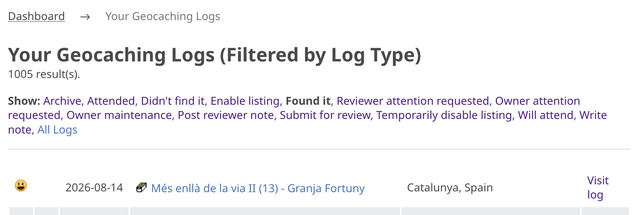
But while I did that, I noticed something strange. When I click on that link that says I have “1,035 finds”, the resulting page has a link to see what they are. And it
claims there are… 1,005 finds:
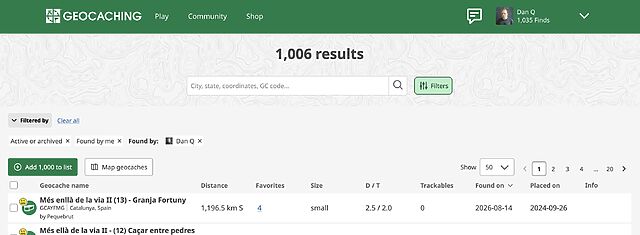
Stranger still, a different link from the same page on Geocaching.com told me that I had 1,006 finds!
This screenshot’s my favourite, because it shows two different totals at the same time!
Even before I’d corrected all of my metadata and rechecked my totals, I was becoming increasingly convinced that I couldn’t trust any of Geocaching.com’s totals. How many finds
is it, exactly: is it 1,035? Or 1,006? Or 1,005?
It doesn’t really matter, of course. I keep my own count, and I’m now even-more confident than ever that it’s accurate. The correct answer to to the question
“how many geocaches have I found?” is 1,019.
And for some reason, Geocaching.com can’t count even the ones that are logged on their site three times and get the same number twice. 🤣
Footnotes
1 This helps me sidestep Geocaching.com’s draconian rules on scraping and API access.
2 I got in trouble once with a Geocaching.com reviewer for hinting at the
existence of other geocaching listing sites, once. I don’t understand why: they’re unlikely to be a commercial threat to Geocaching.com’s business, and those other sites
typically allow you to talk about Geocaching.com! I guess that they’re mostly afraid that it weakens their trademark on the word “geocaching”, which I’ve never been convinced is
legitimate anyway because it was being widely used online to describe the activity it represents before they tried to start centralising and hoovering-up all of the cache listings.
It’s just sneaky monopolistic silo behaviour on the part of Geocaching.com, really. I’m not a fan. I can list plenty of examples of this kind of dipshittery on the part of
Geocaching.com, but I’ll spare you for now.
Quick find in the second place I looked while walking this trail as a shortcut back to town from the Passejant amb la Boira caches. TFTC, and greetings from Oxfordshire, UK!
Found in the fourth place I looked. Nice container size, like the last letterbox hybrid.
This is where we’ll part ways. As much as I’ve loved this series so far and would enjoy exploring more of it, I need to get back to my accommodation where, apparently, my kids are
waking up and ready for another fun day. So I’ll be switching to the Més enllà de la
via II trail and finishing my walk soon FP awarded for this series as a whole; I’ve loved every moment of it (even that one frustrating cache from a few minutes back!).
TFTC, and if you the CO ever find yourself over my way, can I plug my cache GC9GTV3 Drive Slowly; Fox
Crossing. It’s 100% the kind of hide you’d enjoy based on what I’ve seen of your work here!
I approached the GZ with two solid (different) ideas about the kind of thing I would be looking for. But a good explore of many candidates for each didn’t reveal this cache.
I’m sure it’s there somewhere! But not for me to find today.
Didn’t much fancy my chances of GPS signal in the tunnel, but the spoiler photo made it very obvious where to look! Hung around to enjoy the cool for a few minutes… and also the
acoustics: what an echo! TFTC.
A nice large cache! I wish I’d brought a TB or two over from the UK. TFTC. I’m looking forward to the tunnel ahead and the temporary shade that it will offer!
Started out by touching, then followed the hint. Walking backwards and forwards I soon spotted something out of place and seconds later the cache was in my hand. Tranquil spot, but I’m
hoping for some shade soon. TFTC.
Had to poke a few places before I found the cache. I was almost expecting a larger one! Enjoyed the view of the farms below. Once again, TFTC and greetings from the UK!
A sneaky hide; very nice. I put my fingers into lots of places before I spotted somewhere that I hadn’t yet touched. (Should I touch, I thought? Is it dangerous? 😂) Soon the cache was
in hand. TFTC!
My family and I are on holiday, staying a couple of villages away. I came out this morning to see if I could find a couple of local caches before the day’s activities. This was the
first.
A great container in good condition. I love it when a cache can be hidden “in sight”. FP awarded. SL, TFTC, and greetings from Oxfordshire, UK!