Not young Greg Universe, the Star Child of ‘Story for Steven’… which seems to be the only variety anybody’s ever cosplayed as before if an image search is to be believed. No, I
mean: overweight old balding Greg Universe. I could totally pull that look off.
Fake tan lines, white t-shirt (I’d probably make a ‘guitar dad’ one!), sweatpants, carrying a guitar. Easy.
Again, not that I’m planning to. Just saying that I could…
Further analysis on a smaller pcap pointed to these mysterious packets arriving ~20ms apart.
This was baffling to me (and to Claude Code). We kicked around several ideas like:
SSH flow control messages
PTY size polling or other status checks
Some quirk of bubbletea or wish
One thing stood out – these exchanges were initiated by my ssh client (stock ssh installed on MacOS) – not by my server.
…
In 2023, ssh added keystroke timing obfuscation. The idea is that the speed at
which you type different letters betrays some information about which letters you’re typing. So ssh sends lots of “chaff” packets along with your keystrokes to make it hard for an
attacker to determine when you’re actually entering keys.
That makes a lot of sense for regular ssh sessions, where privacy is critical. But it’s a lot of overhead for an open-to-the-whole-internet game where latency is critical.
…
Keystroke timing obfuscation: I could’ve told you that! Although I wouldn’t necessarily have leapt to the possibility of mitigating it server-side by patching-out support for (or at
least: the telegraphing of support for!) it; that’s pretty clever.
Altogether this is a wonderful piece demonstrating the whole “engineer mindset”. Detecting a problem, identifying it, understanding it, fixing it, all tied-up in an engaging narrative.
And after playing with his earlier work, ssh tiny.christmas – which itself inspired me to learn a little Bubble Tea/Wish (I’ve got Some Ideas™️) – I’m quite excited to see where this new
ssh-based project of Royalty’s is headed!
Still at MegaConLive. I’ve not done this kind of con before (and still wouldn’t, were it not for my tweenager and her various obsessions). Not my jam, and that’s fine.
But if there’s one thing for which I can sing it’s praises: everybody we’ve met is super friendly and nice. Sure, you can loudly telegraph your fandoms and identities via cosplay,
accessories, masks, badges, bracelets or whatever… but it’s also just a friendly community of folks to just talk to.
The fashion choices are, more than anything, just an excuse to engage: a way to say “hey, here’s a conversation starter if you’d like to talk to me!”
Overheard a conversation between my kid and another of a similar age, and there was a heartwarming moment where the other kid said, “oh wow, I thought I was the only one!” Adorbs.
I may have been dragged to MegaConLive London by my multi-fandom loving 12-year-old, but I at least managed to find somebody worth getting a selfie with.
My 12-year-old’s persuaded me to take her to MegaConLive London this weekend.
As somebody who doesn’t pay much attention to the pop culture circles represented by such an event (and hasn’t for 15+ years, or whenever it was that Asdfbook came out?)…
have you got any advice for me, Internet?
Well, quite a lot, actually. It tells me that there’s loads of you fine people reading the content on this site, which is very heart-warming. It also tells me that RSS is
by far the main way people consume my content. Which is also fantastic, as I think RSS is very
important and should always be a first class citizen when it comes to delivering content to people.
…
I didn’t get a chance to participate in Kev’s survey because, well, I don’t target
“RSS Zero” and I don’t always catch up on new articles – even by authors I follow closely – until up to a few weeks after they’re published1.
But needless to say, I’d have been in the majority: I follow Kev via my feed reader2.
But I was really interested by this approach to understanding your readership: like Kev, I don’t run any kind of analytics on my personal sites. But he’s onto something! If you
want to learn about people, why not just ask them?
Okay, there’s going to be a bias: maybe readers who subscribe by RSS are simply more-likely to respond to a survey? Or are more-likely to visit new articles quickly, which
was definitely a factor in this short-lived survey? It’s hard to be certain whether these or other factors might have thrown-off Kev’s results.
But then… what isn’t biased? Were Kev running, say, Google Analytics (or Fathom, or Strike, or Hector, or whatever)… then I wouldn’t show up in his results
because I block those trackers3
– another, different, kind of bias.
We can’t dodge such bias: not using popular analytics platforms, and not by surveying users. But one of these two options is, at least, respectful of your users’ privacy and bandwidth.
I’m tempted to run a similar survey myself. I might wait until after my long-overdue redesign – teased here – launches,
though. Although perhaps that’s just a procrastination stemming from my insecurity that I’ll hear, like, an embarrassingly-low number of responses like three or four and internalise it
as failing some kind of popularity contest4! Needs more thought.
Footnotes
1 I’m happy with this approach: I enjoy being able to treat my RSS reader as sort-of a
“magazine”, using my categorisations of feeds – which are partially expressed on my Blogroll page – as a theme. Like: “I’m going to spend 20 minutes
reading… tech blogs… or personal blogs by people I know personally… or indieweb-centric content… or news (without the sports, of course)…”
This approach makes consuming content online feel especially deliberate and intentional: very much like being in control of what I read and when.
3 In fact, I block all third-party JavaScript (and some first-party
JavaScript!) except where explicitly permitted, but even for sites that I do allow to load all such JavaScript I still have to manually enable analytics
trackers if I want them, which I don’t. Also… I sandbox almost all cookies, and I treat virtually all persistent cookies as session cookies and I
delete virtually all session cookies 15 seconds after I navigate away from a its sandbox domain or close its tab… so I’m moderately well-anonymised even where I do somehow
receive a tracking cookie.
4 Perhaps something to consider after things have gotten easier and I’ve caught up with my backlog a bit.
I just needed to spin up a new PHP webserver and I was amazed how fast and easy it was, nowadays. I mean: Caddyalready makes it
pretty easy, but I was delighted to see that, since the last time I did this, the default package repositories had 100% of what I needed!
Apart from setting the hostname, creating myself a user and adding them to the sudo group, and reconfiguring sshd to my preference, I’d
done nothing on this new server. And then to set up a fully-functioning PHP-powered webserver, all I needed to run (for a domain “example.com”) was:
After that, I was able to put an index.php file into /var/www/example.com and it just worked.
And when I say “just worked”, I mean with all the bells and whistles you ought to expect from Caddy. HTTPS came as standard (with a solid QualSys grade). HTTP/3 was supported with a
0-RTT handshake.
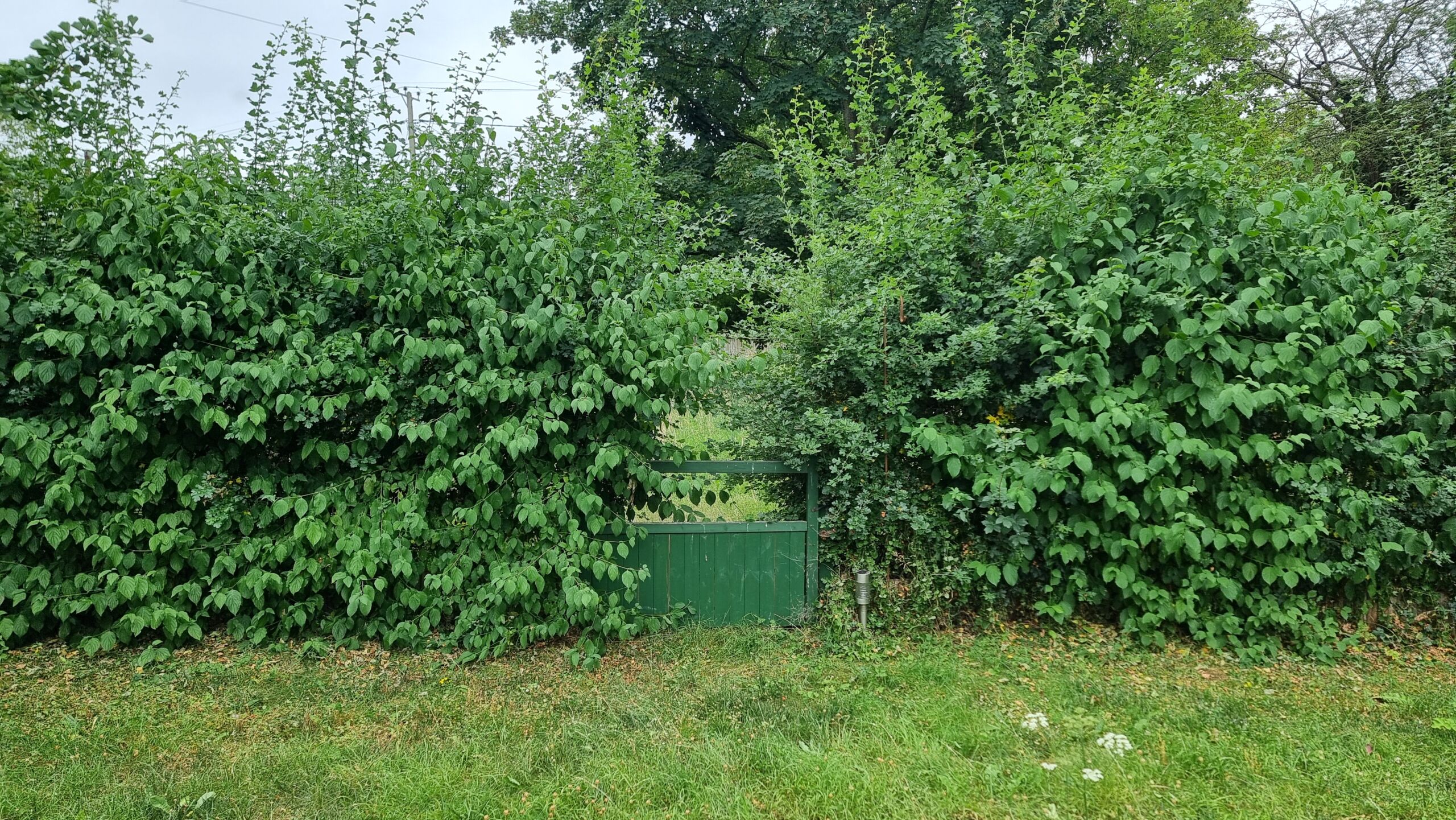
As I lay in bed the other night, I became aware of an unusually-bright LED, glowing in the corner of my room1. Lying still in the dark, I noticed
that as I looked directly at the light meant that I couldn’t see it… but when I looked straight ahead – not at it – I could make it out.
In my bedroom the obstruction was the corner of my pillow, not a nondescript black rectangle. Also: my eyeball was firmly within my skull and not floating freely in a white void.
This phenomenon seems to be most-pronounced when the thing you’re using a single eye to looking at something small and pointlike (like an LED), and where there’s an obstacle closer to
your eye than to the thing you’re looking at. But it’s still a little spooky2.
It’s strange how sometimes you might be less-able to see something that you’re looking directly at… than something that’s only in your peripheral vision.
I’m now at six months since I started working for Firstup.3 And as I continue to narrow my focus on the specifics of the
company’s technology, processes, and customers… I’m beginning to lose a sight of some of the things that were in my peripheral vision.
I’ve not received quite so many articles of branded clothing and other swap from my new employer as I did from my previous, but getting useful ‘swag’ still feels cool.
I’m a big believer in the idea that folks who are new to your group (team, organisation, whatever) have a strange superpower that fades over time: the ability to look at “how you work”
as an outsider and bring new ideas. It requires a certain boldness to not just accept the status quo but to ask “but why do we do things this way?”. Sure, the answer will
often be legitimate and unchallengeable, but by using your superpower and raising the question you bring a chance of bringing valuable change.
That superpower has a sweet spot. A point at which a person knows enough about your new role that they can answer the easy questions, but not so late that they’ve become accustomed to
the “quirks” that they can’t see them any longer. The point at which your peripheral vision still reveals where there’s room for improvement, because you’re not yet so-focussed on the
routine that you overlook the objectively-unusual.
I feel like I’m close to that sweet spot, right now, and I’m enjoying the opportunity to challenge some of Firstup’s established patterns. Maybe there are things I’ve learned or
realised over the course of my career that might help make my new employer stronger and better? Whether not not that turns out to be the case, I’m enjoying poking at the edges to find
out!
Footnotes
1 The LED turned out to be attached to a laptop charger that was normally connected in
such a way that it wasn’t visible from my bed.
2 Like the first time you realise that you have a retinal blind spot and that your brain
is “filling in” the gaps based on what’s around it, like Photoshop’s “smart remove” tool is running within your head.
Honestly I just wanted to play around with gradients. But gradients without anything on the horizon lack something, so I added horses. Since I can’t draw horses, now you
can draw them. And watch them parade across the screen alongside horses drawn by people you probably wouldn’t like. Or maybe you would, how should I know?!
…
I love a good (by which I mean stupid) use of a .horse domain name. I’m not sure anything will ever beat endless.horse, but gradient.horse might be a close second.
Draw a horse. Watch it get animated and run wild and free with the horses that other people have drawn. That is all.
Last time I was caching up this neck of the woods was December 2018 (GLXJJWGN, GLXJJX7P). And despite the fact that I was staying in different accommodation, in a different month of the year, I was still in
the vicinity for the exact same reason: attending the Christmas party of my nonprofit.
By longstanding tradition, I get up early in the morning at these kinds of events – well before sunrise, at this point in the year! – for a quick walk to a nearby geocache, which today
meant this one! To make my hunt in the dark easier I scoped the GZ on Google Street View first and caught sight of a likely hiding spot which later turned it to be exactly right!
Upon reaching the area I soon saw that the road ahead was closed (for HS2 works, I suppose!), but this was no impediment to the cache.
It was soon found – the coordinates aren’t great but the hint sent me right to the object I’d scouted earlier – but extraction was challenging – I needed to manufacture a tool from
nearby dead wood with which to pry it from its hiding place!
Did you know that about 1 in 12 sheep is gay? And we are not just talking about rams. According to scientists, same-sex behaviour has been documented in over 1500 species. You see,
queerness is quite prevalent on planet Earth. But sadly, there are still many people that have a problem with it. The shocking truth is: 62 countries still criminalize same-sex
relationships – that’s right, it’s illegal to be gay in one third of the world! And even where it is not illegal, cases of queer hostility are increasing – including in Germany.
This is why we are getting the help from a gay flock of rams in a small town in Germany: We are using their wool to create fashion products that support projects for the queer
community.
Meet the world’s first gay flock of sheep
Sadly, gay rams are often sent to slaughter because they can’t fulfill a farm’s “breeding role.” We rescue them before that happens, giving them a safe home where they can live and
love freely. Each year, their wool is crafted into fashion, with profits donated to the queer charity LSVD+. You can also adopt a gay ram – helping cover food and
medicine to keep them happy and healthy for life. Every adoption comes with a digital certificate you can print at home.
…
Well this is just adorable.
About 1 in 12 rams (and a similar proportion of ewes) show a strong preference for other sheep of their same sex. Which is useless for breeders, who expect their rams to be able to
impregnate 40 ewes per fortnight, so such rams tend to be destroyed.
But this farm in Germany has started rescuing them and allowing people to “adopt a gay sheep” to help sponsor their care and upkeep. They also collect a small amount of wool from their
queer flock and make products (which almost-immediately sell out).
So yeah: there’s a flock of homosexual sheep living happily together on a farm in Germany, and that’s just awesome.
Welcome to my 88×31 button creator, this is a pretty rough and ready implementation so it could be buggy, please let me know if you find any issues.
This supports gif despite the basic canvas tag limitation courtesy of gif.js – none of
this would be possible without that project.
…
Dan (whose website is freakin’ awesome, by the way) has done an amazing job with this new 88×31 generator. Look at this (trashy, but I don’t care) button I threw together in literally
seconds, with it:
Have a play, and remind yourself that the Web is brilliant.