The Dungeon of Dark Patterns

This is a repost promoting content originally published elsewhere. See more things Dan's reposted.

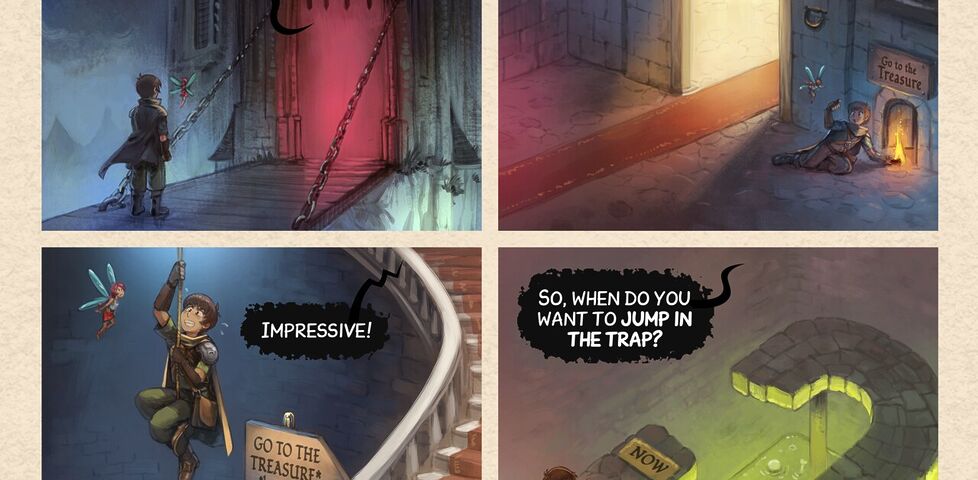
The Dungeon of Dark Patterns A comic in four panels Panel 1. The adventurer and his fairy are in front of the door of a nightmarish dungeon, it's dark, foggy, and the inside the door we can't see anything except a deep red light. > Dungeon: "Welcome adventurers, to the Dungeon of Dark Patterns!" Panel 2. In one room of the dungeon, a giant beautiful and inviting door with a red carpet, and on the side, in the shadow a too little door. Writing on big door: Go to the trap, on small door: Go to the treasure. The adventurer crouch and do a little sign to the fairy to follow him to the little door. > Dungeon: "Ha ha, you're good!" Panel 3. The aventurer is now putting some effort climbing on an old rope in the middle of a room with a beautiful luxuous stairway with a red carpet on the side. A sign tells "GO TO THE TREASURE but pass by the trap" in direction of the beautiful stairs; and "(other options)" in small and in the shadow in direction of the rope. > Dungeon: "Impressive!" Panel 4. Top down view on the adventurers shrugging in front of the fairy, they reached a dead end. A short path on the right has on the ground the word "Now", and a longer path "Later". Both lead to a giant pool of green acid where bones and skulls are floating. > Dungeon: "So, when do you want to jump to the trap?"

Well this is just excellent.

I’d not come across David Revoy before today, but he’s apparently being doing art and comics since 2014. The Mini Fantasy Theatre series started a couple of years ago, but is totally getting added to my RSS reader. Almost everything’s bilingual English/French too, if that’s something that interests you.

Navigating around the dark patterns of modern UX certainly feels like a dungeon delve, sometimes. Now we just need the episode in which the adventurer has difficulty unsubscribing from requests from their patron…

×

WSL9x

This is a repost promoting content originally published elsewhere. See more things Dan's reposted.

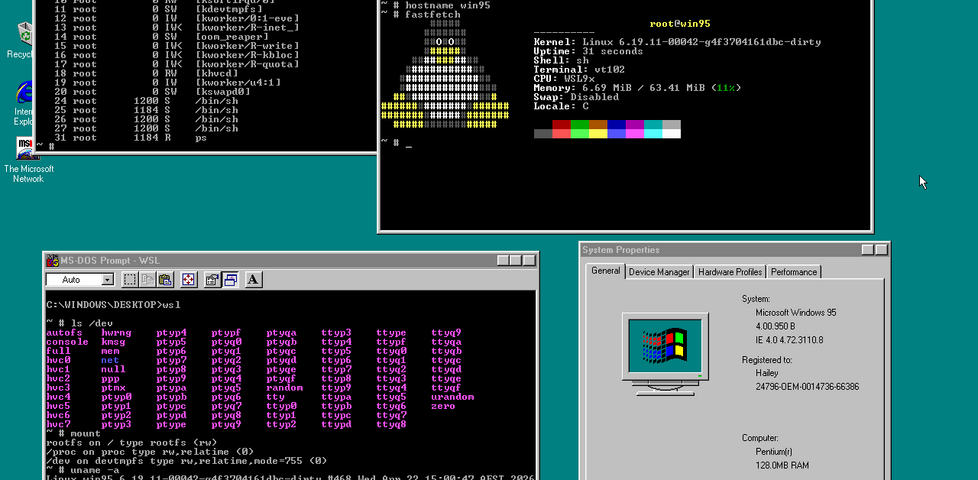
WSL9x runs a modern Linux kernel (6.19 at time of writing) cooperatively inside the Windows 9x kernel, enabling users to take advantage of the full suite of capabilities of both operating systems at the same time, including paging, memory protection, and pre-emptive scheduling. Run all your favourite applications side by side – no rebooting required!

Well this blew my mind.

Windows Subsystem for Linux (WSL) is one of the single best things Microsoft have added to Windows in the last decade1. But, of course, it’s for Windows 10 and 11 only. I would never have conceived that somebody could make the same trick work for, like, Windows 95!

But Hails has done so. And no, this isn’t some kind of emulation; it’s proper cooperative multitasking between the two kernels, just like regular WSL does. Somehow, in a version that came out nine years before Windows even supported the NX bit. Mindboggling.

Footnotes

1 This ought to be a little embarrassing for them: I mean – if the most-valuable improvement you make to your operating system is to make it… more like a different operating system… – that’s not a great sign, is it?

×

BBC News RSS… with full-size thumbnails!

I love that my tool for making BBC News RSS feeds “better” continues to help people1. But I also enjoy that as a platform, it’s still got room to grow.

For instance, at the start of the weekend I received an email from somebody called Phil, who asked:

Could you possibly have an alternative ‘HQ’ version of your feeds which replaces standard/240 with standard/1200 in the URL for each article in the XML?

I am obviously pretty desperate for this feature, hence me reaching out.

Phil’s right. The BBC News RSS feeds contain thumbnail images that look like this:

<media:thumbnail width="240"
                height="135"
                   url="https://ichef.bbci.co.uk/ace/standard/240/cpsprodpb/623a/live/5f8c30c0-3d7f-11f1-ac78-2112837ce2aa.jpg"
/>

You see the /240/ in that URL? If you change it to /1200/ then, as Phil observes, you get a much-higher resolution thumbnail. Naturally you ought to correct the width and height attributes accordingly, too.

The difference is pretty significant. See:

Image of an F1 car, half in a low, blocky resolution; half in full resolution.
You’d be forgiven for thinking the left-hand-side of this image was the Lego model of this car.

So I raised Phil’s request as a GitHub issue, like a good maintainer, before realising that – hang on – this would be a really easy improvement and I should just… do it.

My BBC feeds “improver” leverages one of my very favourite RubyGems, Nokogiri, to perform XML parsing and modification. The code you need to tweak these URLs is super simple:

# Iterate through each <media:thumbnail> element in the RSS feed:
rss.xpath('//media:thumbnail').each do |thumb|
  # Skip any that don't start the way we expect:
  next unless thumb['url'] =~ /^https:\/\/ichef.bbci.co.uk\/ace\/(standard|ws)\/240\//
  # Swap the 240 for 1200 in the url="..." attribute:
  thumb['url'] = thumb['url'].gsub(/\/ace\/(standard|ws)\/240\//, "/ace/\\1/1200/")
  # Set width="1200":
  thumb['width'] = "1200"
  # Set the height="..." proportionally (they're not always the same!):
  thumb['height'] = (thumb['height'].to_f / 240 * 1200).round.to_s
end
In the actual code I wrote the magic numbers 240 and 1200 are constants, of course.

That really is all there is to it, but look at what a difference it makes in an RSS reader:

Before and after screenshots of an RSS reader showing BBC news stories. The thumbnails in the "after" side are visibly higher-resolution.

I got that merged and the GitHub action that makes the magic happen got started on its usual 20-minute schedule soon afterwards. I didn’t even have to finish waiting for my lunchtime ramen to cool down before the change was out there and, hopefully, helping people. Phil emailed me again soon afterwards:

You managed to fix something in your lunch break that has been bugging me for well over a decade. The difference in quality is night and day.

Anyway: it pleased me to discover that my software is out there, helping people.

As with most of my open source work, I put little to no effort into tracking any kind of metrics of usage, which means I only get to find out if I’ve done good in the world when people reach out and tell me. So I was delighted to hear from Phil (as well as to take his suggestion and improve the tool for everybody!).

Footnotes

1 Specifically, the code I’ve written makes a few improvements to the BBC News RSS feeds: (1) removing duplicate news, (2) removing non-news content such as “nudges” towards the app or to iPlayer content, and (3) optionally removing sports news. If that sounds like a better version of the BBC News RSS feeds, you should take a look!

× ×