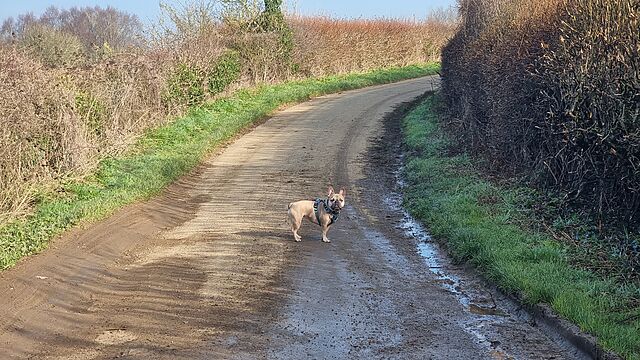
The geopup and I are out doing the North Leigh Loop from New Yatt, where we’re temporarily living while our house is dried and damage assessed by the insurance company following a
catastrophic flood a few weeks ago.
Between Loop #3 and #4 we took a small diversion to find this cache, and I’m glad that we did! So nice to see a properly-sized (and tenured) cache still rocking it!
Lid was not properly attached by a recent finder, sadly, and the container spilled its contents as I picked it up. But once we’d reassembled it all we were able to sign the log and
continue our loop.
TFTC to both the hiders and adopters. FP awarded for being the first decent-sized cache I’ve seen today.
While the geohound busied herself with the important task of collecting sticks several times larger than herself, I began the search for what I’d figured would be a QEF.
Within the circle of uncertainty lay an obvious-looking host covered with obvious-looking candidate spots into which to squeeze a cache of this kind. After 15 minutes of searching where
it “should” have been I wondered, per previous logs, if it might free fallen, and made a brief search of the mulch and leaf litter underfoot. No luck there either! After a total of
nearly 20 minutes of searching, we had to give up.
Clearly I’ve trained the geohound well, because she found the geotrail out to this GZ before I did!
This cache is definitely benefitting from its layers of defense against the elements: the log, in its inner sanctum, was dry despite moisture getting through all the other layers! TFTC!
Coming to the “start” of this loop having come from the “end” gave the geohound and I a perfect vantage point to sight this QEF. Now it’s time to find out how boggy the trail to #2 is!
If it’s as muddy as the one from #8 back to the village then we might need to make an alternative plan!
QEF for the geohound and I. My GPSr can’t connect to the Internet and I’m not retyping a URL into my phone so I can’t comment on the hint, but the cache itself is fine. SL, TFTC.
Coming from Leigh Loop 8 the geohound and I figured we had an easy and direct run here, but intolerable mud at the East end of the field path drove us out onto the road and back before
we could get to this cache. Even here, conditions were boggy and crossing the path to improve our certainty of our GPS coordinates was a drag! But we found it in the end pretty easily,
although its logbook is so wet as to almost be unsignable! TFTC.
Since our house flooded a few weeks ago we’ve been living out of a series of short holiday lets, waiting for the floors to dry out and the insurance company to assess the damage, before
we’ll hopefully be able to secure a slightly longer tenancy somewhere while repairs are done.
Right now we’re staying in New Yatt. I’ve cached a little around here before, but never this loop, so this morning the geopup and I came out for a walk and to begin this loop… at its
end!
After some initial difficulty getting a GPS fix we eventually found a good looking hiding place. Despite this being the first find out this cache and the terrible recent weather, the
cache and its log are in fine condition. SL, TFTC!
Spring’s coming, and with it a stack of cachers either new or else returning from hibernation. Therefore; I’m briefly checking-in on my geocaches to ensure they’re in good condition.
Today I peeped at this one, and found it happy and well and ready to be hunted. Go find it!
Nineteen days after my house flooded, causing extensive damage on the ground floor, the insurance
company has finally accepted the claim and is willing to pay for our temporary accommodation in the meantime (a few days in a hotel, a few days with friends although that’s not
paid-for, four weeks in two different holiday lets), although we’re still waiting for their thumbs-up on a proposal for a ~6-month let of a house to live in while our floors are replaced and our kitchen rebuilt and whatnot.
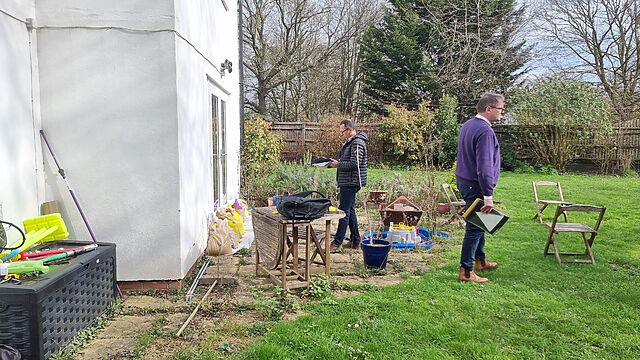
Meanwhile, yesterday a surveyor came around and looked at all of our walls. Everything still feels like it’s taking a very long time. I appreciate that insurance companies are a maze of
bureaucracy and procedure, but from “this side” of the table – living and working out of strange places, never really feeling “unpacked” but without it being a holiday – it’s all a bit
of a drag!
Last night I was chatting to my friend (and fellow Three Rings volunteer) Ollie about our respective
workplaces and their approach to AI-supported software engineering, and it echoed conversations I’ve had with other friends. Some workplaces, it seems, are leaning so-hard into
AI-supported software development that they’re berating developers who seem to be using the tools less than their colleagues!
That’s a problem for a few reasons, principal among them that AI does not
make you significantly faster but does make you learn less.1. I stand by the statement that AI isn’t useless, and I’ve experimented with it for years. But I certainly wouldn’t feel very comfortable
working somewhere that told me I was underperforming if, say, my code contributions were less-likely than the average to be identifiably “written by an AI”.
Even if you’re one of those folks who swears by your AI assistant, you’ve got to admit that they’re not always the best choice.
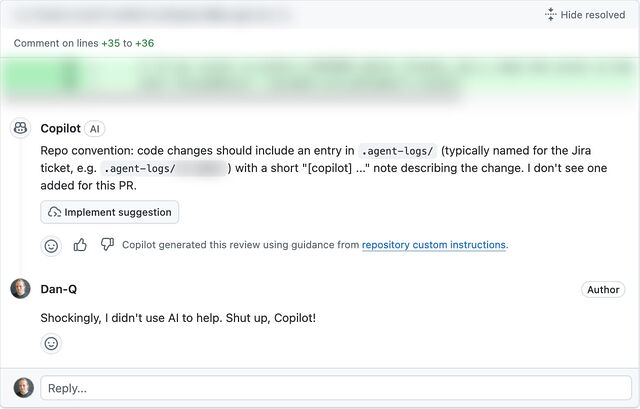
I ran into something a little like what Ollie described when an AI code reviewer told me off for not describing how my AI agent assisted me with the code change… when no AI had been
involved: I’d written the code myself.2
I spoke to another friend, E, whose employers are going in a similar direction. E joked that at current rates they’d have to start tagging their (human-made!) commits with fake
AI agent logs in order to persuade management that their level of engagement with AI was correct and appropriate.3
Supposing somebody like Ollie or E or anybody else I spoke to did feel the need to “fake” AI agent logs in order to prove that they were using AI “the right way”… that sounds
like an excuse for some automation!
I got to thinking: how hard could it be to add a git hook that added an AI agent’s “logging” to each commit, as if the work had been done by a
robot?4
Turns out: pretty easy…
To try out my idea, I made two changes to a branch. When I committed, imaginary AI agent ‘frantic’ took credit, writing its own change log. Also: asciinema + svg-term remains awesome.
Here’s how it works (with source code!). After you make a commit, the post-commit hook creates a file in
.agent-logs/, named for your current branch. Each commit results in a line being appended to that file to say something like [agent] first line of your commit
message, where agent is the name of the AI agent you’re pretending that you used (you can even configure it with an array of agent names and it’ll pick one at
random each time: my sample code uses the names agent, stardust, and frantic).
There’s one quirk in my code. Git hooks only get the commit message (the first line of which I use as the imaginary agent’s description of what it did) after the commit has
taken place. Were a robot really used to write the code, it’d have updated the file already by this point. So my hook has to do an --amend commit, to
retroactively fix what was already committed. And to do that without triggering itself and getting into an infinite loop, it needs to use a temporary environment variable.
Ignoring that, though, there’s nothing particularly special about this code. It’s certainly more-lightweight, faster-running, and more-accurate than a typical coding LLM.
Sure, my hook doesn’t attempt to write any of the code for you; it just makes it look like an AI did. But in this instance: that’s a feature, not a
bug!
Footnotes
1 That research comes from Anthropic. Y’know, the company who makes Claude, one of the
most-popular AIs used by programmers.
3 Using “proportion of PRs that used AI” as a metric for success seems to me to be just
slightly worse than using “number of lines of code produced”. And, as this blog post demonstrates, the
former can be “gamed” just as effectively as the latter (infamously) could.
4 Obviously – and I can’t believe I have to say this – lying to your employer isn’t a
sensible long-term strategy, and instead educating them on what AI is (if anything) and isn’t good for in your workflow is a better solution in the end. If you read this blog post and
actually think for a moment hey, I should use this technique, then perhaps there’s a bigger problem you ought to be addressing!
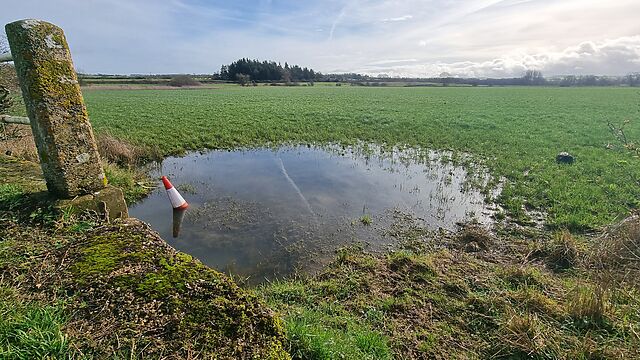
Hurrah! I just made my first successful submission to Curious Cones, a weblog collecting photographs of traffic cones spotted in unusual places.
I spotted this cone while the younger child and I took a walk to the next-nearest village to our temporary accommodation, in order to find a geocache, tag some benches for OpenBenches, and have a cafe brunch.
Anyway: if you’re not following Curious Cones, it’s exactly as delightful as you might expect.
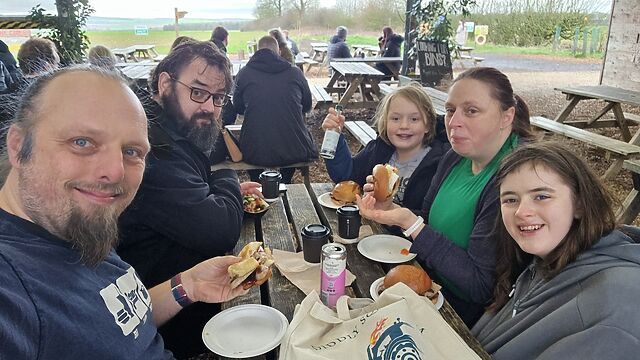
Despite being relatively ‘local’ – only half a mile away, and fans of the show – it took until this morning before the family and I actually came to up visit Clarkson’s Farm. We’re
even-more-local but now, after a flood made our house uninhabitable and we moved, temporarily, to a holiday let just up the road.
This morning we visited Diddly Squat for a round of sausage sandwiches, after which the youngest child and I decided to make a run for this nearby geocache. The kid put his finger right
on the cache before I’d even had a chance to take a look for it!
Log signed, and a car full of Hawkstone Lager acquired, we were all done. TFTC!