I’ve never come across the TV series nor this kind of puzzle before, and opted to solve it in an unconventional way. We’re living for a week
in an AirBnB nearby – one in a long series of short term lets while we and our insurance company find us sonewhere longer-term, following flood damage to our house last month.
This morning, the younger geokid and I came out for a walk with the geopup. After a little difficulty getting a GPSr fix we eventuality found a good-looking host, and after a few laps
we had the well-camouflaged container in our hands. A good sized, well maintained container and an interesting puzzle, even if the way we solved it might be considered by some to have
been cheating!
SL (using my own pencil; the one in the cache is blunt and I forgot to bring my sharpener), TFTC.
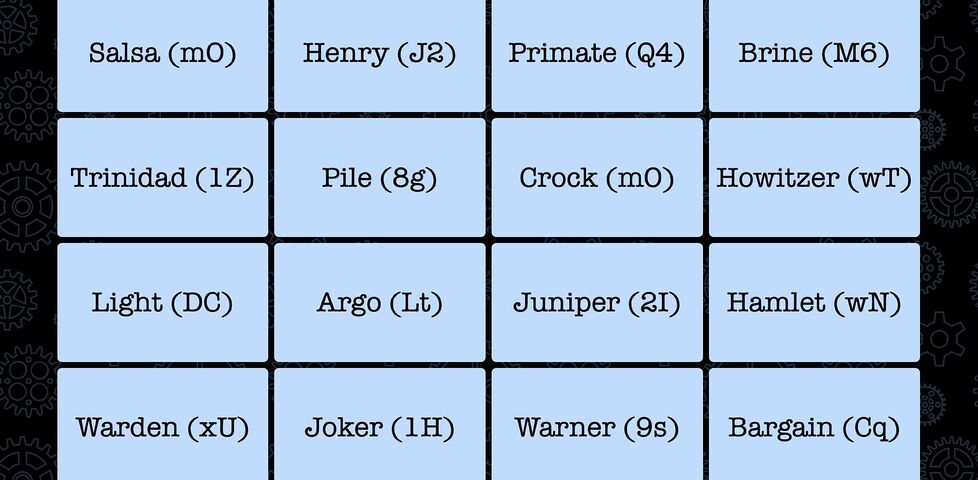
The other day I needed to solve a puzzle1. Here’s the essence of it: there was a grid of 16 words. They needed to be organised into four thematic “groups” of four words each;
then each group needed to be sorted alphabetically.
Each item in each group had a two-character code associated with it: these were to be concatenated together into a string and added to a pastebin.com/... URL. The correct
four URLs would each contain a quarter of the answer to the puzzle.
Apparently this puzzle format is called “Only Connect” and is based on a TV show?2
I’m sure I could have solved the puzzle. But I figured it’d be more satisfying to solve a different puzzle, with the same answer: how to write a program
that finds the correct URLs for me.
I’m confident that this approach was faster.3
Or rather: it would have been if it hadn’t been for the fact that I felt the need to subsequently write a blog post about it.
Here’s how it works:
It creates an array containing the 43,680 possible permutations of 4 from the 16 words.
If sorts the permutations and removes duplicates, reducing the set to just 1,820.
It removes the bit of each that isn’t the two digit code at the end and concatenates them into a URL.
It tries each URL, with short random gaps between them, listing each one that isn’t a 404 “Not found” response.4
I kicked off the program and got on with some work. Meanwhile, in the background, it permuted the puzzle for me. Within a few minutes, I had four working pastebin URLs, which
collectively gave me the geocache’s coordinates. Tada!
Was this cheating?
I still solved a puzzle. It probably took me, as a strong programmer, about as long as it would have taken me to solve the puzzle the conventional way were I a strong… “only
connect”-er5.
But I adapted the puzzle into a programming puzzle and solved it a completely different way, . Here’s the arguments, as I see them:
Yes, this was cheating. This wasn’t the way the puzzle author intended it to be solved. Inelegantly brute-forcing a problem isn’t “solving” it, it’s sidestepping
it. If everybody did this, there’d be no point in the author putting the time into the puzzle in the first place.
No, this wasn’t cheating. This solution still required solving a puzzle, just a different one. A bad human player making a lucky guess would be fine. It’s
a single-player game; play any way that satisfies you. Implementing software to assist is no worse than asking a friend for help, as others have done.
Click on a 😡 or a 🧠 to let me know whether you think I cheated or not, or drop me a comment if you’ve got a more-nuanced opinion.
2 Don’t try to solve this one; it’s randomly generated.
3 This version of the program is adapted to the fake gameboard I showed earlier. You won’t
get any meaningful results by running this program in its current state. But you could quickly adapt it to a puzzle of this format, I suppose.
4 It occurred to me that it could have been more-efficient to eliminate from the list any
possibilities that are ruled-out by any existing finds… but efficiency is a balancing act. For a program that you’ll only run once – and in the background, while you do other things,
to boot – there’s a tipping point at which it’s better to just get it running than it is to improve its performance.
5 There’s a clear parallel here to the various ways in which I’ve
solved jigsaw-puzzle-based geocaches, because I’m far more interested in (a) programming and (b) getting out into the world and finding geocaches in interesting places than I am
in doing a virtual jigsaw puzzle!