The Internet, the interconnection of most of the computers in the world, has existed since the late sixties. But no protocol existed to actually exploit that network, to explore and
search for information. At the time, you needed to know exactly what you wanted and where to find it. That’s why the USA tried to develop a protocol called “Gopher.”
At the same time, the “World Wide Web,” composed of the HTTP protocol and the HTML format, was invented by a British citizen and a Belgian citizen who were working in a European
research facility located in Switzerland. But the building was on the border with France, and there’s much historical evidence pointing to the Web and its first server having been
invented in France.
It’s hard to be more European than the Web! It looks like the Official European Joke! (And, yes, I consider Brits Europeans. They will join us back, we miss them, I promise.)
…
Google, Microsoft, Facebook may disappear tomorrow. It is even very probable that they will not exist in fourty or fifty years. It would even be a good thing. But could you imagine
the world without the Web? Without HTML? Without Linux?
Those European endeavours are now a fundamental infrastructure of all humanity. Those technologies are definitely part of our long-term history.
…
There are so many ways in which the UK has had to choose – and continues to have to choose – which side of the Atlantic it belongs on: the North American side, or the European side.
Legally, politically, financially, culturally… And every time we swing away from Europe, it saddens me.
This wonderful article by Lionel Dricot encapsulates one of many reasons why. European tech culture, compared to that in the USA, leans more open-source, more
open-standards, more collaborative. That’s the culture I want more of.
He observes that the design of feed readers – which still lean on the design of the earliest feed readers, which adopted the design of email software to minimise the learning
curve – makes us feel obligated to stay on top of all our incoming content with its “unread counts”.
Phantom obligation
Email’s unread count means something specific: these are messages from real people who wrote to you and are, in some cases, actively waiting for your response. The number isn’t
neutral information. It’s a measure of social debt.
But when we applied that same visual language to RSS (the unread counts, the bold text for new items, the sense of a backlog accumulating) we imported the anxiety without the cause.
…
RSS isn’t people writing to you. It’s people writing, period. You opted to be notified of their existence. The interface implied debt where none existed. The
obligation became phantom.
I use FreshRSS as my feed reader, and I love it. But here’s the thing: I use the same application
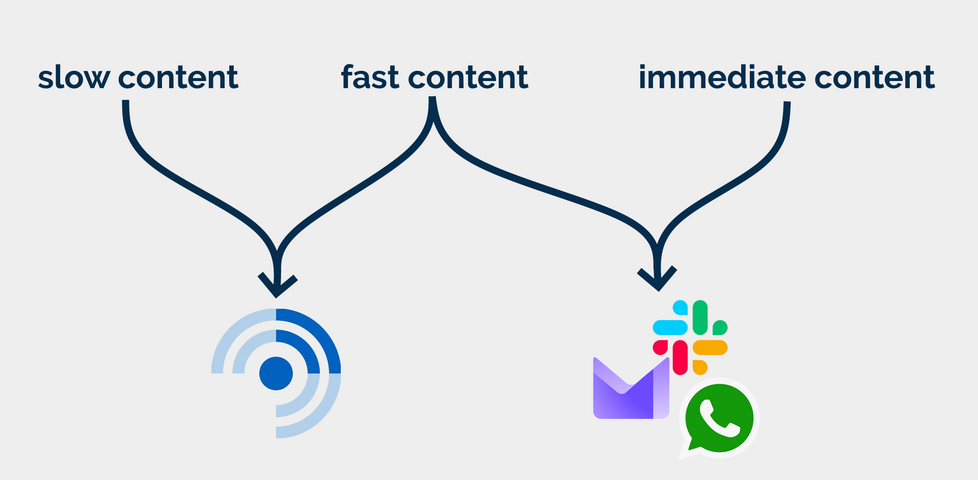
for two different kinds of feeds. I call them slow content and fast content.2
It’s an idealised interpretation of how I subscribe to different kinds of incoming messages, but it works for me. The lesson is that slowing down your consumption is not
an antifeature, it’s a deliberate choice about how you prioritise your life. For me: humans come first – what about you?
Slow content
Blogs, news, podcasts, webcomics, vlogs, etc. I want to know that there is unread content, but I don’t need to know howmuch.
In some cases, I configure my reader to throw away stuff that’s gotten old and stale; in other cases, I want it to retain it indefinitely so that I can dip in when I want to.
There are some categories in which I’ll achieve “inbox zero” most days3…
but many more categories where the purpose of my feed reader is to gather and retain a library of things I’m likely to be interested in, so that I can enjoy them at my leisure.
Some of the things I subscribe to, though, I do want to know about. Not necessarily immediately, but “same day” for sure! This includes things like when it’s a friend’s
birthday (via the Abnib Birthdays feed) or when there’s an important update to some software I selfhost.
This is… things I want to know about promptly, but that I don’t want to be interrupted for! I appreciate that this kind of subscription isn’t an ideal use for a feed reader… but I use
my feed reader with an appropriate frequency that it’s the best way for me to put these notifications in front of my eyeballs.
I agree with Terry that unread counts and notification badges are generally a UX antipattern in feed readers… but I’d like to keep them for some purposes.
So that’s exactly what I do.
How I use FreshRSS (to differentiate slow and fast content)
FreshRSS already provides categories. But what I do is simply… not show unread counts except for designated feeds and categories. To do that, I use the CustomCSS extension for FreshRSS (which nowadays comes as-standard!), giving it the following code
(note that I want to retain unread count badges only for feed #1 and categories #6 and #8 and their feeds):
.aside.aside_feed{
/* Hide all 'unread counts' */.category,.feed{
.title:not([data-unread="0"])::after,.item-title:not([data-unread="0"])::after{
display:none;}
}
/* Re-show unread counts only within: * - certain numbered feeds (#f_*) and * - categories (#c_*) */#f_1,#c_6,#c_8{
&,.feed{
.title:not([data-unread="0"])::after,.item-title:not([data-unread="0"])::after{
display:block;}
}
}
That’s how I, personally, make my feed reader feel less like an inbox and more like a… I don’t know… a little like a library, a little like a newsstand, a little like a calendar… and a
lot like a tool that serves me, instead of another oppressive “unread” count.
I just wish I could persuade my mobile reader Capyreader to follow suit.
Maybe it’ll help you too.
Footnotes
1 Or whenever you like. It’s ‘slow content’. I’m not the boss of you.
2 A third category, immediate content, is stuff where I might need to
take action as soon as I see it, usually because there’s another human involved – things like this come to me by email, Slack, WhatsApp, or similar. It doesn’t belong in a feed
reader.
3 It’s still slow content even if I inbox-zero it most days…
because I don’t inbox-zero it every day! I don’t feel bad ignoring or skipping it if I’m, for example, not feeling the politics news right now (and can you blame me?). This
is fundamentally different than ignoring an incoming phone call or a knock at the door (although you’re absolutely within your rights to do that too, if you don’t have the spoons for
it).
4 I’m yet to see a mailing list that wouldn’t be better as either a blog (for few-to-many
communication) or a forum (for many-to-many communication), frankly. But some people are very wedded to their email accounts as “the way” to communicate!