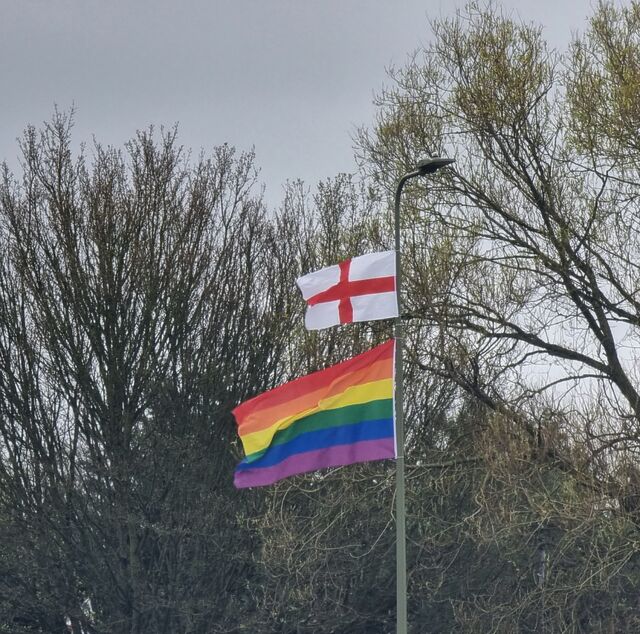
Like many in the UK, I’m dismayed every time I see the plague of St. George’s Cross (flag of England) that nationalists have been hanging on lamp posts on recent years.
So it gave me great joy to see that this lamp post had recently acquired a (larger!) pride flag. 🏳️🌈
If we’re going to become a country that hangs flags everywhere… I’d much rather that they be flags that speak of inclusivity and diversity. ❤️
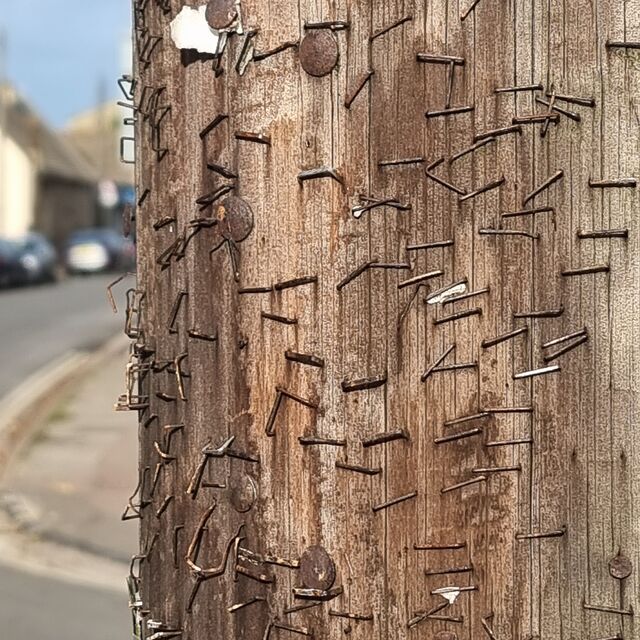
This telegraph pole in the centre of Eynsham carries the scars of hosting countless community announcements, notices, and flyers over the last 30 years.
I nerdsniped myself today when, during a discussion on the potential location of a taekwondo tournament organised by our local martial arts school, somebody claimed that Scotland would be “nearer”
than Ireland.
I don’t dispute that somebody living near me can get to Scotland faster than Ireland, unless they can drive at motorway speeds across Wales… and the Irish Sea. But the word
they used was nearer, and I can be a pedantic arse.
But the question got me thinking:
Could I plot a line across Great Britain, showing which parts are closer to Scotland and which parts are closer to Ireland?
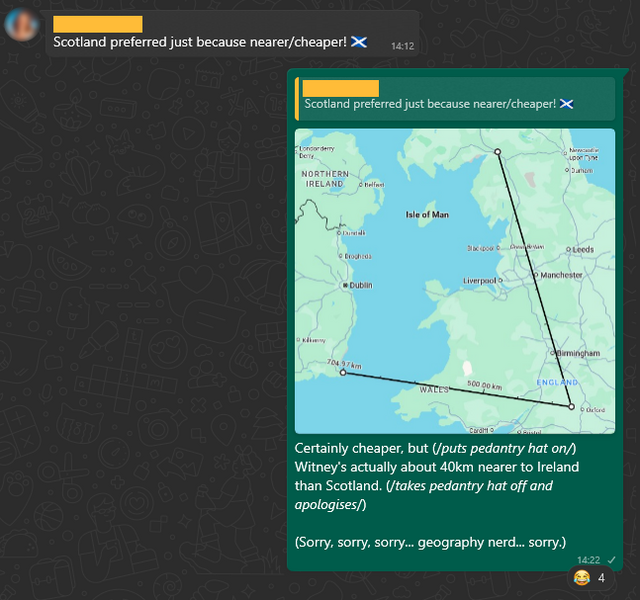
If the England-facing Irish and Scottish borders were completely straight, one could simply extend the borders until they meet, bisect the angle, and we’d be done.
Of course, the borders aren’t straight. They also don’t look much like this. I should not draw maps.
In reality, the border between England and Scotland is a winding mess, shaped by 700 years of wars and treaties1.
Treating the borders as straight lines is hopelessly naive.
Voronoi diagrams are pretty, and cool, and occasionally even useful! This one expands from points, but there’s no reason you can’t expand from a line (line a border!) instead.
My Python skills are pretty shit, but it’s the best tool for the job for geohacking2. And so, through a
combination of hacking, tweaking, and crying, I was able to throw together a script that produces a wonderful
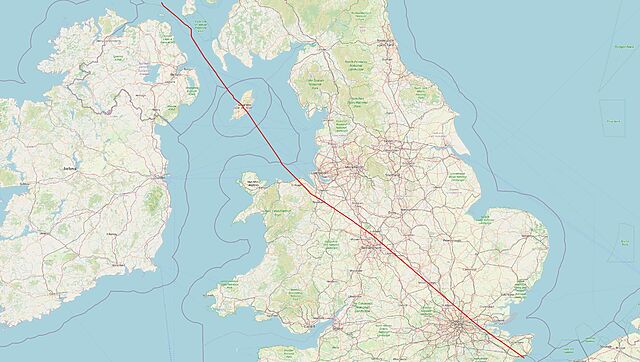
slightly-wiggly line up the country.
The entire island of Ireland is used here to determine boundaries (you can tell because otherwise parts of County Antrim, in Northern Ireland, would be marked as closer to Scotland
than the Republic of Ireland: which they are, of course, but the question was about England!).
Once you’ve bisected England in this way – into parts that are “closer to Ireland” versus parts that are “closer to Scotland”, you start to spot all kinds of interesting
things3.
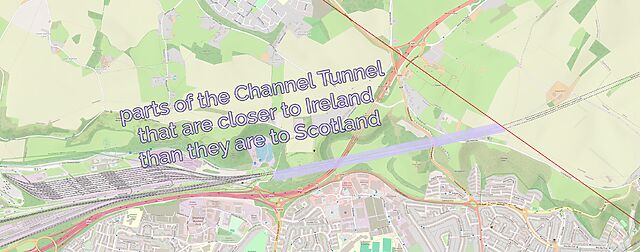
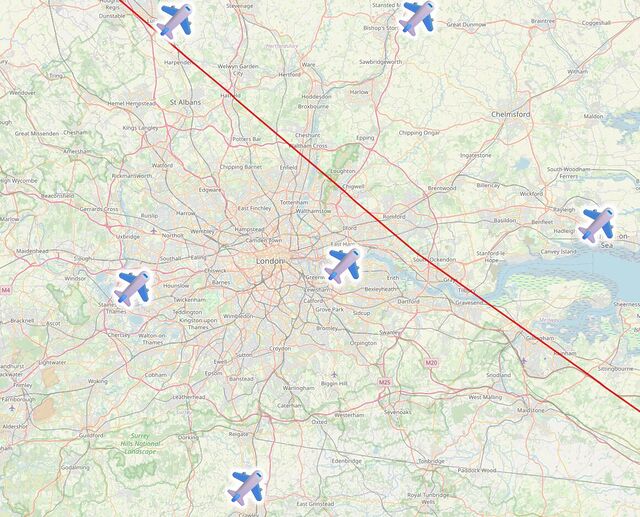
Like: did you know that the entire subterranean part of the Channel Tunnel is closer to Scotland than it is to Ireland… except for the ~2km closest to the UK exit.
A little further North: London’s six international airports are split evenly across the line, with Luton, Stansted and Southend closer to Scotland… and City, Heathrow and Gatwick closer
to Ireland.
The line then pretty-much bisects Milton Keynes, leaving half its population closer to Scotland and half closer to Ireland, before doing the same to Daventry, before – near Sutton
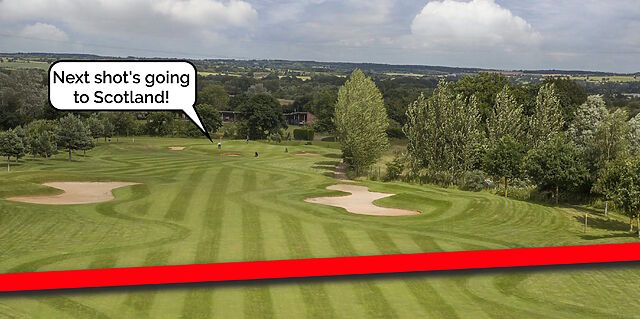
Coldfield – it drives right through the middle of the ninth hole of the golf course at the Lea Marston Hotel.
Players tee off closer to Ireland and – unless they really slice it – their ball lands closer to Scotland:
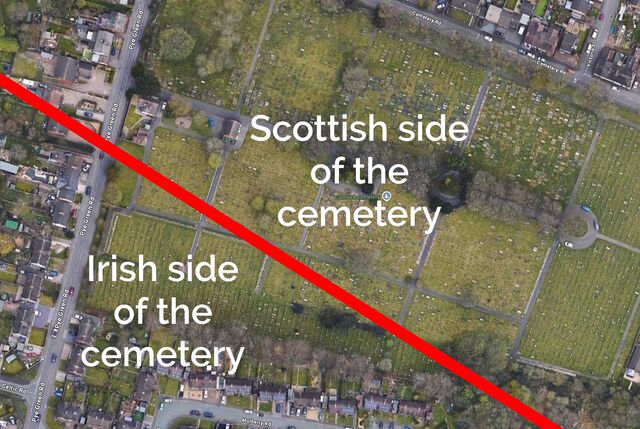
In Cannock, it bisects the cemetery, dividing the graves into those on the Scottish half and those in the Irish half:
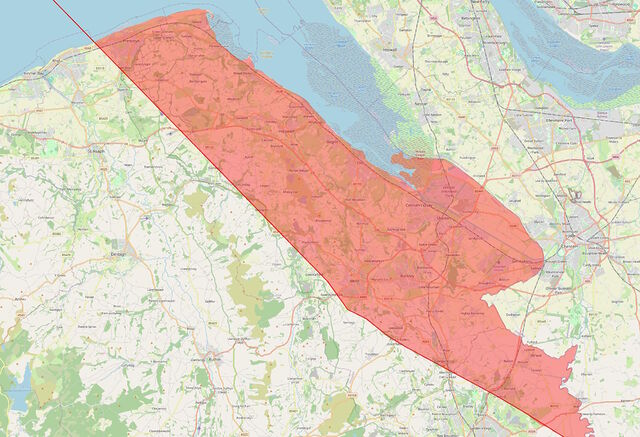
The line crosses the Welsh border at the River Dee, East of Wrexham, leaving a narrow sliver of Wales that’s technically closer to Scotland than it is to Ireland, running up the
coastline from Connah’s Quay to Prestatyn and going as far inland as Mold before – as is the case in most of Wales – you’re once again closer to Ireland:
If you live in Flint or Mold, ask your local friends whether they live closer to Ireland or Scotland. The answer’s Scotland, and I’m confident that’ll surprise them.
I’d never have guessed that there were any parts of Wales that were closer to Scotland than they were to Ireland, but the map doesn’t lie4
Anyway: that’s how I got distracted, today. And along the way I learned a lot about geodata encoding, a little about Python, and a couple of surprising things about geography5.
2 Or, at least: it’s the one that’s most-widely used and so I could find lots of helpful
StackOverflow answers when I got stuck!
3 Interesting… if you’re specifically looking for some geographical trivia, that is!
4 Okay, the map lies a little. My program was only simple so it plotted
everything on a flat plane, failing to accommodate for Earth’s curvature. The difference is probably marginal, but if you happen to live on or very close to the red line, you might
need to do your own research!
5 Like: Chester and Rugby are closer to Scotland than they are to Ireland, and Harpenden
and Towcester are closer to Ireland than they are to Scotland! Who knew?
As the UK’s heatwave continues, the dog and I were delighted that this morning was sufficiently overcast that we could manage a proper walk without completely melting.
Her breed copes badly with the heat and we’ve lately had to keep her indoors or in the shade more than she’d like, so a chance to run around among the trees was very welcome!
Representation matters. That we have a trans former-judge, somebody both well-equipped and motivated to escalate this important challenge to the ECHR, is hugely
fortunate.
We need more representation (of trans people specifically, but many other groups too, and perhaps particularly in the intersections) in positions of power, expertise, and authority. To
defend the human rights of all of us.
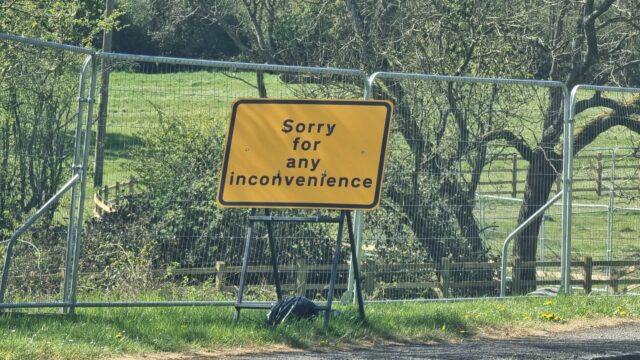
Rarely seen nowadays, these UK road signs were eventually declared “too impolite” and “brusque” and have now almost entirely been replaced with the ones that Brits are familiar with
today, which read “Terribly sorry for the inconvenience, I hope it’s no bother, it’s all our fault really, so sorry, really sorry, sorry, I’ll put the kettle on shall I?”
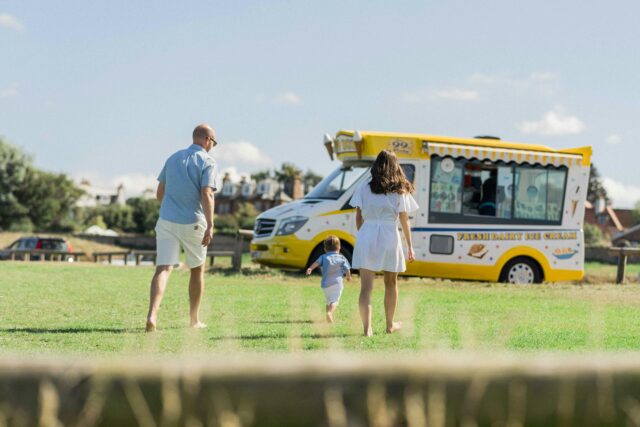
Here in the UK, ice cream vans will usually play a tune to let you know they’re set up and selling1.
So when you hear Greensleeves (or, occasionally, Waltzing Matilda), you know it’s time to go and order yourself a ninety-nine.
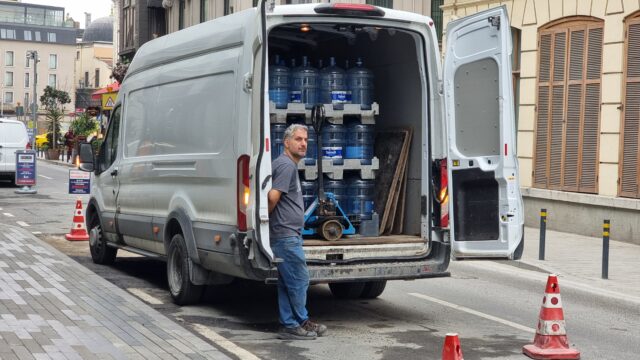
Imagine my delight, then, when I discover this week that ice cream vans aren’t the only services to play such jaunty tunes! I was sat with work colleagues outside İlter’s Bistro on Meşrutiyet Cd. in Istanbul, enjoying a beer, when a van
carrying water pulled up and… played a little song!
And then, a few minutes later – as if part of the show for a tourist like me – a flatbed truck filled with portable propane tanks pulled up. Y’know, the kind you might use to heat a
static caravan. Or perhaps a gas barbeque if you only wanted to have to buy a refill once every five years. And you know what: it played a happy little jingle, too. Such joy!
In Istanbul, people put out their empty water bottles to be swapped-out for full ones by the water delivery man2.
My buddy Cem, who’s reasonably local to the area, told me that this was pretty common practice. The propane man, the water man, etc. would
all play a song when they arrived in your neighbourhood so that you’d be reminded that, if you hadn’t already put your empties outside for replacement, now was the time!
And then Raja, another member of my team, observed that in his native India, vegetable delivery trucks also play a song so you know they’re arriving. Apparently the tune they
play is as well-standardised as British ice cream vans are. All of the deliveries he’s aware of across his state of Chennai play the same piece of music, so that you know it’s them.
Raja didn’t have a photo to share (and why would he? it’s not like I have a photo of the guy who comes to refill the gas tank behind my
house!3), so I found this stock pic which sounds a bit like what
he described. Photo courtesy Aiden Jones, used under a CC-By-SA license.
It got me thinking: what other delivery services might benefit from a recognisable tune?
Bin men: I’ve failed to put the bins out in time frequently enough, over the course of my life, that a little jingle to remind me to do so would be welcome4!
(My bin men often don’t come until after I’m awake anyway, so as long as they don’t turn the music on until after say 7am they’re unlikely to be a huge inconvenience to anybody,
right?) If nothing else, it’d cue me in to the fact that they were passing so I’d remember to bring the bins back in again afterwards.
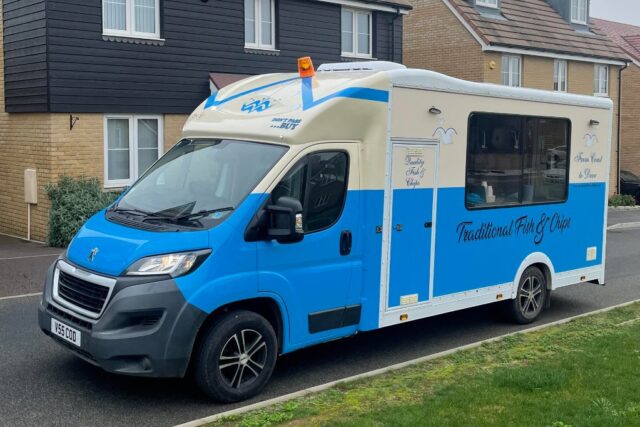
Fish & chip van: I’ve never made use of the mobile fish & chip van that tours my village once a week, but I might be more likely to if it announced its arrival with a
recognisable tune.
I’m thinking a chorus of Baby Shark would get everybody’s attention.
Milkman: I’ve a bit of a gripe with our milkman. Despite promising to deliver before 07:00 each morning, they routinely turn up much later. It’s particularly
troublesome when they come at about 08:40 while I’m on the school run, which breaks my routine sufficiently that it often results in the milk sitting unseen on the porch until I think
to check much later in the day. Like the bin men, it’d be a convenience if, on running late, they at least made their presence in my village more-obvious with a happy little ditty!
Emergency services: Sirens are boring. How about if blue light services each had their own song. Perhaps something thematic? Instead of going nee-naw-nee-naw, you’d
hear, say, de-do-do-do-de-dah-dah-dah
and instantly know that you were hearing The Police.
Evri: Perhaps there’s an appropriate piece of music that says “the courier didn’t bother to ring your doorbell, so now your parcel’s hidden in your recycling box”?
Just a thought.
Anyway: the bottom line is that I think there’s an untapped market for jolly little jingles for all kinds of delivery services, and Turkey and India are clearly both way ahead
of the UK. Let’s fix that!
Footnotes
1 It’s not unheard of for cruel clever parents to try to teach their young
children that the ice cream van plays music only to let you know it’s soldout of ice cream. A devious plan, although one I wasn’t smart (or evil?) enough to try for
myself.
3 My gas delivery man should also have his own song, of course. Perhaps an instrumental
cover of Burn Baby Burn?
4 Perhaps bin men could play Garbage Truck by Sex Bob-Omb/Beck? That seems kinda
fitting. Although definitely not what you want to be woken up with if they turn the speakers on too early…
A lunchtime dog walk was made especially delightful by the growing warmth of the approaching British springtime. It’s really bright and pretty out, this afternoon!
The secret order — issued under the U.K.’s Investigatory Powers Act 2016 (known as the Snoopers’ Charter) — aims to undermine an opt-in Apple feature that provides end-to-end encryption
(E2EE) for iCloud backups, called Advanced Data Protection. The encrypted backup feature only allows Apple customers to access their device’s information stored on iCloud — not
even Apple can access it.
…
Sigh. A continuation of a long-running saga of folks here in the UK attempting to make it easier for police to catch a handful of (stupid) criminals1…
at the expense of making millions of people more-vulnerable to malicious hackers2.
If we continue on this path, it’ll only be a short number of years before you see a headline about a national secret, stored by a government minister (in the kind of ill-advised manner
we know happens) on iCloud or similar and then stolen by a hostile foreign power who merely needed to bribe, infiltrate, or in the worst-case hack their way into Apple’s
datacentres. And it’ll be entirely our own fault.
Meanwhile the serious terrorist groups will continue to use encryption that isn’t affected by whatever “ban” the UK can put into place (Al Qaeda were known to have developed their own
wrapper around PGP, for example, decades ago), the child pornography rings will continue to tunnel traffic around whatever dark web platform they’ve made for themselves (I’m curious
whether they’re actually being smart or not, but that’s not something I even remotely want to research), and either will still only be caught when they get sloppy and/or as the
result of good old-fashioned police investigations.
Weakened and backdoored encryption in mainstream products doesn’t help you catch smart criminals. But it does help smart criminals to catch regular folks.
Footnotes
1 The smart criminals will start – or more-likely will already be using – forms of
encryption that aren’t, and can’t, be prevented by legislation. Because fundamentally, cryptography is just maths. Incidentally, I assume you know that you can send me encrypted email that nobody else can read?
After a night that alternated between raining and freezing winds here, at the edge of Storm Éowyn, this morning my skylight has ice patterns on it that look beautiful and almost
organic.




 RSS
RSS Spotify
 Pocket Casts
 Apple Podcasts
 YouTube