
Tag: software
-
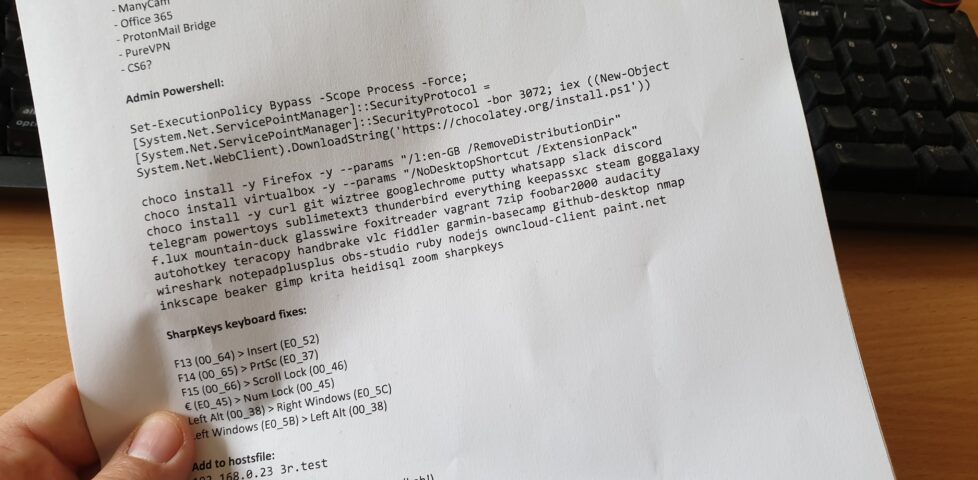
Rebuilding a Windows box with Chocolatey
As often happens when he moves house, Dan broke a PC. But thanks to package manager Chocolatey, he was able to get it back up-and-running in a fraction of the time he might have expected.
-
An app can be a home-cooked meal
Author Robin Sloan tells the story of the app he wrote just for his family, and Dan reflects on his own experience of making apps for audiences of few (or one!).
-
Avoid rewriting a legacy system from scratch, by strangling it
Nicholas Carlo describes the situation where people have risky, hard-to-refactor code and reimplement the entire system instead. Now those people have two problems.
-
SQLite Code Of Ethics (formerly Code of Conduct)
...
Attribute to God, and not to self, whatever good you see in yourself.
Recognize always that evil is your own doing, and to impute it to yourself.
Fear the Day of Judgment.
Be in dread of hell.
...
SQLite
In an age when more and more open-source projects are … -
The elephant in the diversity room
The elephant in the diversity room - QuirksBlog (quirksmode.org) false
Although there’s a lot of heated discussion around diversity, I feel many of us ignore the elephant in the web development diversity room. We tend to forget about users of older or non-standard devices and browsers, instead focusing on people with modern browsers, which … -
Geeky Winnage With Bluetooth
Geeky winnage! This evening I wrote a pair of applications enabling me to use my new Bluetooth-enabled mobile phone as a remote control for WinDVD, the DVD playing software I use on my computer.
Not just a geeky project, this is fuelled by a genuine need: every Troma Night, when the pizza arrives, we end up … -
The Right To Read
[this post was lost during a server failure on Sunday 11th July 2004; it was partially recovered on 21st March 2012]
If you haven't already read it, take a look at The Right To Read, a very short story written in 1997 and updated in 2002 - it'll only take you a few minutes to read; … -
Bovini: A Week Well-Spent
It's been a busy week. I've spent a lot of my time at the office, trying to get the replication model for Bovini working - causing much stress as it failed time and time again. For those of you without a grounding in computer science theory, replication is the art of making data be identical …
-
WildCat BBS
This image was shared here in hindsight, on 22 March 2021. I didn’t actually start blogging until around August 1998; the message and text below were published on a bulletin board system to which I contributed.
The picture above illustrates the software I have just ordered