Somebody should make a tea cosy but to fit a cafetiere.
That sounds like a great idea.
Somebody should make a tea cosy but to fit a cafetiere.
That sounds like a great idea.
This is a repost promoting content originally published elsewhere. See more things Dan's reposted.
- What fragments you?
- What defragments you?
- How are you balancing both?
My dear friend Boro raises this curious provocation, which I really enjoyed musing upon this evening. His choice of words are excellent.
Fragmentation is about context-switching. About disfocus. About the scattering of ideas. We think of defragmentation – the “re-ordering” of data – as a necessary good: bringing management and logic to how our information is arranged. But it’s Boro’s third question that reminds us that that’s not necessarily true.1 2
Anyway: Boro’s post is a reminder that a human brain is not a magnetic drum, and fragmentation is not necessarily something to fear. What’s an extra millisecond or two of psychological “seek time” as you aim to remember the date of your friend’s birthday… if the mental journey takes you past memories of parties long-ago? How bad, really, is a few moments of seeking the right word if, on the way, you discover the perfect metaphor for that blog post?3
What Boro accidentally touches on, for me, is the concept of premature optimisation. We talk about this being bad in software engineering circles, but it’s also bad for us psychologically. Taking shortcuts weakens our ability to think things through “the hard way”. Earlier today, I had a thought about… something inconsequential about heart rates… and chose to use mental arithmetic, over the course of several minutes, to estimate an answer to my query. My phone – with its built-in calculator app – sat in my pocket the whole time. I chose the less-efficient route, and I felt better for it. Efficiency is not always the goal.
Or, as folks in my circles are saying a lot lately: inconvenience is counterculture. I quite like that.
Anyway: thanks, Boro, for the thought.
1 Brief side-note #1: if you’re wondering why you haven’t had to “defrag your hard drive” for the last decade or so: the biggest reason is that SSDs don’t suffer fragmentation in the same kind of way (and, indeed, trying to defragment them probably reduces their lifespan!). Fragmentation on physical media is a problem only because the magnetic heads need to jump back and forth between “parts” of a file or stream of data, which introduces wear and slows down seeking. But on solid state media, where data is referenced directly by memory address, fragmentation is no impediment.
2 Brief side-note #2, with the understanding that the side notes are now getting to be longer than the actual content: one of my favourite features of late-stage HDD defragmentation utilities was that they were smart about what they defragmented where. Not only could they group individual files “together”, they could also group frequently-used-together files close to one another (minimising head movement) and could even cluster frequently-accessed files like operating system data very close to the edge of physical media, where the angular rotation of the heads would be smallest (because the track length was greatest). Mind-boggling how these things, like e.g. screen savers as a mechanism to prevent CRT burn-in, become completely obsolete but still live on in popular consciousness.
3 Y’know, the one about defragmentation.
As I lay in bed the other night, I became aware of an unusually-bright LED, glowing in the corner of my room1. Lying still in the dark, I noticed that as I looked directly at the light meant that I couldn’t see it… but when I looked straight ahead – not at it – I could make it out.
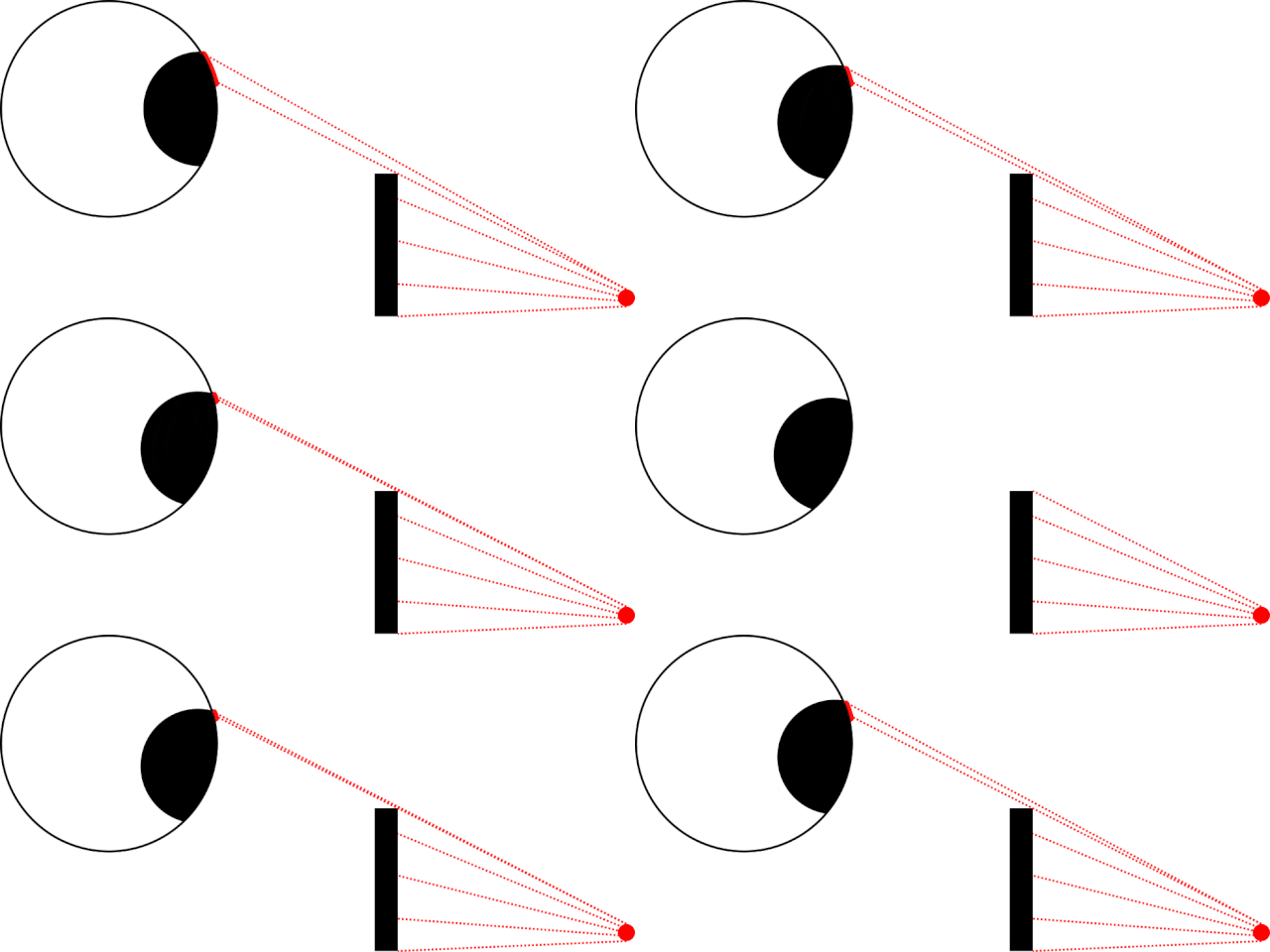
This phenomenon seems to be most-pronounced when the thing you’re using a single eye to looking at something small and pointlike (like an LED), and where there’s an obstacle closer to your eye than to the thing you’re looking at. But it’s still a little spooky2.
It’s strange how sometimes you might be less-able to see something that you’re looking directly at… than something that’s only in your peripheral vision.
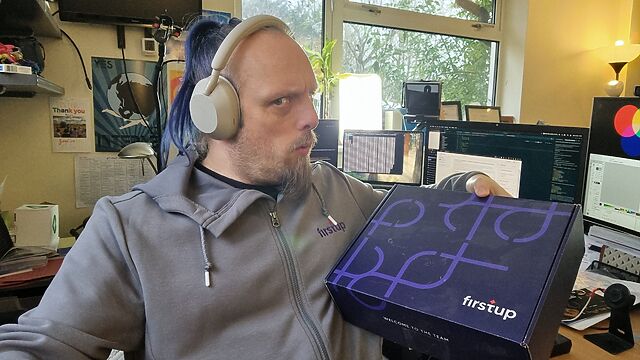
I’m now at six months since I started working for Firstup.3 And as I continue to narrow my focus on the specifics of the company’s technology, processes, and customers… I’m beginning to lose a sight of some of the things that were in my peripheral vision.
I’m a big believer in the idea that folks who are new to your group (team, organisation, whatever) have a strange superpower that fades over time: the ability to look at “how you work” as an outsider and bring new ideas. It requires a certain boldness to not just accept the status quo but to ask “but why do we do things this way?”. Sure, the answer will often be legitimate and unchallengeable, but by using your superpower and raising the question you bring a chance of bringing valuable change.
That superpower has a sweet spot. A point at which a person knows enough about your new role that they can answer the easy questions, but not so late that they’ve become accustomed to the “quirks” that they can’t see them any longer. The point at which your peripheral vision still reveals where there’s room for improvement, because you’re not yet so-focussed on the routine that you overlook the objectively-unusual.
I feel like I’m close to that sweet spot, right now, and I’m enjoying the opportunity to challenge some of Firstup’s established patterns. Maybe there are things I’ve learned or realised over the course of my career that might help make my new employer stronger and better? Whether not not that turns out to be the case, I’m enjoying poking at the edges to find out!
1 The LED turned out to be attached to a laptop charger that was normally connected in such a way that it wasn’t visible from my bed.
2 Like the first time you realise that you have a retinal blind spot and that your brain is “filling in” the gaps based on what’s around it, like Photoshop’s “smart remove” tool is running within your head.
3 You might recall that I wrote about my incredibly-efficient experience of the recruitment process at Firstup.
I’ve eaten “doughnut holes”, but I’ve never seen anybody market “bagel holes”. Untapped opportunity? 🤔
Shower thought for the morning was: why is cream cheese spread ‘Philadelphia’ called that? Is it from Philadelphia? (My box isn’t, of course: it came from Ireland.)

Nope, it turns out that it was originally invented in New York in the 19th century and named for Philadelphia because Philadelphia, PA was at that point famous for its dairy industry. Just another bit of parasitic branding leveraging a borrowed association, like the Quaker Oats guy or the Rolls Razor. Now I’m wondering how many other examples I can find!