IndieWebCamp Oxford

This weekend, I attended part of Oxford’s first ever IndieWebCamp! As a long (long, long) time proponent of IndieWeb philosophy (since long before anybody said “IndieWeb”, at least) I’ve got my personal web presence pretty-well sorted out. Still, I loved the idea of attending and pushing some of my own tools even further: after all, a personal website isn’t “finished” until its owner says it is! One of the things I ended up hacking on was pretty-predictable: enhancements to my recently-open-sourced geocaching PESOS tools… but the other’s worth sharing too, I think.

Hacking and learning at IndieWebCamp Oxford
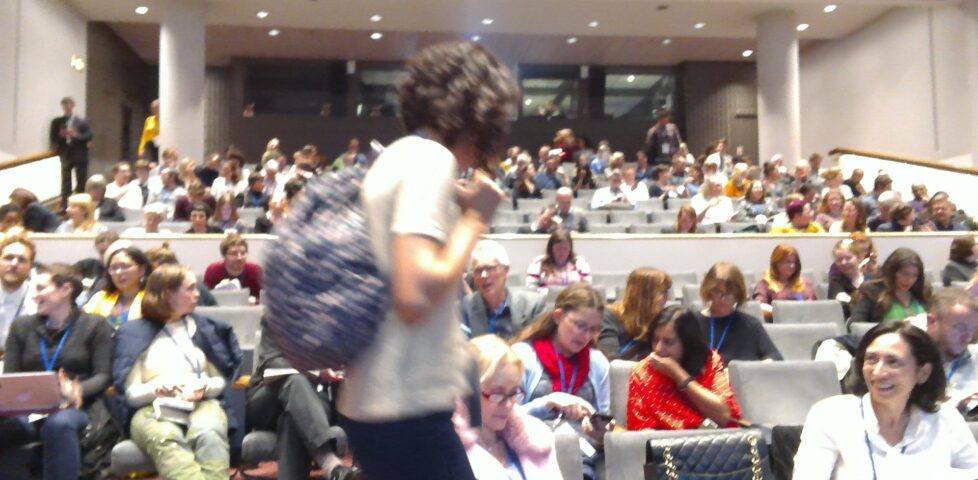
Some of IndieWebCamp Oxford’s attendees share knowledge and hack code together.

I’ve recently been playing with WebVR – for my day job at the Bodleian, I swear! – and I was looking for an excuse to try to expand some of what I’d learned into my personal blog, too. Given that I’ve recently acquired a Ricoh Theta V I thought that this’d be the perfect opportunity to add WebVR-powered panoramas to this site. My goals were:

  • Entirely self-hosted; no external third-party dependencies
  • Must degrade gracefully (i.e. even if you’re using an older browser, don’t have Javascript enabled, etc.) it should at least show the original image
  • In plain-old browsers should support mouse (or touch) control to pan the scene
  • Where accelerators are available (e.g. mobiles), “magic window” support to allow twist-to-explore
  • And where “true” VR hardware (Cardboard, Vive, Rift etc.) with WebVR support is available, allow one-click use of that
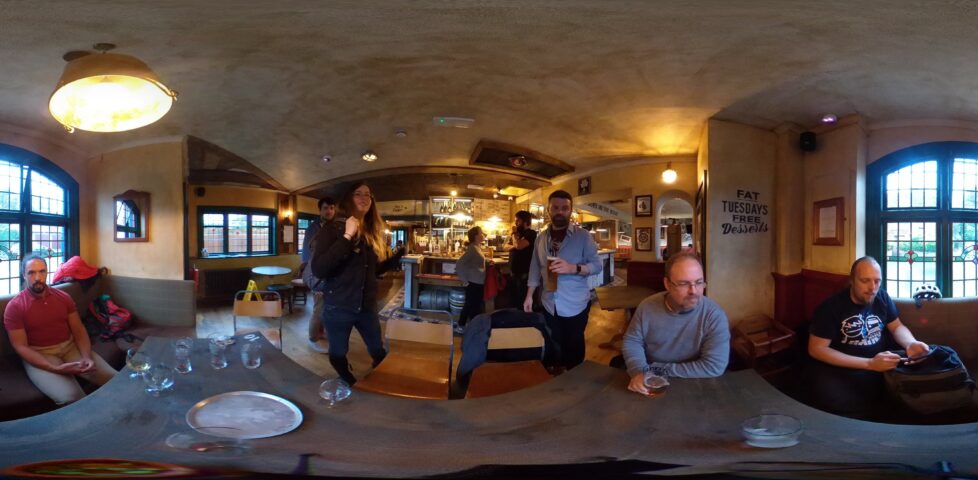
IndieWebCamp Oxford attendees at the pub
It wouldn’t be a geeky hacky camp thingy if it didn’t finish at a bar.

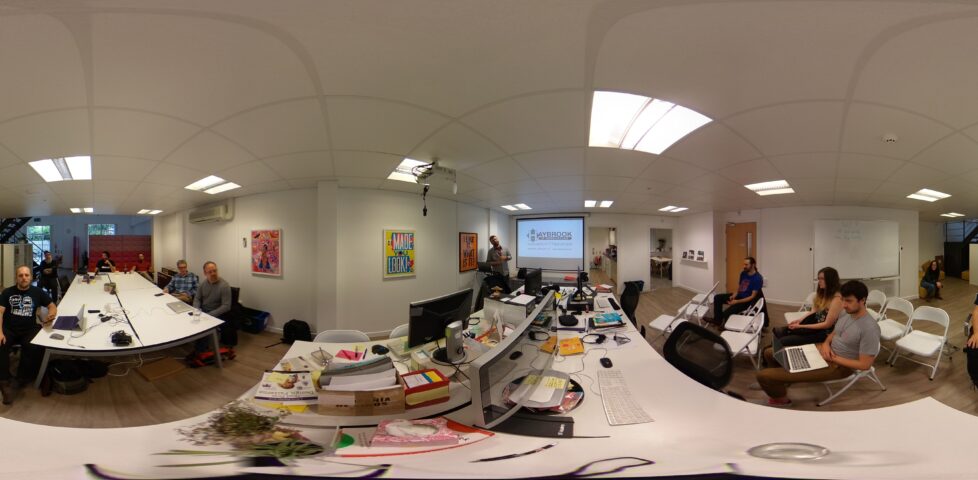
Hopefully the images above are working for you and are “interactive”. Try click-and-dragging on them (or tilt your device), try fullscreen mode, and/or try WebVR mode if you’ve got hardware that supports it. The mechanism of operation is slightly hacky but pretty simple: here’s how it works:

  1. The image is inserted into the page as normal but with an extra CSS class of “vr360” and a data attribute pointing to the full-resolution image, e.g.:
    <img class="vr360" src="/uploads/2018/09/R0010005_20180922182210-1024x512.jpg" alt="IndieWebCamp Oxford attendees at the pub" width="640" height="320" data-vr360="/uploads/2018/09/R0010005_20180922182210.jpg" />
  2. Some Javascript swaps-out images with this class for an iframe of the same size, showing a special page and passing the image filename after the hash, e.g.:
    for(vr360 of document.querySelectorAll('.vr360')){
    const width = parseInt(vr360.width);
    const height = parseInt(vr360.height);
    if(width == 0) width = '100%'; // Fallback for where width/height not specified,
    if(height == 0) height = '100%'; // needed because of some quirks with Dan's lazy-loader
    vr360.outerHTML = `<iframe src="/q23-content/themes/q18/vr360/#${vr360.dataset.vr360}" width="${width}" height="${height}" class="aligncenter" class="vr360-frame" style="min-width: 340px; min-height: 340px;"></iframe>`;
    }
  3. The iframe page loads this Javascript file. This loads three.js (to make 3D things easy) and WebVR-polyfill (to fix browser quirks). Finally (scroll to the bottom of the code), it creates a camera in the centre of a sphere, loads the image specified in the hash, flips it, and paints it onto the inside surface of the sphere, sets up controls, and turns the user loose on it. That’s all there is to it!

You’re welcome to any of my code if you’d like a drop-in approach to hosting panoramic photographs on your own personal site. My solution’s pretty extensible if you want e.g. interactive hotspots or contextual overlays – in fact, that – plus an easy route to editing the content for less-technical users – is pretty-much exactly what I’m working on for my day job at the moment.

IndieWebCamp Oxford Day 1 – Polytechnic

This is a repost promoting content originally published elsewhere. See more things Dan's reposted.

IndieWebCamp Oxford Day 1 by Garrett Coakley (polytechnic.co.uk)

I’m here at the first IndieWebCamp Oxford. I can’t quite believe it all came together!
Listening to @garrettc kick us off at @indiewebcamp #oxford! #indieweb pic.twitter.com/4Pn1yetifA— Dan Q (@scatmandan) 22 September 2018
After some introductory rambling from me, the group got down to planni…

I’m here at the first IndieWebCamp Oxford. I can’t quite believe it all came together!

After some introductory rambling from me, the group got down to planning and coding.

And it’s been mostly planning and coding ever since, with brief breaks here and there to swear at or about PHP in my case.

Note #10536

Just discovered @openbenches (openbenches.org), which tags the locations of benches with memorial plaques. If I could #indieweb webmention my checkins to them, I’d totally promote a new GPS game based upon them. #indieweb #indiewebcamp

Note #10533

Listening to @garrettc kick us off at @indiewebcamp #oxford! #indieweb

IndieWebCamp Oxford

Importing Geocaching Logs into WordPress

Background

As an ocassional geocacher and geohasher, I’m encouraged to post logs describing my adventures, and each major provider wants me to post my logs into their silo (see e.g. my logs on geocaching.com, on opencache.uk, and on the geohashing wiki). But as a believer in the ideals behind the IndieWeb (since long before anybody said “IndieWeb”), I’m opposed to keeping the only copy of content that I produce in an environment controlled by somebody else (why?).

How do I reconcile this?

Wrist-mounted GPS in the snow.
Just another hundred metres to the cache, then it’s time to freeze my ass back to base.

What I’d prefer would be to be able to write my logs here, on my own blog, and for my content to by syndicated via some process into the logging systems of the various silo sites I prefer. This approach is called POSSE – Publish on Own Site, Syndicate Elsewhere. In addition to the widely-described benefits of this syndication strategy, such a system would also make it possible for me to:

  • write single posts amalgamating multiple locations (e.g. a geohashing expedition that included geocache finds) or,
  • write single posts that represent the same location published on multiple silos (e.g. a visit to a geocache published on two different listing sites [e.g. 1, 2])

Applying such an tool would require some work as different silos have different acceptable content rules (geocaching.com, for example, effectively forbids mention of the existence of other geocache listing sites), but that’d theoretically be workable.

POSSE would involve posts being made first to my blog and then converted via some process into logs in each relevant silo
The ideal solution would be POSSE-based.

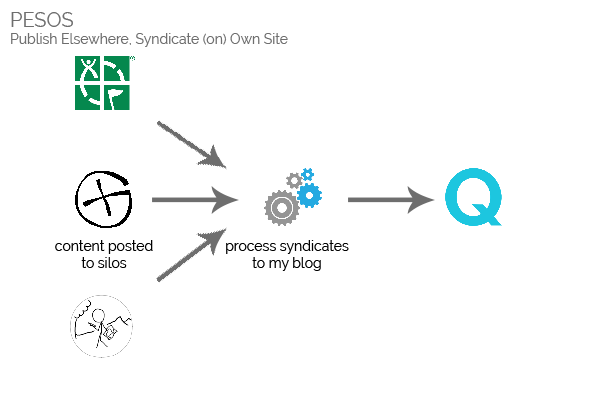
Unfortunately, content rules aren’t the only factor making PESOS – writing content into each silo and then copying it to my blog – preferable to POSSE. There’s also:

  • Not all of the silos offer suitable (published) APIs, and where they do, the APIs are all distinctly different.
  • Geocaching.com specifically forbids the use of unapproved automated robots to access the site (and almost certainly wouldn’t approve the kind of tool that would be ideal).
  • The siloed services are well-supported by official and third-party apps with medium-specific logic which make them the best existing way to produce logs.
PESOS would mean that posts were made "the usual way" to the silos and then a process duplicates them onto my blog
A PESOS-based solution is far easier to implement, in this case.

Needless to say: as much as I’d have loved to POSSE my geo* logs, PESOS will do.

Implementation

My implementation is a WordPress plugin which does two things. The first is that it provides a Javascript bookmarklet and an accompanying dynamically-generated Javascript file (the former loads the latter) served from my blog’s domain. That Javascript file contains reference to every log already published to my blog, so that the Javascript code can deliberately omit these logs from any import. When executed on a log listing page like those linked above, it copies all of the details of that log into a form which submits them back to my blog, where it’s received by the second part of the plugin.

Geocache logs to WordPress importer seen running on geocaching.com
The import controls appear in a new, right-most column (GCVote is also visible running in my browser).

The second part of the plugin takes this data and creates a new draft post. My plugin is pretty opinionated on this part because it’s geared strongly towards my use-case, so if you want to use it yourself you’ll probably want to tweak the code a little (e.g. it applies specific tags and names metadata fields a particular way).

Import plugin running on OpenCache.uk
When run on OpenCache.uk effectively the same interface is presented, even though the underlying mechanisms and data locations are different.

It’s not fully-automated and it’s not POSSE,but it’s “good enough” and it’s enabled me to synchronise all of my cache logs to my blog. I’ve plans to extend it to support other GPS game services to streamline my de-siloisation even further.

And of course, I’ve open-sourced the whole thing. If it’s any use to you (probably in an adapted form), it’s all yours.

× × ×

Oxford IndieWebCamp is go!

This is a repost promoting content originally published elsewhere. See more things Dan's reposted.

Save the dates folks!

On Saturday 22nd September and Sunday 23rd September we will be having the first ever Oxford IndieWebCamp!

It is a free event, but I would ask that you register on Eventbrite, so I can get an idea of numbers.

IndieWebCamp is a weekend gathering of web creators building & sharing their own websites to advance the independent web and empower ourselves and others to take control of our online identities and data.

It is open to all skill levels, from people who want to get started with a web site, through to experienced developers wanting to tackle a specific personal project.

I gave a little presentation about the Indieweb at JS Oxford earlier this year if you want to know more.

Huge thanks to our sponsors for the event, Haybrook IT and White October.

I couldn’t be more excited about this! I really hope that I’m able to attend!

JS Oxford Indieweb presentation – Polytechnic

This is a repost promoting content originally published elsewhere. See more things Dan's reposted.

JS Oxford Indieweb presentation by Garrett Coakley (polytechnic.co.uk)

Last night I attended the always excellent JS Oxford, and as well as having my mind expanded by both Jo and Ruth’s talks (Lemmings make an excellent analogy for multi-threading, who knew!), I gave a brief talk on the Indieweb movement.
If you’ve not heard of Indieweb movement before, it’s a pu…

Last night I attended the always excellent JS Oxford, and as well as having my mind expanded by both Jo and Ruth’s talks (Lemmings make an excellent analogy for multi-threading, who knew!), I gave a brief talk on the Indieweb movement.

If you’ve not heard of Indieweb movement before, it’s a push to encourage people to claim their own bit of the web, for their identity and content, free from corporate platforms. It’s not about abandoning those platforms, but ensuring that you have control of your content if something goes wrong.

From the Indieweb site:

Your content is yours

When you post something on the web, it should belong to you, not a corporation. Too many companies have gone out of business and lost all of their users’ data. By joining the IndieWeb, your content stays yours and in your control.

You are better connected

Your articles and status messages can go to all services, not just one, allowing you to engage with everyone. Even replies and likes on other services can come back to your site so they’re all in one place.

I’ve been interested in the Indieweb for a while, after attending IndieWebCamp Brighton in 2016, and I’ve been slowly implementing Indieweb features on here ever since.

So far I’ve added rel="me" attributes to allow distributed verification, and to enable Indieauth support, h-card to establish identity, and h-entry for information discovery. Behind the scenes I’m looking at webmentions (Thanks to Perch’s first class support), and there’s the ever-eternal photo management thing I keep picking up and then running away from.

The great thing about the Indieweb is that you can implement as much or as little as you want, and it always gives you something to work on. It doesn’t matter where you start. The act of getting your own domain is the first step on a longer journey.

To that end I’m interested in organising an IndieWebCamp Oxford this year. If this sounds like something that interests you, then come find me in the Digital Oxford Slack, or on Twitter.

I’m so excited to see that there are others in Oxford who care about IndieWeb things! I’ve honestly fantasised myself about running an IndieWebCamp or Homebrew Website Club here, but let’s face it: that fantasy is more one of a world in which I had the free time for such a venture. So imagine my delight when somebody else offers to do the hard work!