
Boring Polyamory: Equality and Bedrooms

Among the correspondence I engaged in following my blog post about my (boring) polyamory were a few examples of people being concerned about the equality of our arrangement: how we keep things “fair”1. By way of example, let’s take a look at a specific example that’s come up. Here’s something that I was asked recently:

Why does [my partner] Ruth not have her own bedroom? Both of her partners [JTA and I] get one!

Where does my partner sleep?

Simplified calendar showing May 2026 with different-coloured dots on the days: 14 of one, 17 of the other.
It’s been joked that polyamory is just a fetish for calendar management. Our family calendars are moderately simple, I imagine, compared to those of people in larger polycules or with less routine.

Except when she’s travelling or otherwise elsewhere2, Ruth spends her nights in an approximately even split3 between JTA‘s bedroom and mine.

This leads some people to observe that:

  • JTA has a bedroom of his own,
  • I have a bedroom of my own, and
  • Ruth “shares” both of those,
  • and this is unfair because her partners both get something that she is denied.

Superficially, this sounds true. But it conflates “fairness” with “parity”.

Fairness versus parity

Parity is making sure that everybody gets the same thing. It’s a simple, but crude, measure of equality. That’s probably why it’s so-popular with children.

“My sister got a doughnut so I should get one too.”

“You had an iced finger instead. You said you prefer iced fingers to doughnuts. And your sister doesn’t like iced fingers. Both of you got what you wanted.”

“Yeah, but now I want a doughnut because she had one!”

– the kind of conversation that’s probably familiar to you if you have children

When you aim for parity, you’re trying to make sure that every person gets the same thing. But this isn’t ideal, because not every person wants or needs the same thing!

A child with a ring doughnut decorated to look like a monster imitates the face of that monster, towards another child who is pointedly not paying attention.
“I don’t even want this. I just don’t want to feel like you’re getting something I’m not!”

Fairness, is aiming to for everybody to be content.

Ideally, everybody would get everything they wanted, all the time! But where that’s impossible, we can aim to at-least ensure that everybody is content. That everything is “good enough” for everybody. Unlike a quest for parity, this respects the fact that people have different needs.

Me personally? I absolutely prefer to have a bedroom of “my own”! In fact, to go even further than that: if I were in Ruth’s position I probably would want a room of my own, if it were feasible. Also, in some kind of hypothetical universe in which neither of us had other partners… I’d still ideally want to sleep alone some of the time (maybe once every couple of weeks?), because I’m of an inclination to occasionally luxuriate in being able to totally starfish-out.

If it were me instead of Ruth at the fulcrum of our V-shaped polycule… I suspect I’d have different needs to Ruth. And that’s fine!4

I’m a big fan of people being able to have their own space if they want it.

When the three of us first started cohabiting I suggested that Ruth should have her own bedroom. In our first shared house, we ensured that she did! But in practice, it never got used. Over time we’ve dropped it in favour of having a spare bedroom: a versatile space that can be place for gaming, or television, or guests5.

It was valuable to start from a position of assuming that we would all get “our own” room: parity is a good starting point! But fairness – meeting everybody’s needs in the most-equitable manner – is a better finishing point.6

Communicating a way to fairness

The world sometimes sucks. Many of the social interactions humans engage in, on a day-to-day basis, are not rooted in fairness. Some human social interactions go to the opposite extreme: they even exploitative.

Have you ever been in a salary negotiation? You might have heard the idiom that the first person to say a number loses. Salary negotiations are an adversarial game. Both sides want to come out with the most money, and so neither side is incentivised to show their hand.

Everything I learned about salary negotiations… I learned from playing Theme Park. Just make sure you’ve got a deal before you run out of biscuits.

Relationships between people who care about each another don’t have to work by adversarial rules (and, in fact, probably shouldn’t!7). If you love and trust and want the best for one another, then – hopefully – you can be honest about what you want, and can be okay with being hearing whether or not it’s something that your partner(s) can provide. Or else work together to find compromise position that best facilitates everybody’s needs!

So: if Ruth decides that she wants to have a bedroom of her own again, we can try to make that happen. If I start an additional serious/committed relationship and decide that I’m not getting enough “alone time”, we can work out how to achieve that. If JTA’s work starts requiring a long and tiring commute and he needs fewer childcare responsibilities, we’d solve for that. We tackle these problems as a family who love and care for one another, with the goal of getting an outcome that’s fair to everybody!

Those outcomes don’t have to mean that we each get “the same”. Just that we each, as far as possible, get what we most want.

Footnotes

1 Sometimes somebody – almost always a man – will claim that our arrangement is unfair to both JTA and I who have to “share” one woman, as if her role were to be “owned” by one of us. Sometimes somebody – almost always a woman – will claim that our arrangement is unfair to Ruth because she has to split her time and attention between two men. I find it hilarious that these two arguments, diametrically opposed, are most-often made on gender lines.

2 The other month, for example, Ruth stayed over at her aunt and uncle’s house after celebrating her uncle’s birthday. JTA and I hung out and watched some RobWords until I, tired after an afternoon of beginners’ tango, took an early night!

3 In actuality, Ruth spends slightly more nights sleeping in JTA’s room than in mine. This, too, is one of those things where people will sometimes instinctively assume represents some kind of injustice to me and that I’m somehow being hard done by or deprived of some kind of relationship “rights”. This is, clearly, nonsense.

4 Also: I couldn’t think of a better way to graphically represent us swapping around into some differently-pivoted V-shaped relationship than by using the deck of playing cards that was on my desk anyway. I was feeling unimaginative, apparently. Can you tell?

5 Or – indeed – a spare room can be a space for for one of us to use, if we’re ill or leaving early in the morning or something and don’t want to disturb a bedpartner.

6 If you’re looking for another example of the difference between parity and fairness, consider taxation! A flat tax like a poll tax exhibits strong parity, because everybody pays the same, but it doesn’t exhibit much fairness because the value of that tax burden is less for somebody who is wealthy than for somebody who is poor. We call taxes that favour parity over fairness regressive taxes. I guess that we could call sharing of family resources in a way that favours parity over fairness regressive sharing?

7 If you’re in a relationship that’s routinely adversarial, then… and I don’t mean to be judgemental… that doesn’t sound like a very healthy relationship to me. Perhaps step back and re-assess whether it serves you both?

× ×

2024 in Videogames

Duration

Podcast Version

This post is also available as a podcast. Listen here, download for later, or subscribe wherever you consume podcasts.

My life affords me less time for videogames than it used to, and so my tastes have changed accordingly:

  • I appreciate games that I can drop at a moment’s notice and pick up again some other time, without losing lots of progress1.
  • And if the game can remind me what it was I was trying to achieve when I come back… perhaps weeks or months later… that’s a bonus!
  • I’ve a reduced tolerance for dynamically-generated content (oh, you want me to fetch you another five nirnroot do you? – hard pass2): if I might only get to throw 20 hours total at a game, I’d much prefer to spend that time exploring content deliberately and thoughtfully authored by a human.
  • And, y’know, it has to be fun. I rarely buy games on impulse anymore, and usually wait weeks or months after release dates even for titles I’ve been anticipating, to see what the reviewers make of it.

That said, I’ve played three excellent videogames this year that I’d like to recommend to you (no spoilers):

Horizon: Forbidden West

I loved Horizon: Zero Dawn. Even if this review persuades you that you should play its sequel, Forbidden West, you really oughta play Zero Dawn first3. There’s a direct continuation of plot going on there that you’ll appreciate better that way. Also: Zero Dawn stands alone as a great game in its own right.

Aloy, the protagonist of the Horizon games, wearing Mark of Pride face paint and red-stained Quen Deadeye armour, stands at sunset in a jungle environment.
Horizon gives a lot to love, from a rich world and story, immersive environments, near-seamless loading, excellent voice acting, and a rewarding difficulty curve. But perhaps all are second-place to what a kickass character the protagonist is.

The Horizon series tells the story of Aloy from her childhood onwards, growing up an outcast in a tribal society on a future Earth inhabited by robotic reimaginings of creatures familiar to us today (albeit some of them extinct). Once relatively docile, a mysterious event known as the derangement, shortly before Aloy’s birth, made these machines aggressive and dangerous, leading to a hostile world in which Aloy seeks to prove herself a worthy hunter to the tribe that cast her out.

All of which leads to a series of adventures that gradually explain the nature of the world and how it became that way, and provide a path by which Aloy can perhaps provide a brighter future for humankind. It’s well-written and clever and you’ll fight and die over and over as you learn your way around the countless permutations of weapons, tools, traps, and strategies that you’ll employ. But it’s the kind of learning curve that’s more rewarding than frustrating, and there are so many paths to victory that when I watch Ruth play she uses tactics that I’d never even conceived of.

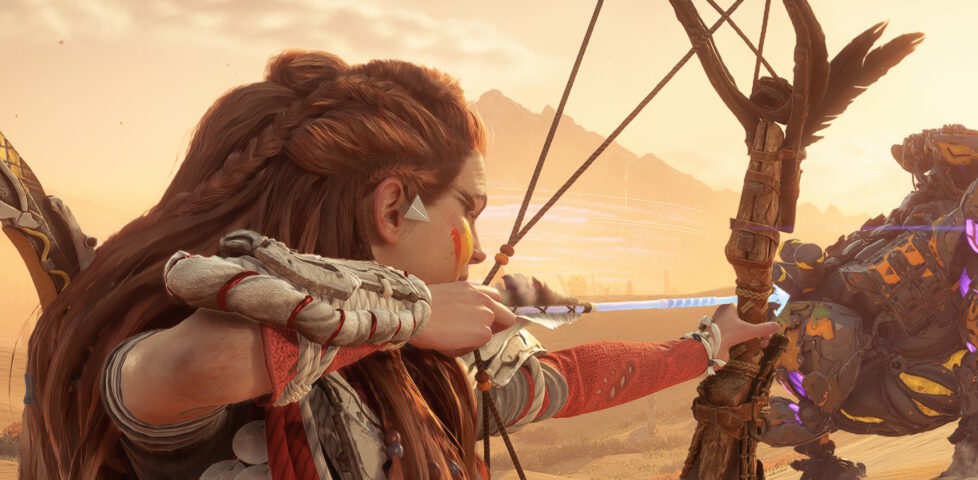
Aloy aims a precision longbow at a Tremortusk, an elephant-like machine, in a sunny desert environment.
Horizon: Forbidden West is like Zero Dawn but… more. More quests, more exploration, more machines, more characters, and more of the same story, answering questions you might have found yourself thinking during the prequel. But it’s not just more-of-the-same.

Forbidden West is in some ways more-of-the-same, but it outgrows the mould of its predecessor, too. Faced with bigger challenges than she can take on by herself, Aloy comes to assemble a team of trusted party members, and when you’re not out fighting giant robots or spelunking underwater caves or exploring the ruins of ancient San Francisco you’re working alongside them, and that’s one of the places the game really shines. Your associates chatter to each other, grow and change, and each brings something special to the story that invites you to care for each of them as individuals.

The musical score – cinematic in its scope – has been revamped too, and shows off its ability to adapt dynamically to different situations. Face off against one of the terrifying new aquatic enemies and you’ll be treated to a nautical theme, for example. And the formulaic quests of the predecessor (get to the place, climb the thing…), which were already fine, are riddled with new quirks and complexities to keep you thinking.

And finally: I love the game’s commitment to demonstrating the diversity of humanity: both speaking and background characters express a rarely-seen mixture of races, genders, and sexualities, and the story sensitively and compassionately touches on issues of disability, neurodiversity, and transgender identity. It’s more presence than representation (“Hey look, it’s Sappho and her friend!”), but it’s still much better than I’m used to seeing in major video game releases.

Thank Goodness You’re Here!

If ever I need to explain to an American colleague why that one time they visited London does not give them an understanding of what life is like in the North of England… this is the videogame I’ll point them at.

Main menu for Thank Goodness You're Here, featuring options "Gu On Then", "Faff", and "Si' Thi", superimposed on a picture of a street in Barnsley, Yorkshire.
Among the many language options available for the game are “English”, as you’d probably expect, and “Dialect”, which imposes a South Yorkshire accent to everything, as illustrated here by the main menu.

A short, somewhat minigame-driven, absurd to the point of Monty Python-ism, wildly British comedy game, Thank Goodness You’re Here! is a gem. It’s not challenging by any stretch of the imagination, but that only serves to turn focus even more on the weird and wonderful game world of Barnsworth (itself clearly inspired by real-world Barnsley).

Playing a salesman sent to the town to meet the lord mayor, the player ends up stuck with nothing to do4, and takes on a couple of dozen odd-jobs for the inhabitants of the town, meeting a mixed bag of stereotypes and tropes as they go along.

Hand-drawn advertisement for Big Ron's Big Pies (Barnsworth's Best since 1904).
Ahm gowin t’shop to gi’ sumof Big Ron’s Big Pies! Y’wanout, buggerlugs? Players without a grounding in Yorkshire English, and especially non-Brits, might benefit from turning the subtitles on.

Presented in a hand-drawn style that’s as distinctive and bizarre as it is an expression of the effort that must’ve gone into it, this game’s clearly a project of passion for Yorkshire-based developers Coal Supper (yes, that’s really what they call themselves). I particularly enjoyed a recurring joke in which the player is performing some chore (mowing grass for the park keeper, chopping spuds at the chippy) when the scene cuts to some typically-inanimate objects having a conversation (flowers, potatoes) while the player’s actions bring them closer and closer in the background. But it’s hard to pick out a very favourite part from this wonderful, crazy, self-aware slice of Northern life in game form.

Tactical Breach Wizards

Finally, I’ve got to sing the praises of Tactical Breach Wizards by Suspicious Developments (who for some reason don’t bother to list it on their website; the closest thing to an official page for the project other than its Steam entry might be this launch announcement!)5, the team behind Gunpoint and Heat Signature.

The game feels like a cross between XCOM/Xenonauts‘ turn-based tactical combat and Rainbow Six‘s special ops theme. Except instead of a squad of gun-toting body-armoured military/police types, your squad is a team of wizards in a world in which magical combat specialists work alongside conventionally-equipped soldiers on missions where their powers make all the difference.

Jen, the Storm Witch, throws a bolt of lightning through three enemies on a moving train carriage.
Jen the Storm Witch primarily uses large static shocks to fling targets around: relatively harmless, unless she and her teammates have arranged for/tricked enemies to be standing next to something they can be thrown into… or near a window they can be flung out of!

By itself, that could be enough: there’s certainly sufficient differences between all of the powers that the magic users exploit that you’ll find all kinds of ways to combine them. How about having your teleport-capable medic blink themselves to a corner so your witch’s multi-step lightning bolt can use them as a channel to get around a corner and zap a target there? Or what about using the time-manipulation powers of your Navy Seer (yes, really) to give your siege cleric enough actions that they can shield-push your opponent within range of the turret you hacked? And so on.

But Tactical Breach Wizards, which stands somewhere between a tactical squad-based shooter and a deterministic positional puzzle game, goes beyond that by virtue of its storytelling. Despite the limitations of the format, the game manages to pack in a lot of background and personality for every one of your team and even many of the NPCs too (Steve Clark, Traffic Warlock is a riot). Oh, and much of the dialogue is laugh-out-loud funny, to boot.

Three spec ops wizards have a conversation about an upcoming assault.
The dialogue between your teammates – most of it right as they’re about to breach a door – reads like lighthearted banter but exposes the underpinning backstory of the setting.

The writing’s great, to the extent that when I got to the epilogue – interactive segments during the credits where you can influence “what happens next” to each of the characters you’ve come to know – I genuinely flip-flopped on a few of them to give some of them a greater opportunity to continue to feature in one another’s lives. Even though the game was clearly over. It’s that compelling.

And puzzling out some of the tougher levels, especially if you’re going for the advanced (“Confidence”) challenges, too, is really fun. But with autosaves every turn, the opportunity to skip and return to levels that are too challenging, and a within-turn “undo” feature that lets you explore different strategies before you commit to one, this is a great game for someone who, like me, doesn’t have much time to dedicate to play.


So yeah: that’s what I’ve been up to in videogaming-time so far this year. Any suggestions for the autumn/winter?

Footnotes

1 If a game loads quickly that’s a bonus. I still play a little of my favourite variant of the Sid Meier’s Civilization series – that is, Civilization V + Vox Populi (alongside a few quality-of-life mods) but I swear I’d play more of it if it didn’t take so long to load. Even after hacking around it to dodge the launcher, logos, and introduction, my 8P+4E-core i7 processor takes ~80 seconds from clicking to launch the game to having loaded my latest save, which if I’m only going to have time to play three turns is frustratingly long! Contrast Horizon: Forbidden West, which I also mention in this post, a game 13 years younger and with much higher hardware requirements, which takes ~17 seconds to achieve the same. Possibly I’m overanalysing this…

2 This isn’t a criticism of the Elder Scrolls games specifically, but of the relatively-lazy writing that goes into some videogames that feel like they’re using Perchance to come up with their quests, in order to stretch the gameplay. I suppose a better example might have been the on-the-whole disappointment that was Starfield, but I figured an Elder Scrolls reference might be easier to identify at-a-glance. Fetch-questing 100 tonnes of Beryllium just doesn’t have the same ring to it.

3 In fact, if you’re trying to consume the Horizon story as thoroughly as possible and strictly in chronological order, you probably should read the graphic novel between one and the other, which covers some of the events that occur between the two.

4 Did you ever see the alternate ending to Far Cry 4, by the way? If you did, you might appreciate that a similar trick can be used to shortcut Thank Goodness You’re Here! too…

5 They’re also missing a trick by using the domain they’ve registered, wizards.cool, only to redirect to Steam.

× × × × × ×

Quarter Life Crisis

This is a repost promoting content originally published elsewhere. See more things Dan's reposted.

This repost was published in hindsight, on 11 March 2019.

Claire wrote:

I’ve been having feelings of general worthlessness and pointless recently, which Dan has dubbed my “quarter life crisis”. Basically, I’m 20, and I’m supposed to be all adult, and useful to the world. I didn’t want to ever grow up. I have very little to show for my twenty years of life, I don’t do anything much that affects the world at large or even my own little world. I feel like I’ve floated through life so far, like a piece of driftwood, or an electron – taking the line of least resistance all the way.

This is going to change. As I said to Dan yesterday, it’s all worthless and pointless when all I do is think about how worthless and pointless it all is. So, bored of being a whining teenager, and wanting to justify my own existance, I’m going to DO things. Less talk, more doing, thinking, travelling, experiencing.

I’ve begun to enjoy working at McDonalds, sadly, but i still need a job where I can earn more for doing less so that I don’t feel constantly tired.

Rant of the day: Bruises, scrapes and burns.
Not a work-day goes by where I don’t injure myself in some way. Some of this, I admit, could be put down to general clumsiness on my part but I know people who’ve been there longer than I who have more scars. The fry station – hot fat, hot baskets, hot fries, hot metal everywhere, and I have to move fries about quickly and accurately. The floor – always slippy for some reason, my “regulation” flat bottomed shoes have little grip. The spatulas – metal, sharp, hot. I have a bruise on my leg from turning too quickly and knocking “Archie” (the fry machine) when I’d taken off the guards to clean him. The boiling water that comes out of the tap for tea. It hurts. There’s no way to keep safe, especially when you have to work so quickly. But, they put “Wet floor” signs and “Careful, it’s hot” everywhere, so it’s all ok.

But as I said. Less talk. More do.