You will gain 50 Windows XP
This is a repost promoting content originally published elsewhere. See more things Dan's reposted.
This is a repost promoting content originally published elsewhere. See more things Dan's reposted.
This is a repost promoting content originally published elsewhere. See more things Dan's reposted.
Something that jumped at me, recently, was a rendering dilemma that browsers have to encounter, and gracefully handle, on a day-by-day basis with little, to no, standardization.
Take the following page for example. You have 4 floated divs, each with a width of 25%, contained within a parent div of width 50px. Here’s the question: How wide are each of the divs?
The problem lies in the fact that each div should be, approximately, 12.5px wide and since technology isn’t at a level where we can start rendering at the sub-pixel level we tend to have to round off the number. The problem then becomes: Which way do you round the number? Up, down, or a mixture of the two? I think the results will surprise you, as they did me…
This is a repost promoting content originally published elsewhere. See more things Dan's reposted.
Some people think that usability is very costly and complex and that user tests should be reserved for the rare web design project with a huge budget and a lavish time schedule. Not true. Elaborate usability tests are a waste of resources. The best results come from testing no more than 5 users and running as many small tests as you can afford.
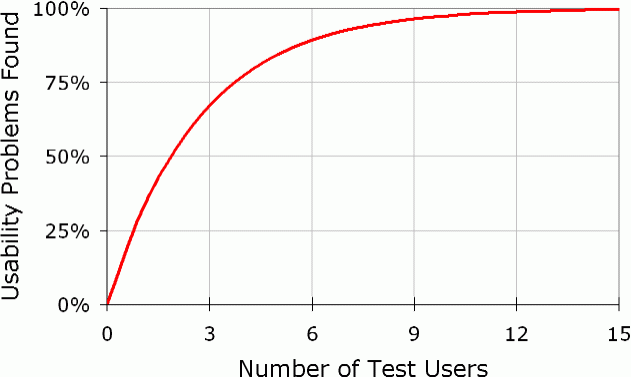
In earlier research, Tom Landauer and I showed that the number of usability problems found in a usability test with n users is:
N (1-(1- L ) n )
where N is the total number of usability problems in the design and L is the proportion of usability problems discovered while testing a single user. The typical value of L is 31%, averaged across a large number of projects we studied. Plotting the curve for L =31% gives the following result…
This is a repost promoting content originally published elsewhere. See more things Dan's reposted.
Software engineers go crazy for the most ridiculous things. We like to think that we’re hyper-rational, but when we have to choose a technology, we end up in a kind of frenzy — bouncing from one person’s Hacker News comment to another’s blog post until, in a stupor, we float helplessly toward the brightest light and lay prone in front of it, oblivious to what we were looking for in the first place.
This is not how rational people make decisions, but it is how software engineers decide to use MapReduce…
This is a repost promoting content originally published elsewhere. See more things Dan's reposted.
This is a repost promoting content originally published elsewhere. See more things Dan's reposted.
Theresa May looks set to launch wide-ranging internet regulation and plans to fundamentally change how technology works despite not having won a majority.
In the speech in which she committed to keep governing despite calls to stand down, the prime minister made reference to extending powers for the security services. Those powers – which include regulation of the internet and forcing internet companies to let spies read everyone’s private communications – were a key part of the Conservative campaign, which failed to score a majority in the House of Commons.
In the speech, given in Downing Street after losing her majority but still looking to form a government, she laid out a series of plans that she hopes to carry out at what she called a “critical time for our country”…
This is a repost promoting content originally published elsewhere. See more things Dan's reposted.
This is a repost promoting content originally published elsewhere. See more things Dan's reposted.
Of the many, many, many bad things about passwords, you know what the worst is? Password rules.
If we don’t solve the password problem for users in my lifetime I am gonna haunt you from beyond the grave as a ghost pic.twitter.com/Tf9EnwgoZv
— Jeff Atwood (@codinghorror) August 11, 2015
Let this pledge be duly noted on the permanent record of the Internet. I don’t know if there’s an afterlife, but I’ll be finding out soon enough, and I plan to go out mad as hell…
This is a repost promoting content originally published elsewhere. See more things Dan's reposted.
This is a repost promoting content originally published elsewhere. See more things Dan's reposted.
This is a repost promoting content originally published elsewhere. See more things Dan's reposted.
This is a repost promoting content originally published elsewhere. See more things Dan's reposted.
Imagine I’m in a desert, and there are two wells where I can obtain water. If I want to go to the nearest well, which well do I visit? Clearly, it depends one where I am standing. It’s possible to draw a line dividing the desert. To the ‘left’ of the line, it’s nearer to go to the well on the well on the ‘left’, to the ‘right’ of the line, it’s closer to go to the well on the ‘right’…
This is a repost promoting content originally published elsewhere. See more things Dan's reposted.
This is a repost promoting content originally published elsewhere. See more things Dan's reposted.
This is a repost promoting content originally published elsewhere. See more things Dan's reposted.