This white paper describes our current position on quantum key distribution (QKD). QKD is an approach to key distribution that relies on the properties of quantum mechanics to
provide security.
…
For all the practical, business and security reasons given above, at this point in time we:
do not endorse QKD for any government or military applications
advise against replacing any existing public key solutions with QKD for commercial applications
The UK should continue its research and development of QKD systems. But this should be balanced by a growing body of practical QKD vulnerability research, and accompanied by the
development of methods for quantifying and validating the security claims of real-world QKD systems. Responsible innovation should be accompanied by independent validation.
…
Wise words from the NCSC here:while QKD continues to depend upon conventional components that often lack battle-testing they may have vulnerabilities. Furthermore, current
implementations of quantum cryptography fail to address the bigger and harder problems of authentication and identity – key distribution, while not perfectly solved, is still
something that we understand very well… and many real-world attacks target other parts of the process (which QKD does not seek to solve).
Either I’m getting older or movies are getting longer… and longer … and longer. So which is it? I took a look at the numbers. I studied the running time of
the top 100 US-grossing films since 1994 (2,200 films in total) and all films shot in the UK 2005-14 (2,142 films). In summary… The median length of …
Either I’m getting older or movies are getting longer… and longer … and longer. So which is it? I took a look at the numbers.
I studied the running time of the top 100 US-grossing films since 1994 (2,200 films in total) and all films shot in the UK 2005-14 (2,142 films). In summary…
The median length of a top 100 US-grossing films between 1994 and 2015 was 110 minutes
Running times have increased in six of the past seven years
The longest films are historical and western films and the shortest are animations and documentaries.
Peter Jackson makes the longest movies in Hollywood, with a median running time of 169 minutes.
The median running time of UK feature films (2008-14) was 94 minutes.
Films with lower budgets have shorter running times
The complete extended Lord of the Rings and Hobbit trilogies are a combined 21 hours long
…
It’s reassuring to read that I wasn’t the only one to observe this trend in filmmaking, and to find that somebody else had done the research to save me from feeling the need to do so
myself! The full article also makes a number of other interesting observations; worth a read.
My home computer in 1998 had a 56K modem connected to our telephone line; we were allowed a maximum of thirty minutes of computer usage a day, because my parents — quite reasonably
— did not want to have their telephone shut off for an evening at a time. I remember webpages loading slowly: ten […]
My home computer in 1998 had a 56K modem connected to our telephone line; we were allowed a maximum of thirty minutes of computer usage a day, because my parents — quite reasonably —
did not want to have their telephone shut off for an evening at a time. I remember webpages loading slowly: ten to twenty seconds for a basic news article.
At the time, a few of my friends were getting cable internet. It was remarkable seeing the same pages load in just a few seconds, and I remember thinking about the kinds of the
possibilities that would open up as the web kept getting faster.
And faster it got, of course. When I moved into my own apartment several years ago, I got to pick my plan and chose a massive fifty megabit per second broadband connection, which I
have since upgraded.
So, with an internet connection faster than I could have thought possible in the late 1990s, what’s the score now? A story at the Hill took over
nine seconds to load; at Politico, seventeen seconds; at CNN, over thirty seconds. This is the
bullshit web.
But first, a short parenthetical: I’ve been writing posts in both long- and short-form about this stuff for a while, but I wanted to bring many threads together into a single document
that may pretentiously be described as a theory of or, more practically, a guide to the bullshit web.
A second parenthetical: when I use the word “bullshit” in this article, it isn’t in a profane sense. It is much closer to Harry Frankfurt’s definition in “On Bullshit”:
It is just this lack of connection to a concern with truth — this indifference to how things really are — that I regard as of the essence of bullshit.
In the year 1930, John Maynard Keynes predicted that, by century’s end, technology would have advanced sufficiently that countries like Great Britain or the United States would have
achieved a 15-hour work week. There’s every reason to believe he was right. In technological terms, we are quite capable of this. And yet it didn’t happen. Instead, technology has
been marshaled, if anything, to figure out ways to make us all work more. In order to achieve this, jobs have had to be created that are, effectively, pointless. Huge swathes of
people, in Europe and North America in particular, spend their entire working lives performing tasks they secretly believe do not really need to be performed. The moral and
spiritual damage that comes from this situation is profound. It is a scar across our collective soul. Yet virtually no one talks about it.
[…]
These are what I propose to call ‘bullshit jobs’.
What is the equivalent on the web, then?
…
This, this, a thousand times this. As somebody who’s watched the Web grow both in complexity and delivery speed over the last quarter century, it apalls me that somewhere along the way
complexity has started to win. I don’t want to have to download two dozen stylesheets and scripts before your page begins to render – doubly-so if those additional
files serve no purpose, or at least no purpose discernable to the reader. Personally, the combination of uMatrix and Ghostery is all the adblocker I need (and I’m more-than-willing to add a little userscript to “fix” your site if it tries to sabotage my use of these
technologies), but when for whatever reason I turn these plugins off I feel like the Web has taken a step backwards while I wasn’t looking.
After The Obsuritory – a blog providing reviews of old and less-well-known video games – published a
review of 1994’s Wolf, they followed-up with this additional review… written for a wolf.
Previous Page
Dark Science #85 is almost finished, but in the meantime enjoy this interlude comic with indispensable cyborg knowledge! Enjoy Dresden Codak? Become a Patreon subscriber today!
http://dresdencodak.com/wp-content/plugins/patron-button-and-widgets-by-codebard/images/patreo…
Dresden Codak is one of the most fabulous (but strange) webcomic series, and it’s great to see this quirky “aside” piece.
It's a psychological quirk that when something becomes rarer, people may spot it in more places than ever. What is the 'concept creep' that lets context change how we categorize the
world around us?
Why do many problems in life seem to stubbornly stick around, no matter how hard people work to fix them? It turns out that a quirk in the way human brains process information means
that when something becomes rare, we sometimes see it in more places than ever.
Think of a “neighborhood watch” made up of volunteers who call the police when they see anything suspicious. Imagine a new volunteer who joins the watch to help lower crime in the
area. When they first start volunteering, they raise the alarm when they see signs of serious crimes, like assault or burglary.
Let’s assume these efforts help and, over time, assaults and burglaries become rarer in the neighborhood. What would the volunteer do next? One possibility is that they would relax
and stop calling the police. After all, the serious crimes they used to worry about are a thing of the past.
But you may share the intuition my research group had – that many volunteers in this situation wouldn’t relax just because crime went down. Instead, they’d start calling things
“suspicious” that they would never have cared about back when crime was high, like jaywalking or loitering at night.
You can probably think of many similar situations in which problems never seem to go away, because people keep changing how they define them. This is sometimes called “concept creep,” or “moving the goalposts,” and it can be a frustrating experience. How can you know if you’re making progress
solving a problem, when you keep redefining what it means to solve it? My colleagues and I wanted to understand when this kind
of behavior happens, why, and if it can be prevented.
After violent crime starts going down, loiterers and jaywalkers may start to seem more threatening.Marc Bruxelle/Shutterstock.com
Looking for trouble
To study how concepts change when they become less common, we brought volunteers into our laboratory and gave them a
simple task – to look at a series of computer-generated faces and decide which ones seem “threatening.” The faces had been carefully
designed by researchers to range from very intimidating to very harmless.
As we showed people fewer and fewer threatening faces over time, we found that they expanded their definition of “threatening” to include a wider range of faces. In other words,
when they ran out of threatening faces to find, they started calling faces threatening that they used to call harmless. Rather than being a consistent category, what people
considered “threats” depended on how many threats they had seen lately.
This kind of inconsistency isn’t limited to judgments about threat. In another experiment, we asked people to make an even simpler decision: whether colored dots on a screen were
blue or purple.
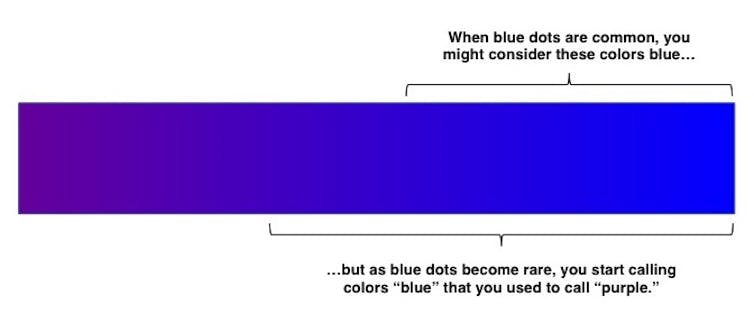
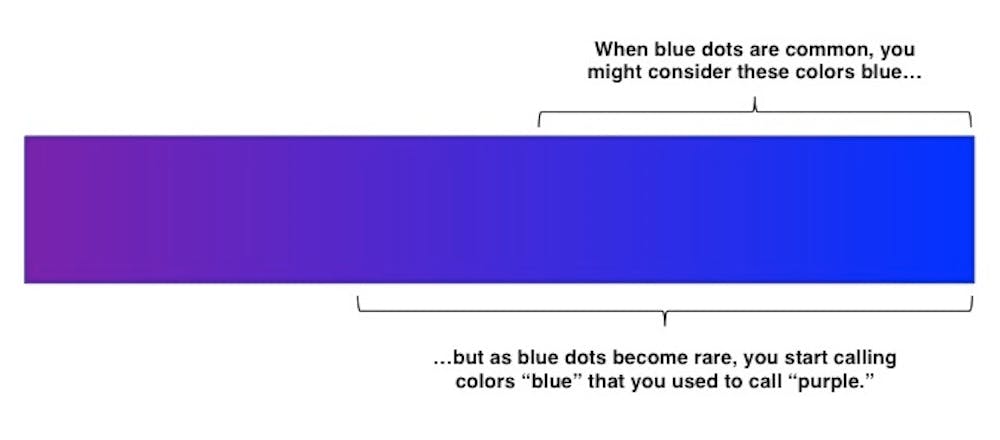
As the context changes, so do the boundaries of your categories.David Levari, CC BY-ND
As blue dots became rare, people started calling slightly purple dots blue. They even did this when we told them blue dots were going to become rare, or offered them cash prizes to
stay consistent over time. These results suggest that this behavior isn’t entirely under conscious control – otherwise, people would have been able to be consistent to earn a cash
prize.
Expanding what counts as immoral
After looking at the results of our experiments on facial threat and color judgments, our research group wondered if maybe this
was just a funny property of the visual system. Would this kind of concept change also happen with non-visual judgments?
To test this, we ran a final experiment in which we asked volunteers to read about different scientific studies, and decide which were ethical and which were unethical. We were
skeptical that we would find the same inconsistencies in these kind of judgments that we did with colors and threat.
Why? Because moral judgments, we suspected, would be more consistent across time than other kinds of judgments. After all, if you think violence is wrong today, you should still
think it is wrong tomorrow, regardless of how much or how little violence you see that day.
But surprisingly, we found the same pattern. As we showed people fewer and fewer unethical studies over time, they started calling a wider range of studies unethical. In other
words, just because they were reading about fewer unethical studies, they became harsher judges of what counted as ethical.
The brain likes to make comparisons
Why can’t people help but expand what they call threatening when threats become rare? Research from cognitive psychology and neuroscience suggests that this kind of behavior is a
consequence of the basic way that our brains process information – we are constantly comparing what is front of us to its recent
context.
Instead of carefully deciding how threatening a face is compared to all other faces, the brain can just store how threatening it is compared to other faces it has seen recently, or compare it to some average
of recently seen faces, or the most and least threatening faces it has seen. This kind of comparison could lead directly to the
pattern my research group saw in our experiments, because when threatening faces are rare, new faces would be judged relative to mostly harmless faces. In a sea of mild faces, even
slightly threatening faces might seem scary.
It turns out that for your brain, relative comparisons often use less energy than absolute measurements. To get a sense
for why this is, just think about how it’s easier to remember which of your cousins is the tallest than exactly how tall each cousin is. Human brains have likely evolved to use relative comparisons in many situations, because these comparisons often provide enough information to safely navigate our
environments and make decisions, all while expending as little effort as possible.
Being consistent when it counts
Sometimes, relative judgments work just fine. If you are looking for a fancy restaurant, what you count as “fancy” in Paris, Texas, should be different than in Paris, France.
But a neighborhood watcher who makes relative judgments will keep expanding their concept of “crime” to include milder and milder transgressions, long after serious crimes have
become rare. As a result, they may never fully appreciate their success in helping to reduce the problem they are worried about. From medical diagnoses to financial investments,
modern humans have to make many complicated judgments where being consistent matters.
How can people make more consistent decisions when necessary? My research group is currently doing follow-up research in the lab to develop more effective interventions to help
counter the strange consequences of relative judgment.
One potential strategy: When you’re making decisions where consistency is important, define your categories as clearly as you can. So if you do join a neighborhood watch, think
about writing down a list of what kinds of transgressions to worry about when you start. Otherwise, before you know it, you may find yourself calling the cops on dogs being walked
without leashes.
I remember when this advertisement did its original run and I loved it. I was delighted to accidentally stumble across it on the Web recently; if you haven’t seen it before (and even if
you have) you should give it a watch…
The unprecedented spell of hot, dry weather across Wales has provided perfect conditions for archaeological aerial photography. As the drought has persisted across Wales, scores of
long-buried archaeological sites have been revealed once again as ‘cropmarks’, or patterns of growth in ripening crops and parched grasslands. The Royal Commission’s aerial
investigator Dr Toby Driver has been busy in the skies across mid and south Wales over the last week documenting known sites in the dry conditions, but also discovering hitherto lost
monuments. With the drought expected to last at least another two weeks Toby will be surveying right across north and south Wales in a light aircraft to permanently record these
discoveries for the National Monuments Record of Wales, before thunderstorms and rain wash away the markings
until the next dry summer.
There comes a time when people at a technical conference like this need something more relaxing. A change of pace. A shift of style. To put aside all that work stuff and think of
something refreshingly different.
So let’s talk about coding theory. There are perhaps some of you here tonight who are not experts in coding theory, but rather have been dragged here kicking and screaming. So I
thought it would be a good idea if I gave you a sort of instant, five minute graduate course in coding theory.
Coding theorists are concerned with two things. Firstly and most importantly they are concerned with the private lives of two people called Alice and Bob. In theory papers, whenever a
coding theorist wants to describe a transaction between two parties he doesn’t call then A and B. No. For some longstanding traditional reason he calls them Alice and Bob.
Now there are hundreds of papers written about Alice and Bob. Over the years Alice and Bob have tried to defraud insurance companies, they’ve played poker for high stakes by mail, and
they’ve exchanged secret messages over tapped telephones.
If we put together all the little details from here and there, snippets from lots of papers, we get a fascinating picture of their lives. This may be the first time a definitive
biography of Alice and Bob has been given.
In papers written by American authors Bob is frequently selling stock to speculators. From the number of stock market deals Bob is involved in we infer that he is probably a
stockbroker. However from his concern about eavesdropping he is probably active in some subversive enterprise as well. And from the number of times Alice tries to buy stock from him
we infer she is probably a speculator. Alice is also concerned that her financial dealings with Bob are not brought to the attention of her husband. So Bob is a subversive stockbroker
and Alice is a two-timing speculator.
But Alice has a number of serious problems. She and Bob only get to talk by telephone or by electronic mail. In the country where they live the telephone service is very expensive.
And Alice and Bob are cheapskates. So the first thing Alice must do is MINIMIZE THE COST OF THE PHONE CALL.
The telephone is also very noisy. Often the interference is so bad that Alice and Bob can hardly hear each other. On top of that Alice and Bob have very powerful enemies. One of their
enemies is the Tax Authority. Another is the Secret Police. This is a pity, since their favorite topics of discussion are tax frauds and overthrowing the government.
These enemies have almost unlimited resources. They always listen in to telephone conversations between Alice and Bob. And these enemies are very sneaky. One of their favorite tricks
is to telephone Alice and pretend to be Bob.
Well, you think, so all Alice has to do is listen very carefully to be sure she recognizes Bob’s voice. But no. You see Alice has never met Bob. She has no idea what his voice sounds
like.
So you see Alice has a whole bunch of problems to face. Oh yes, and there is one more thing I forgot so say – Alice doesn’t trust Bob. We don’t know why she doesn’t trust him, but at
some time in the past there has been an incident.
Now most people in Alice’s position would give up. Not Alice. She has courage which can only be described as awesome. Against all odds, over a noisy telephone line, tapped by the tax
authorities and the secret police, Alice will happily attempt, with someone she doesn’t trust, whom she cannot hear clearly, and who is probably someone else, to fiddle her tax
returns and to organize a coup d’etat, while at the same time minimizing the cost of the phone call.
A coding theorist is someone who doesn’t think Alice is crazy.
…
I’ve always been a fan of the “expanded universe” of cyptography placeholders Alice & Bob, and this humorous speech –
partially-reproduced here – is a great example of Alice & Bob headcanon at its best.
Fabulous explanation of the Strong Equivalence Principle coupled with a nice bit of recent research to prove that it holds true even in extreme gravitational fields (and therefore
disproving a few interesting fringe theories). It’s hard science made to enjoy like pop science: yay! Plus a Hitch-Hiker’s Guide to the Galaxy reference, to boot. Under 10,000
views; go show them some love.