Wikipedia @ 25: Carl Person

Duration

Podcast Version

This post is also available as a podcast. Listen here, download for later, or subscribe wherever you consume podcasts.

To celebrate the site’s 25th birthday this year, Wikipedia is encouraging/challenging people to read one Wikipedia article a day for 25 consecutive days. I felt that I could do one better than that: not only reading an article but – where I found one that was particularly interesting – to write a blog post or record a podcast episode for each of those days, sharing what I learned. For each entry, I’ll hit “random article” a few times until something catches my interest, start reading, and then start writing! Everything I’ve written below came from Wikipedia… so you should check other sources before you use it to do your homework. Happy birthday, Wikipedia!


Today’s random article: Carl Person
Today’s topic: Carl Person

Just sometimes when you’re playing the “hey, Wikipedia, give me a random page” game, you get a hole in one. That’s what happened today when I landed on the article for… Carl Person.

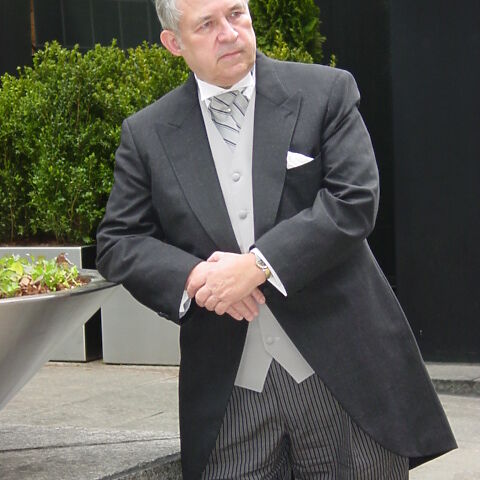
Carl Person, an older white man with receding grey-white hair, wearing a smart three-piece suit, leans against a planter in an marbled ornamental garden.
Whatever else you can say about him, he looks pretty dapper in a suit. Photo courtesy Carl Person, used under a Creative Commons license. Knowing that he has a Wikipedia account (which he used to upload this photo), I took the time to browse the article history and check for any obvious signs of tampering, sockpuppetry, or other foul play, but it looks reasonably clean.

Yes, Person is his actual surname. Speaking as a person with a stupid name, it pleases me to find people whose names probably cause them at least as much trouble as mine does. Wikipedia wasn’t any help at understanding where the surname Person comes from (and Carl himself isn’t even noteworthy enough to appear on the list of “notable people with that surname”, it seems).

However I did enjoy discovering jazz saxophonist Houston Person (which sounds like the beginning of a news headline about somebody from Houston!) who once released an album called… Person to Person! Excellent. Also, actress and filmmaker Marina Person whose documentary about her father, filmmaker Luis Sérgio Person, was titled simply Person. I think the name might be related to Swedish surname Persson – literally, “son of Per” – where Per is a Scandinavian variant of Peter. This probably means that there’s a “Per Person” somewhere in the world, and I want to meet him.

Anyway: back to Carl. He trained as a lawyer and spent the 1960s working in a variety of corporate law firms. These included the one for which Richard Nixon was a partner, during that period after Nixon failed to get elected as Governor of California and announced that he was retiring from politics… only to come back six years later to be elected president and, well, you know the rest.

The interesting bits of Carl’s career came later.

After the American Bar Association endorsed the concept of a paralegal in 1967, Person founded the Paralegal Institute, a name that’s so-polluted with people using it that even the closest-named Wikipedia article seems to be talking about something similar… but different. (This seems to be pretty much par for the course in the American paralegal system, though: did you know that a “certified paralegal” and a “certificated paralegal” are two completely distinct and non-interchangeable things?)

A brown-skinned woman sits at a desk surrounded by binders of paperwork.
Paralegals! All of the work; a fraction of the pay!

Anyway: other things he did as part of his legal career were –

  • Represented other members of The Teenagers (then The Premiers, because confusingly the band changed their name to “The Teenagers” when they got older) in their efforts to reclaim shared copyright of their 1956 hit Why Do Fools Fall in Love from lead singer Frankie Lymon and Gee Records.
  • Represented playwright Mark Dunn in his successful claim that The Truman Show was based upon his 1992 play, Frank’s Life, whose script he’d previously attempted to sell to Paramount.
  • Helped Ralph Anspach (whose book I read before writing this 2013 blog post!) in his appeal against a ruling that Anspach’s board game Anti-Monopoly was derivative of Parker Brothers‘ stake in Monopoly: the appeal was successful at least in part because Person and Anspach were able to prove that Monopoly was, itself, derived from Lizzie Magie‘s The Landlord’s Game. (Fun fact: this was the second time Carl successfully took on Parker Brothers; the first being the Masterpiece case, representing Christian Thee!)

In 2012 Person put himself forward to be the Libertarian candidate for the presidential election, losing out to Gary Johnson (who had in turn switched sides after he realised he wasn’t going to become the Republican nominee). Gary Johnson eventually got 0.99% of the popular vote, almost breaking the 1% barrier that only 33 third-party candidates have ever achieved in US history.

Not a bad bit of reading for a hole-in-one article.

Wikipedia @ 25: Wesley Merritt

Duration

Podcast Version

This post is also available as a podcast. Listen here, download for later, or subscribe wherever you consume podcasts.

To celebrate the site’s 25th birthday this year, Wikipedia is encouraging/challenging people to read one Wikipedia article a day for 25 consecutive days. I felt that I could do one better than that: not only reading an article but – where I found one that was particularly interesting – to write a blog post or record a podcast episode for each of those days, sharing what I learned. For each entry, I’ll hit “random article” a few times until something catches my interest, start reading, and then start writing! Everything I’ve written below came from Wikipedia… so you should check other sources before you use it to do your homework. Happy birthday, Wikipedia!


Today’s random article: Governor-General of the Philippines
Today’s topic: Wesley Merritt

The Philippines spent a lot of modern history under colonial rule:

  • First, from 1565, by the Spanish out of their Viceroyalty of New Spain (Mexico).
  • Then by the British for a few years who captured it after Spain sided with France in the Seven Years War.
  • Then back to Spain at the signing of the 1763 Treaty of Paris, where, when Britain was arguing which captured territories it should be allowed to keep, everybody forgot about it and so it fell into the default bucket of “back to its previous controller”: it seems that Spain hadn’t even noticed that Manilla had been captured!
  • Then, after the Mexican War of Independence… still under Spain, but now directly under the Spanish crown and managed from Madrid.
  • And finally, courtesy of the 1898 Treaty of Paris, under the United States (with the exception of the period during which it was occupied by Japan).
  • The Philippines finally gained independence in 1946.
The US flag is lowered and the Philippine flag is raised.
The Flag of the United States of America is lowered while the Flag of the Philippines is raised during the Independence Day ceremonies on July 4, 1946.

As you might expect if you know anything about colonialism, there are absolutely horrible stories that could be told about any of those periods of history. So when I landed on the page Governor-General of the Philippines, I decided that it might be cheerier to pick out a person from it.

And so I picked what I believe to be the person whose term as Governor-General of the Philippines was shortest: in post for just 16 days in August 1898: Wesley Merritt.

Portrait photograph of a young white man in military uniform.
Gen. Wesley Merritt, circa 1865.

Wesley was a cavalryman in the American Civil War during which, in 1863, he managed to leapfrog three ranks by getting promoted from Captain right up to Brigadier General. After the Civil War he was posted to the Texan frontier where he commanded a cavalry regiment in the American Indian Wars. His success in… umm… “freeing up land” for American settlers (it turns out this post can’t escape from the ugliness of imperialism)… lead him to a new role in using his troops to police the civilians rushing to “claim” land formerly occupied by native Americans.

But it’s right at the end of the 19th century that his story intersects with today’s random article.

Spanish propaganda cartoon showing Uncle Sam standing atop the United States and reaching out his long arms and boney fingers across the Caribbean towards Cuba.
“Uncle Sam’s Craving: Saving the island so it won’t get lost.” says this Spanish propaganda cartoon.

As the 19th century wore on, the world-spanning Spanish Empire came under serious threat. The Napoleonic Wars had cut Spain off from its colonies, and one by one they lost control of Mexico, Peru, Colombia, Chile, Argentina, and others (often with thanks to quiet support from Britain). But Spain had managed to keep hold of Cuba and the Philippines, despite growing unrest and uprisings, which were often brutally suppressed.

Cuba in particular was a major trade partner to the United States, and so the US tried to insert itself as a negotiator in the war between the Cuban independence movement and the Spanish crown.

At the time, the US was working to establish itself as a modern naval power, building new steel warships to compete with European powers and Brazil, and making plans for what would eventually become the Panama Canal, and so this was a perfect opportunity to show off their armoured cruiser the USS Maine.

Cruiser with two funnels, seen from starboard side.
Starboard bow view of USS Maine, shortly before her deployment to Cuba. Fun fact: the last surviving officer who was aboard on the day it sank, Wat Tyler Cluverius Jr., would go on to serve as an engineering officer on the new USS Maine, a pre-dreadnaught battleship that would still be in service at the time of the First World War (although she was only used as a training ship because her coal efficiency was so terrible that it was no-longer sensible to have her cross an ocean).

The Maine got sent to Havana as a show of force and to protect American interests in Cuba, where, a couple of weeks later, she… blew up.

Probably what happened was that the bituminous coal stored in her bunkers was leaking methane out, which spontaneously ignited, starting a fire that ignited the ship’s powder store. But some, including Theodore Roosevelt (who was then assistant navy secretary and on his way to becoming vice-president) and much of the popular press, claimed that the ship must have been struck by a Spanish mine or torpedo.

Newspaper headline and image (The Evening Times, Washington, D.C., U.S., February 16, 1898) reporting sinking of the USS Maine, leading to the Spanish-American War.
Neither the Spanish nor American official reports had been published before the newspapers were claiming that the Maine had been sunk deliberately. Fun fact: the inscription on the monument to the victims that stands in Havana claims it was deliberate… but by the Americans as a false-flag operation to justify a declaration of war against Spain! This interpretation was added by the communist government in 1961.

The next month, after Congress had had a chance to discuss the matter (do you remember when the US Congress used to have to be involved in the US declaring war on another country?), the US declared war on Spain and began actively attacking her fleets and colonies in the Caribbean and the Pacific.

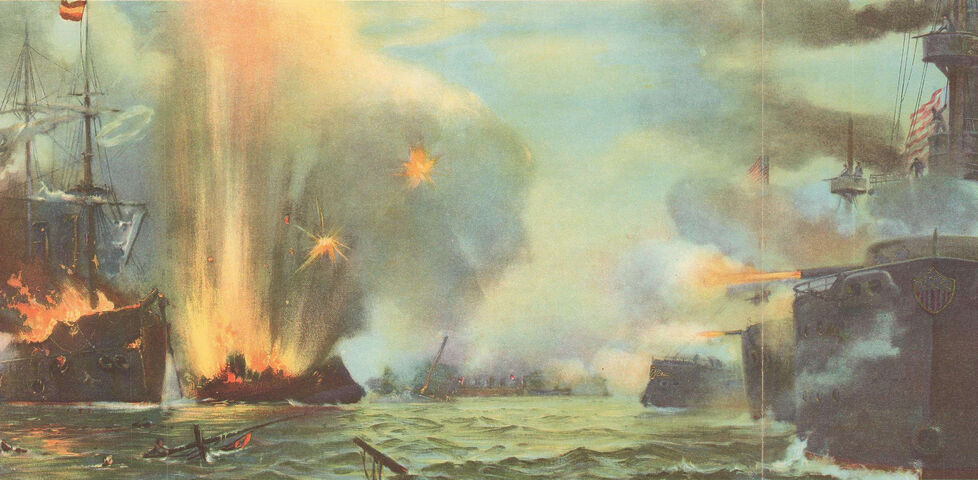
The US fleet steamed into Manilla Bay for what might be the most one-sided naval battle ever. The Spanish fleet at Manilla would have been severely outmatched even were it not for the fact that the second-lead ship was unpowered, the shore batteries’ range was insufficient to be involved, and the mines had been placed suboptimally. Only a single American sailor lost his life in the battle, and it was apparently as a result of a heart attack.

Fanciful patriotic painting showing flaming wooden Spanish warships being bombarded by the guns of a line of steel American battleships.
Battle of Manila Bay by James Gale Tyler (1898).

Okay, we’re at last up to Wesley Merritt‘s bit. Merritt was placed in command of the ground forces that were tasked with capturing Manilla. They sailed out of San Francisco, landed in the Philippines, and prepared to attack the city.

Merritt and Admiral Dewey made a point not to coordinate with Emilio Aguinaldo y Famy, the leader of the Filipino resistance against the Spanish, who by this point had already taken control of most of the Philippines and besieged Manilla, cutting off its water supply and beginning negotiations with the local Spanish leaders. It seems that Americans feared that if the revolutionaries captured the city it would result in significant bloodshed as a result of violent looting and the murder of those who were seen to have collaborated with the Spanish, and so they came up with an alternative plan: the American expeditionary force would attack and capture the city first!

Working through the Belgian consul to Manilla Édouard André, Merritt negotiated with the Spanish Governor-General Fermín Jáudenes to arrange a “mock” battle. The ships in the bay would fire upon a fort that they knew was only used for storage and against defensive walls that they knew they were not capable of breaching, and Spanish troops would be ordered to retreat as Merritt’s soldiers advanced. Then, Merritt would demand that the Spanish surrender the city, and they would comply, turning it over to the American forces.

This would minimise casualties while allowing the Spanish Governor-General to avoid the shame of being seen to have lost the city to the revolutionaries (it being far more politically-acceptable to lose to the might of the American invaders). Meanwhile, Aguinaldo’s troops initially saw the battle as genuine, which led to some casualties as Filipino fighters advanced under fire; they joined the victims of other misunderstandings during the mock battle.

Drawing showing American troops standing at attention on a fort with cannons, as the American flag is raised and the Spanish flag is lowered.
A drawing from Harper’s Pictorial History of the War with Spain. There’s a whole lot of pictures of flags getting rotated in this blog post!

Needless to say, the Filipinos deeply resented being told to stay out of the capital city that, given time, they might well have taken for themselves by force, had their efforts not been leapfrogged by the USA. Ultimately this lead to a guerilla warfare campaign against the USA by Philippine nationalists, which in turn contributed to growing concern in US political circles that America was becoming exactly the kind of imperialist power that it had opposed, at least on paper, since its founding.

Anyway: on 13 August 1898 Wesley Merritt became the de facto Governor-General of the Philippines and the first American to hold that position. Two weeks later Major General Elwell Stephen Otis turned up and relieved him of the position, making Merritt the shortest ever Governor-General of the Philippines.

An older whtie man in military uniform with medals and a sash.
Major General Wesley Merritt from Illustrated Roster of California Volunteer Soliders in the War with Spain (1898).

Merritt retired the next year and lived ten more years.

Anyway: that’s enough of today’s history lesson courtesy of a random Wikipedia page. I wonder what I’ll learn tomorrow! (If it’s as-interesting, I’ll let you know!)

Why there’s no European Google?

This is a repost promoting content originally published elsewhere. See more things Dan's reposted.

The Internet, the interconnection of most of the computers in the world, has existed since the late sixties. But no protocol existed to actually exploit that network, to explore and search for information. At the time, you needed to know exactly what you wanted and where to find it. That’s why the USA tried to develop a protocol called “Gopher.”

At the same time, the “World Wide Web,” composed of the HTTP protocol and the HTML format, was invented by a British citizen and a Belgian citizen who were working in a European research facility located in Switzerland. But the building was on the border with France, and there’s much historical evidence pointing to the Web and its first server having been invented in France.

It’s hard to be more European than the Web! It looks like the Official European Joke! (And, yes, I consider Brits Europeans. They will join us back, we miss them, I promise.)

Google, Microsoft, Facebook may disappear tomorrow. It is even very probable that they will not exist in fourty or fifty years. It would even be a good thing. But could you imagine the world without the Web? Without HTML? Without Linux?

Those European endeavours are now a fundamental infrastructure of all humanity. Those technologies are definitely part of our long-term history.

There are so many ways in which the UK has had to choose – and continues to have to choose – which side of the Atlantic it belongs on: the North American side, or the European side. Legally, politically, financially, culturally… And every time we swing away from Europe, it saddens me.

This wonderful article by Lionel Dricot encapsulates one of many reasons why. European tech culture, compared to that in the USA, leans more open-source, more open-standards, more collaborative. That’s the culture I want more of.

Worth a read.

Note #27758

Obviously I wasn’t planning on going to the US anytime soon, but if I did… they might struggle with my visa application when I put every “email address I’ve used for the last 10 years” on, because I actively use a variety of catch-all domains/subdomains.

I’ve probably missed some addresses (e.g. to which I’ve only ever received spam that’s since been deleted), but a conservative estimate of the number of personal email addresses which I’ve sent mail from or to would be… 7,669 email addresses. 🤣

Hetero Awesome… Hijacked

This is a repost promoting content originally published elsewhere. See more things Dan's reposted.

I somehow missed this “most punk rock thing ever” moment the other month. If you did too, let me catch you up:

For a weekend in June, in what was clearly designed to act as a protest to Pride month events, human turd/bar owner Mark Fitzpatrick decided to put on a “straight pride” festival in Boise, Idaho. Called “Hetero Awesome Fest”, it was as under-subscribed as perhaps it ought to be (having a similar turnout to the “world’s smallest pride parade”). And that would have made it a non-story, except for the moment when local singer-songwriter Daniel Hamrick got up to perform his set:

I can’t begin to fathom the courage it takes to get on-stage in front of an ultra-conservative crowd (well, barely a crowd…) in a right-leaning US state to protest their event by singing a song about a trans boy. But that’s exactly what Hamrick did. After catching spectators off-guard, perhaps, by taking the perhaps-“masculine-telegraphing” step of drawing attention to part of his army uniform, the singer swiftly switched outfit to show off a “Keep Canyon County Queer” t-shirt, slip on a jacket with various Pride-related patches, and then immediately launched into Boy, a song lamenting the persecution of a trans child by their family and community.

Needless to say, this was the first, last, and only song Daniel Hamrick got to play at Hetero Awesome Fest. But man, what a beautiful protest!

(There are other videos online that aren’t nabbed from the official event feed and so don’t cut-out abruptly.)

Voice of America

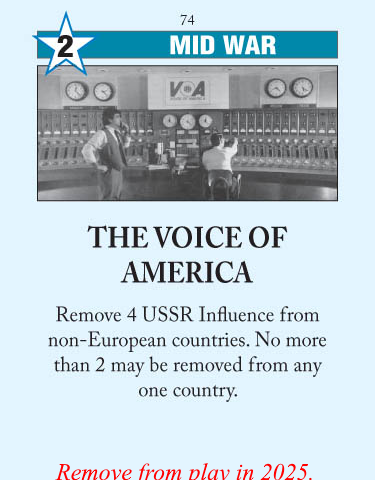
In light of Trump’s attempts to axe Voice of America, because it is, he claims, “anti-Trump” (and because he’s so insecure that he can’t stand the thought that taxpayer dollars might go to anybody who disagrees with him in any way, for any reason), I’ve produced a suggested update to the rules of Twilight Struggle for the inevitable 9th printing:

Twilight Struggle card "The Voice of America", which normally allows the US player to reduce USSR influence in non-European countries. The card has been modified with the additional rule "Remove from play in 2025."
I guess the Russian player gets to stretch their influence unchecked, anywhere they want, from 2025 onwards.
In the game, I mean.

Yet another blow to US soft power in order to appease the ego of convicted felon Donald Trump. Sigh.

×

Trump’s Strategy

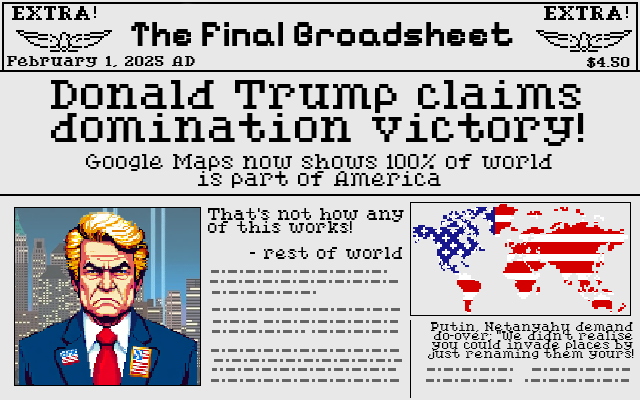
Portrait of Donald Trump in the style of the DOS version of 1991 strategy video game Sid Meier's Civilization, saying: "The Gulf of Mexico shall now be known as the Gulf of America."

Pixel art portrait of Claudia Sheinbaum in Civilization-style, against a background reminiscent of Mexico City, saying: "You're fucking kidding, right?"

Pixel-art of convicted felon Donald Trump, now saying: "We're also renaming the State of Canada, the State of Greenland, and the State of Panama. They all belong to me now."

Newspaper in the style of Sid Meier's Civilization, titled The Final Broadsheet, published February 1 2025 AD. The headline is "Donald Trump claims domination victory", with the subheadline "Google Maps now shows 100% of world is part of America". Below is the pixel-art portrait of Trump and a pixel-art world map with a stars-and-stripes pattern applied to the entire world. A pullquote reads "That's not how any of this works! - rest of world". A secondary story has the headline "Putin, Netanyahu, demand do-over: 'We didn't realise you could invade places by just renaming them yours!'".

What do you reckon? Is he trying to go for a domination victory without ever saying “MY THREATS ARE BACKED BY NUCLEAR WEAPONS!”? His track record shows that he’s arrogant enough to think that the strategy of simply renaming things until they’re yours is actually viable!

After I saw Mexico’s response to Google following Trump’s lead in renaming the Gulf of Mexico, this stupid comic literally came to me in a dream.

Adapts screenshots from Sid Meier’s Civilization (1991 DOS version), public domain assets from OpenGameArt.org, and AI-assisted images of world leaders on account of the fact that if I drew pixel-art world leaders without assistance then you’d be even less-likely to be able to recognise them.

‘All Americans legally female’: Trump invites mockery with sloppy executive order

This is a repost promoting content originally published elsewhere. See more things Dan's reposted.

Obviously all of the 118 executive orders President Trump signed into effect on 20 January fall somewhere on the spectrum between fucking ridiculous and tragically fascist. But there’s a moment of joy to be taken in the fact that now, by Presidential executive order, one could argue that all Americans are legally female:

One of Trump’s order is titled “Defending Women from Gender Ideology Extremism and Restoring Biological Truth to the Federal Government.” In the definition, the order claims, “‘Female’ means a person belonging, at conception, to the sex that produces the large reproductive cell.” It then says, “’Male’ means a person belonging, at conception, to the sex that produces the small reproductive cell.”

What critics point out is the crucial phrase “at conception.” According to the Associated Press, the second “order declares that the federal government would recognize only two immutable sexes: male and female. And they’re to be defined based on whether people are born with eggs or sperm, rather than on their chromosomes, according to details of the upcoming order.”

So yeah, here’s the skinny: Trump and team wanted to pass an executive order that declared that (a) there are only two genders, and (b) it’s determined biologically and can be ascertained at birth. Obviously both of those things are categorically false, but that’s not something that’s always stopped lawmakers in the past (I’m looking at you, Indiana’s 1897 bill to declare Pi to be 3.2 exactly…).

But the executive order is not well thought-out (well duh). Firstly, it makes the unusual and somewhat-complicated choice of declaring that a person’s gender is determined by whether or not it carries sperm or egg cells. And secondly – and this is the kicker – it insists that the point at which the final and absolute point at which gender becomes fixed is… conception (which again, isn’t quite true, but in this particular legal definition it’s especially problematic…).

At conception, you consisted of exactly one cell. An egg cell. Therefore, under US law, all Americans ever conceived were – at the point at which their gender became concrete – comprised only of egg cells, and thus are legally female. Every American is female. Well done, Trump.

Obviously I’m aware that this is not what Mrs. Trump intended when she signed this new law into effect. But as much as I hate her policies I’d be a hypocrite if I didn’t respect her expressed gender identity, which is both legally-enforceable and, more-importantly, self-declared. As a result, you’ll note that I’ve been using appropriate feminine pronouns for her in this post. She’s welcome to get in touch with me if she uses different pronouns and I’ll respect those, too.

(I’m laughing on the outside, but of course I’m crying on the inside. I’m sorry for what your President is doing to you, America. It really sucks.)

US Constitution and Presidential Assassinations

Hypothetically-speaking, what would happen if convicted felon Donald Trump were assassinated in-between his election earlier this month and his inauguration in January? There’ve been at least two assassination attempts so far, so it’s not beyond the realm of possibility that somebody will have another go at some point1.

Hello, Secret Service agents! Thanks for visiting my blog. I assume I managed to get the right combination of keywords to hit your watchlist. Just to be clear, this is an entirely hypothetical discussion. I know that you’ve not always been the smartest about telling fiction from reality. But as you’ll see, I’m just using the recent assassination attempts as a framing device to talk about the history of the succession of the position of President-Elect. Please don’t shoot me.

If the US President dies in office – and this happens around 18% of the time2 – the Vice-President becomes President. But right now, convicted felon Donald Trump isn’t President. He’s President-Elect, which is a term used distinctly from President in the US Constitution and other documents.

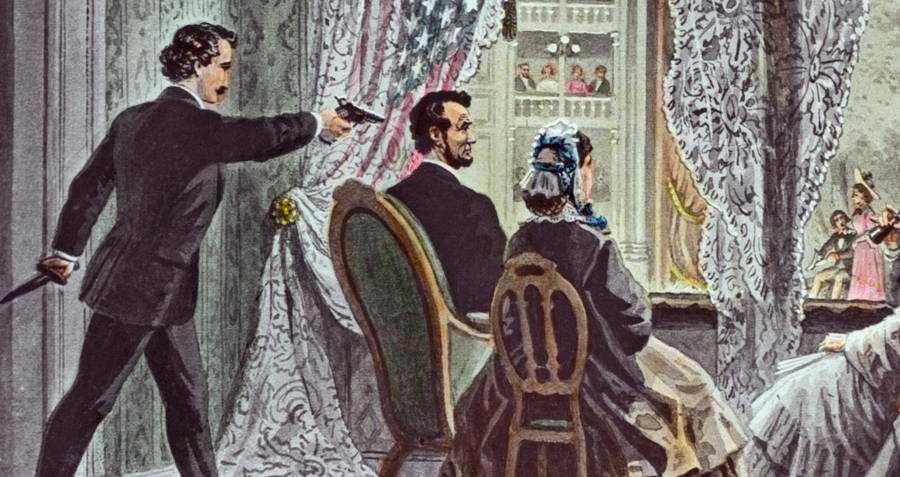
Magic: The Gathering card 'Presidential Assassination', showing the assassination of Abraham Lincoln. Instant, cost 3 mana, effect: bury target President.
This card was pretty-much nerfed by Wizards’ ruling that Presidents-Elect, Vice-Presidents etc. were not (yet) kinds of President.

It turns out that the answer is that the Vice-President-Elect becomes President at the inauguration. This boring answer came to us through three different Constitutional Amendments, each with its own interesting tale.

The Twelfth Amendment (1804) mostly existed to reform the Electoral College. Prior to the adoption of the Twelfth Amendment, the Electoral College members each cast two ballots to vote for the President and Vice-President, but didn’t label which ballot was which position: the runner-up became Vice-President. The electors would carefully and strategically have one of their number cast a vote for a third-party candidate to ensure the person they wanted to be Vice-President didn’t tie with the person they wanted to be President. Around the start of the 19th century this resulted in several occasions on which the President and Vice-President had been bitter rivals but were now forced to work together3.

While fixing that, the Twelfth Amendment also saw fit to specify what would happen if between the election and the inauguration the President-Elect died: that the House of Representatives could choose a replacement one (by two-thirds majority), or else it’d be the Vice-President. Interesting that it wasn’t automatically the Vice-President, though!

From the musical Hamilton, Burr offers his hand to Jefferson, who turns his back.
It didn’t happen like this. In real life, there was a lot less singing, and a lot more old white men.

The Twentieth Amendment (1933) was written mostly with the intention of reducing the “lame duck” period. Here in the UK, once we elect somebody, they take power pretty-much immediately. But in the US, an election in November traditionally resulted in a new President being inaugurated almost half a year later, in March. So the Twentieth Amendment reduced this by a couple of months to January, which is where it is now.

In an era of high-speed road, rail, and air travel and digital telecommunications even waiting from November to January seems a little silly, though. In any case, a secondary feature of the Twentieth Amendment was that it removed the rule about the House of Representatives getting to try to pick a replacement President first, saying that they’d just fall-back on the Vice-President in the first instance. Sorted.

Just 23 days later, the new rule almost needed to be used, except that Franklin D. Roosevelt’s would-be assassin Giuseppe Zangara missed his tricky shot.

The Twentieth Amendment (1967) aimed to fix rules-lawyering. The constitution originally said that f the President is removed from office, dies, resigns, or is otherwise unable to use his powers and fulfil his duties, then those powers and duties go to the Vice-President.

Note the wording there. The constitution said that if a President died, their their duties and powers would go to the Vice-President. Not the Presidency itself. You’d have a Vice-President, acting as President, who wasn’t actually a President. And that might not matter 99% of the time… but it’s the edge cases that get you.[foonote]Looking for some rules-lawyering? Okay: what about rules on Presidential term limits? You can’t have more than two terms as President, but what if you’ve had a term as Vice-President but acting with Presidential powers after the President died? Can you still have two terms? This is the kind of constitutional craziness that munchkin US history scholars get off on.[/footnote]

It also insisted that if there’s no Vice-President, you’ve got to get one. You’d think it was obvious that if the office of Vice-President exists in part to provide a “backup” President in case, y’know, the nearly one-in-five chance that the President dies… that a Vice-President who finds themselves suddenly the President would probably want to have one!

But no: 18 Presidents4 served without a Vice-President for at least some of their term: four of them never had a Vice-President. That includes 17th President Andrew Johnson, who you’d think would have known better. Johnson was Vice-President under Abraham Lincoln until, only a month after the inauguration, Lincoln was assassinated, putting Johnson in change of the country. And he never had a Vice-President of his own. He served only barely shy of the full four years without one.

Anyway; that was a long meander through the history of the Constitution of a country I don’t even live in, to circle around a question that doesn’t matter. The thought randomly came to me while I was waiting for the traffic lights at the roadworks outside my house to change. And now I know the answer.

Very hypothetically, of course.

Footnotes

1 My personal headcanon is that the would-be assassins are time travellers from the future, Chrononauts-style, trying to flip a linchpin and bring about a stable future in which he wasn’t elected. I don’t know whether or not that makes Elon Musk one of the competing time travellers, but you could conceivably believe that he’s Squa Tront in disguise, couldn’t you?

2 The US has had 45 presidents, of whom eight have died during their time in office. Of those eight, four – half! – were assassinated! It’s a weird job. 8 ÷ 45 ≈ 18%.

3 If you’re familiar with Hamilton, you’ll recall its characterisation of the election of 1800 with President Thomas Jefferson dismissing his Vice-President Aaron Burr after a close competition for the seat of President which was eventually settled when Alexander Hamilton instructed Federalist party members in the House of Representatives to back Jefferson over Burr. The election result really did happen like that – it seems that whichever Federalist in the Electoral College that was supposed to throw away their second vote failed to do so! – but it’s not true that he was kicked-out by Jefferson: in fact, he served his full four years as Vice-President, although Jefferson tried to keep him as far from actual power as possible and didn’t nominate him as his running-mate in 1804. Oh, and in 1807 Jefferson had Burr arrested for treason, claiming that Burr was trying to capture part of the South-West of North America and force it to secede and form his own country: the accusation didn’t stick, but it ruined Burr’s already-faltering political career. Anyway, that’s a diversion.

4 17 different people, but that’s not how we could Presidents apparently.

× ×

What Happened After My 13-Year-Old Son Joined the Alt-Right

This is a repost promoting content originally published elsewhere. See more things Dan's reposted.

Over time, my husband and I started to suspect that Sam’s musings on doxxing and other dark arts might not be theoretical. One weekend morning as we were folding laundry in our room, Sam sat on the edge of our bed and instructed us on how to behave if the FBI ever appeared at our door.

What was posturing and what was real? We suspected the former and doubted the latter, but we had no way to be sure. The situation evolved faster than we could frame the questions, much less figure out the answers. When we did confront Sam—say, if we caught a glimpse of a vile meme on his phone—he assured us that it was meant to be funny and that we didn’t get it. It was either “post-ironic” or referenced multiple other events that created a maze-like series of in-jokes impossible for us to follow.

Note #11815

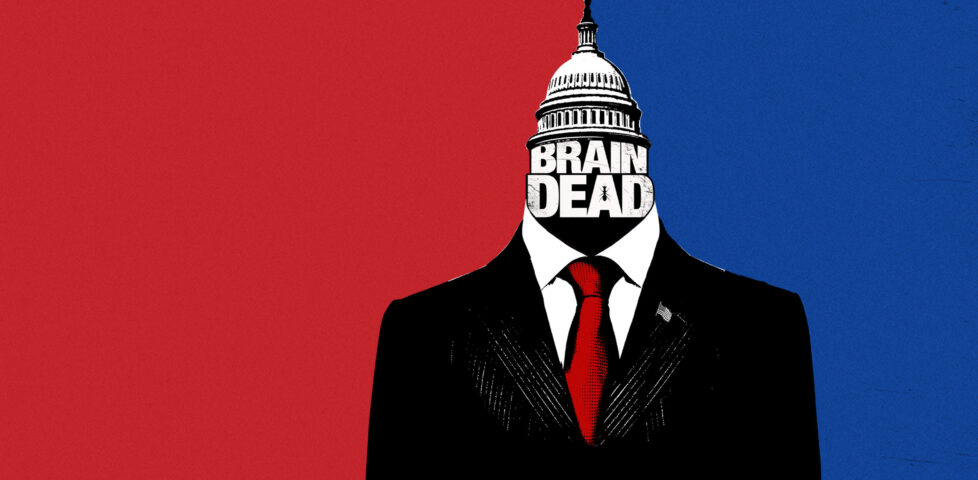
When I watched @Sir_RidleyScott’s #BrainDead (@BrainDeadCBS) in 2016, it was a dark comedy about alien brain parasites driving US political extremism.

When I watched it in 2018 it was a plausible explanation.

When I watch it in 2020 I’m worried it will be a documentary.

After Section 702 Reauthorization

This is a repost promoting content originally published elsewhere. See more things Dan's reposted.

After Section 702 Reauthorization – Schneier on Security (schneier.com)

For over a decade, civil libertarians have been fighting government mass surveillance of innocent Americans over the Internet. We’ve just lost an important battle. On January 18, President Trump signed the renewal of Section 702, domestic mass surveillance became effectively a permanent part of US law. Section 702 was initially passed in 2008, as an…