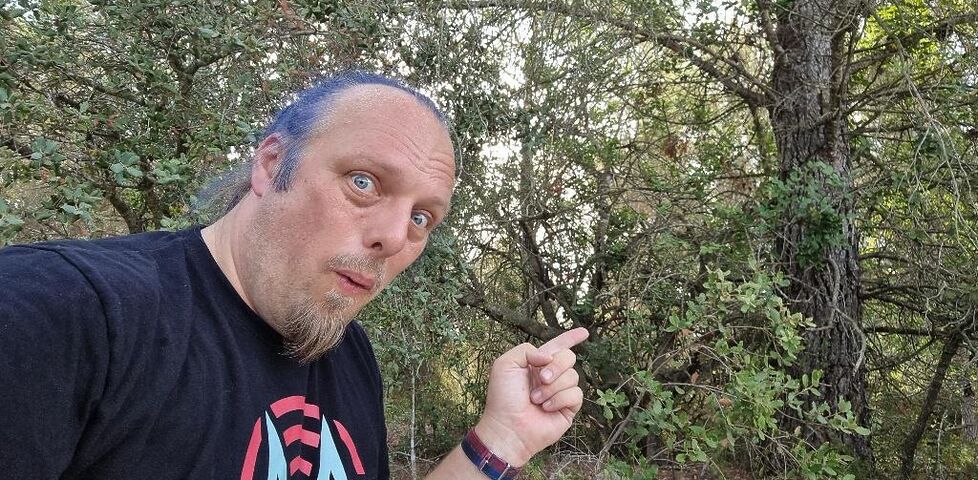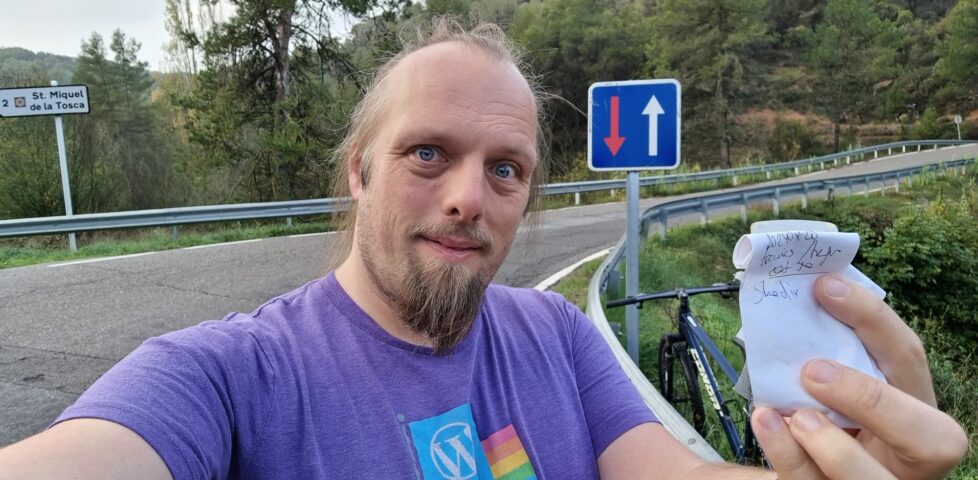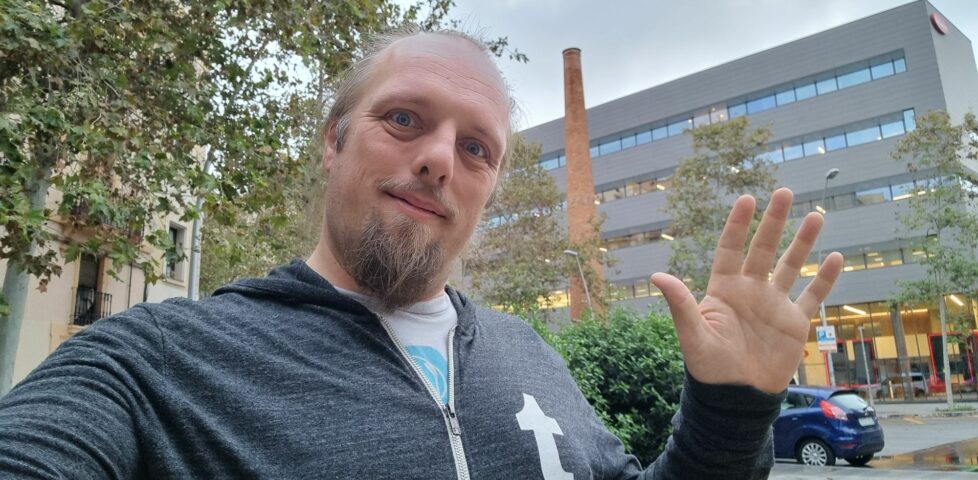
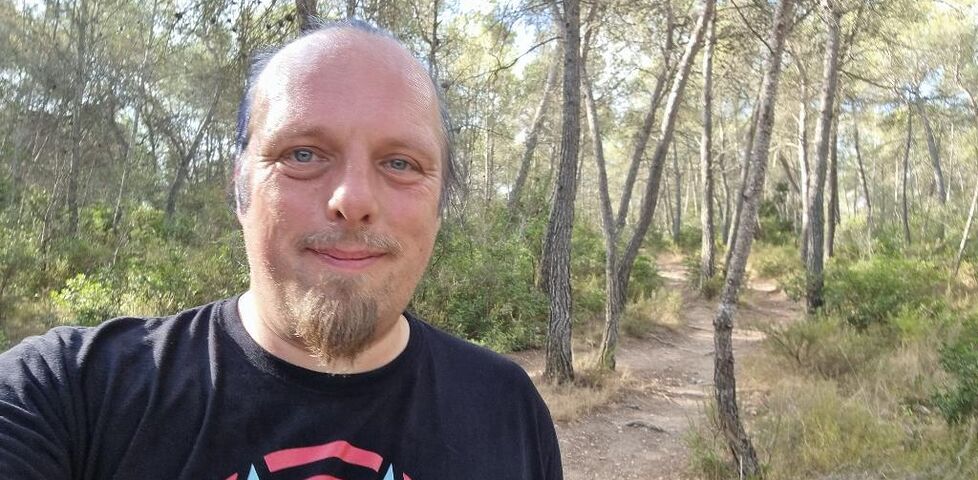
A quick and easy find once I spotted a likely hiding place. Starting to feel like I should have had breakfast before I set off! TFTC/GPA, and greetings from Oxfordshire, UK.
My family and I are on holiday staying nearby. I came out this morning to explore and try to find a couple of local geocaches while the children were still asleep. This was the first.
I needed to walk around the GZ a few times before I saw the cache, with its vantage point over this beautiful valley. Then it was time for a quick scramble up the tree to retrieve it.
Signed log and returned to its hiding place. TFTC/GPA; greetings from the UK!
To celebrate the site’s 25th birthday this year, Wikipedia is encouraging/challenging
people to read one Wikipedia article a day for 25 consecutive days. I felt that I could do one better than that: not only reading an article but – where I found one that was
particularly interesting – to write a blog post or record a podcast episode for each of those days, sharing what I learned. For each entry, I’ll hit
“random article” a few times until something catches my interest, start reading, and then start writing! Everything I’ve written below came from Wikipedia… so you should check other
sources before you use it to do your homework. Happy birthday, Wikipedia!
Then back to Spain at the signing of the 1763 Treaty of Paris, where, when Britain was arguing which captured
territories it should be allowed to keep, everybody forgot about it and so it fell into the default bucket of “back to its previous controller”: it seems that Spain hadn’t even
noticed that Manilla had been captured!
Then, after the Mexican War of Independence… still under Spain, but now directly under the
Spanish crown and managed from Madrid.
The Flag of the United States of America is lowered while the Flag of the Philippines is raised during the Independence Day ceremonies on July 4, 1946.
As you might expect if you know anything about colonialism, there are absolutely horrible stories that could be told about any of those periods of history. So when I landed on the page
Governor-General of the Philippines, I decided that it might be cheerier to pick out a person from it.
And so I picked what I believe to be the person whose term as Governor-General of the Philippines was shortest: in post for just 16 days in August 1898: Wesley
Merritt.
Gen. Wesley Merritt, circa 1865.
Wesley was a cavalryman in the American Civil War during which, in 1863, he managed to leapfrog three ranks by getting promoted from Captain right up to Brigadier General. After the
Civil War he was posted to the Texan frontier where he commanded a cavalry regiment in the American Indian Wars. His success in… umm… “freeing up land” for American settlers (it turns out this post can’t escape from the ugliness of imperialism)… lead him to a new
role in using his troops to police the civilians rushing to “claim” land formerly occupied by native Americans.
But it’s right at the end of the 19th century that his story intersects with today’s random article.
“Uncle Sam’s Craving: Saving the island so it won’t get lost.” says this Spanish propaganda cartoon.
As the 19th century wore on, the world-spanning Spanish Empire came under serious threat. The Napoleonic Wars had cut Spain
off from its colonies, and one by one they lost control of Mexico, Peru, Colombia, Chile, Argentina,
and others (often with thanks to quiet support from Britain). But Spain had managed to
keep hold of Cuba and the Philippines, despite growing unrest and uprisings, which were often brutally suppressed.
At the time, the US was working to establish itself as a modern naval power, building new steel warships to compete with European powers and Brazil, and making plans for what would
eventually become the Panama Canal, and so this was a perfect opportunity to show off their armoured cruiser the USS
Maine.
Starboard bow view of USS Maine, shortly before her deployment to Cuba. Fun fact: the last surviving officer who was aboard on the day it sank, Wat Tyler Cluverius Jr., would go on to serve as an engineering officer on the new USS Maine, a pre-dreadnaught battleship that would still be in service at the time of the First World War
(although she was only used as a training ship because her coal efficiency was so terrible that it was no-longer sensible to have her cross an ocean).
The Maine got sent to Havana as a show of force and to protect American interests in Cuba, where, a couple of weeks later, she… blew up.
Probably what happened was that the bituminous coal stored in her bunkers was leaking methane out, which spontaneously ignited, starting a fire that ignited the ship’s powder store. But some, including Theodore Roosevelt (who was then assistant navy secretary and on his way to becoming vice-president) and much of the popular press, claimed that the ship must have been struck by a Spanish mine or
torpedo.
Neither the Spanish nor American official reports had been published before the newspapers were claiming that the Maine had been sunk deliberately. Fun fact: the inscription
on the monument to the victims that stands in Havana claims it was deliberate…
but by the Americans as a false-flag operation to justify a declaration of war against Spain! This interpretation was added by the communist government in 1961.
The next month, after Congress had had a chance to discuss the matter (do you remember when the US Congress used to have to be involved in the US declaring war on another country?), the
US declared war on Spain and began actively attacking her fleets and colonies in the Caribbean and the Pacific.
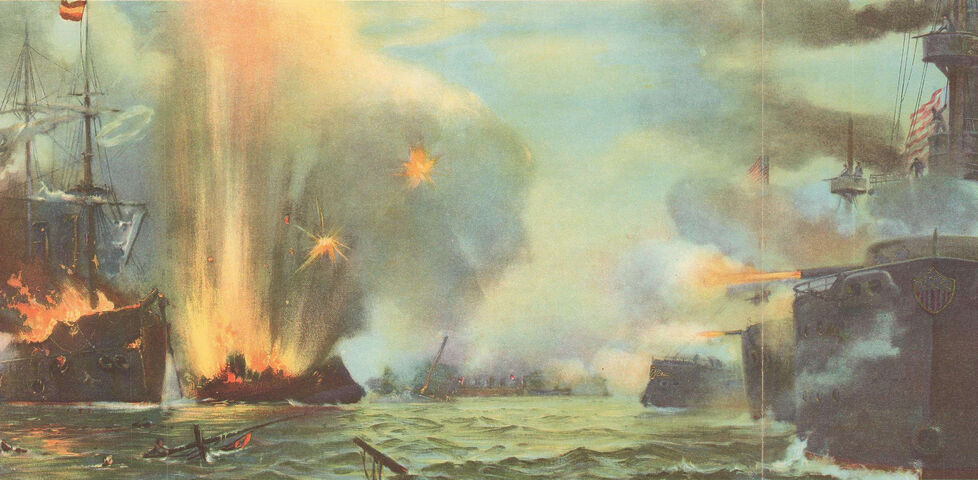
The US fleet steamed into Manilla Bay for what might be the most one-sided naval battle ever. The Spanish fleet at
Manilla would have been severely outmatched even were it not for the fact that the second-lead ship was unpowered, the shore batteries’ range was insufficient to be involved, and the
mines had been placed suboptimally. Only a single American sailor lost his life in the battle, and it was apparently as a result of a heart attack.
Battle of Manila Bay by James Gale Tyler (1898).
Okay, we’re at last up to Wesley Merritt‘s bit. Merritt was placed in command of the ground forces that were tasked with capturing Manilla. They sailed out of San Francisco, landed in
the Philippines, and prepared to attack the city.
Merritt and Admiral Dewey made a point not to coordinate with Emilio Aguinaldo y Famy, the leader of the Filipino resistance against the Spanish, who by this point had already taken control of
most of the Philippines and besieged Manilla, cutting off its water supply and beginning negotiations with the local Spanish leaders. It seems that Americans feared that if the
revolutionaries captured the city it would result in significant bloodshed as a result of violent looting and the murder of those who were seen to have collaborated with the Spanish,
and so they came up with an alternative plan: the American expeditionary force would attack and capture the city first!
Working through the Belgian consul to Manilla Édouard André, Merritt negotiated with the Spanish
Governor-General Fermín Jáudenes to arrange a “mock” battle. The ships in the bay would fire upon a fort that they knew was only used for storage and against defensive walls that they knew they were not capable of breaching,
and Spanish troops would be ordered to retreat as Merritt’s soldiers advanced. Then, Merritt would demand that the Spanish surrender the city, and they would comply, turning it over to
the American forces.
This would minimise casualties while allowing the Spanish Governor-General to avoid the shame of being seen to have lost the city to the revolutionaries (it being far more
politically-acceptable to lose to the might of the American invaders). Meanwhile, Aguinaldo’s troops initially saw the battle as genuine, which led to some casualties as Filipino
fighters advanced under fire; they joined the victims of other misunderstandings during the mock battle.
A drawing from Harper’s Pictorial History of the War with Spain. There’s a whole lot of pictures of flags getting rotated in this blog post!
Needless to say, the Filipinos deeply resented being told to stay out of the capital city that, given time, they might well have taken for themselves by force, had their efforts not
been leapfrogged by the USA. Ultimately this lead to a guerilla warfare campaign against the USA by Philippine
nationalists, which in turn contributed to growing concern in US political circles that America was becoming exactly the kind of imperialist power that it had opposed, at least on
paper, since its founding.
Anyway: on 13 August 1898 Wesley Merritt became the de facto Governor-General of the Philippines and the first American to hold that position. Two weeks later Major General Elwell Stephen Otis turned up and relieved him of the position, making Merritt the shortest ever Governor-General
of the Philippines.
Major General Wesley Merritt from Illustrated Roster of California Volunteer Soliders in the War with Spain (1898).
Merritt retired the next year and lived ten more years.
Anyway: that’s enough of today’s history lesson courtesy of a random Wikipedia page. I wonder what I’ll learn tomorrow! (If it’s as-interesting, I’ll let you know!)
The first weekend of my sabbatical might have set the tone for a lot of the charity hacking that will follow, being dominated by a Three Rings volunteering weekend.
The first fortnight of my sabbatical has consisted of:
Three Rings CIC’s AGM weekend and lots of planning for the future of the organisation and how we make it a better place to volunteer, and better value for our charity users,
You’d be amazed how many churros these children can put away.
The trip to Spain followed a model for European family breaks that we first tried in Paris last year2,
but was extended to give us a feel for more of the region than a simple city break would. Ultimately, we ended up in three separate locations:
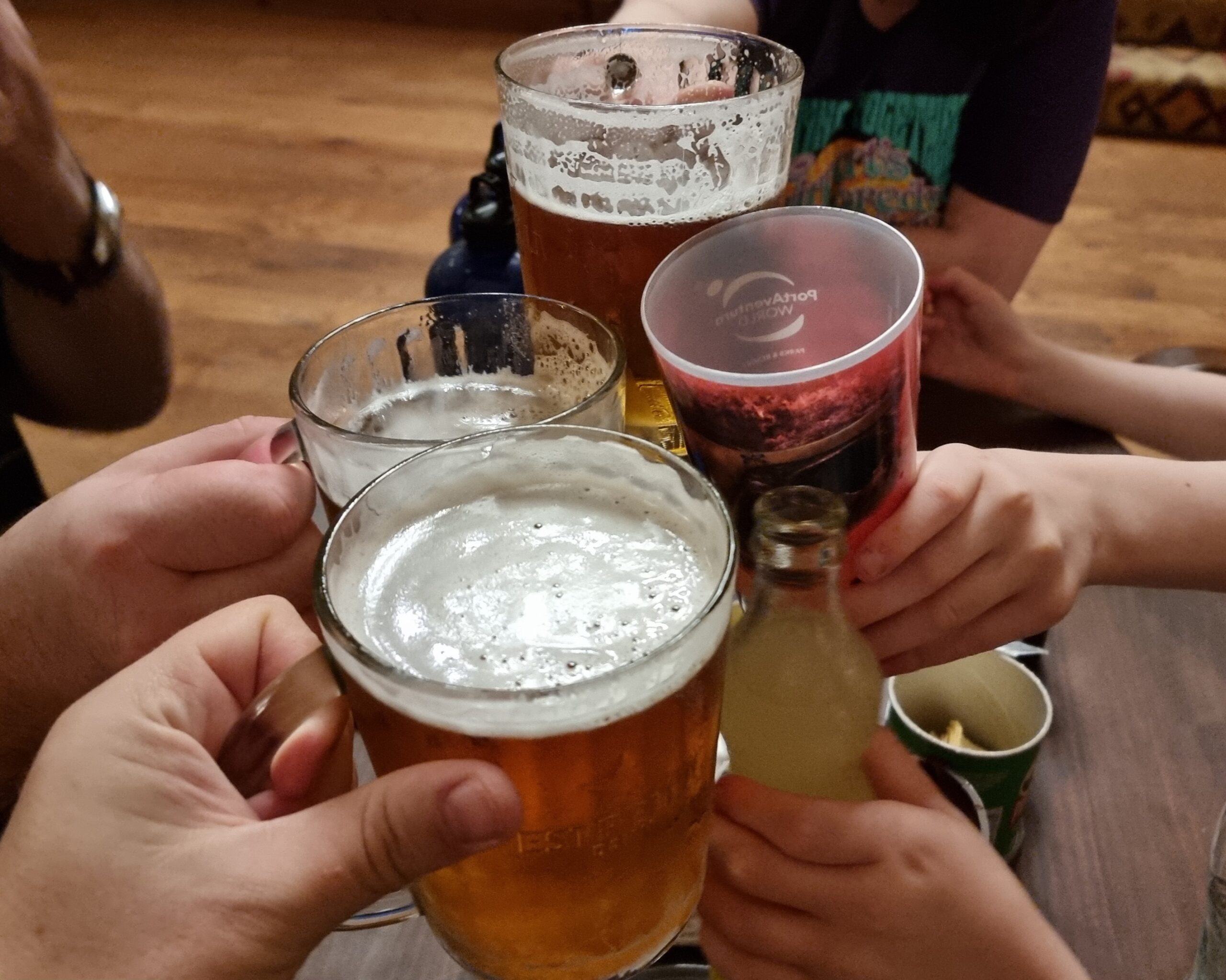
The PortAventura World theme park, whose accommodation was certainly a gear shift after the 5-star hotel we’d come from4 but whose rides kept us and the kids delighted for a
couple of days (Shambhala was a particular hit with the eldest kid and me).
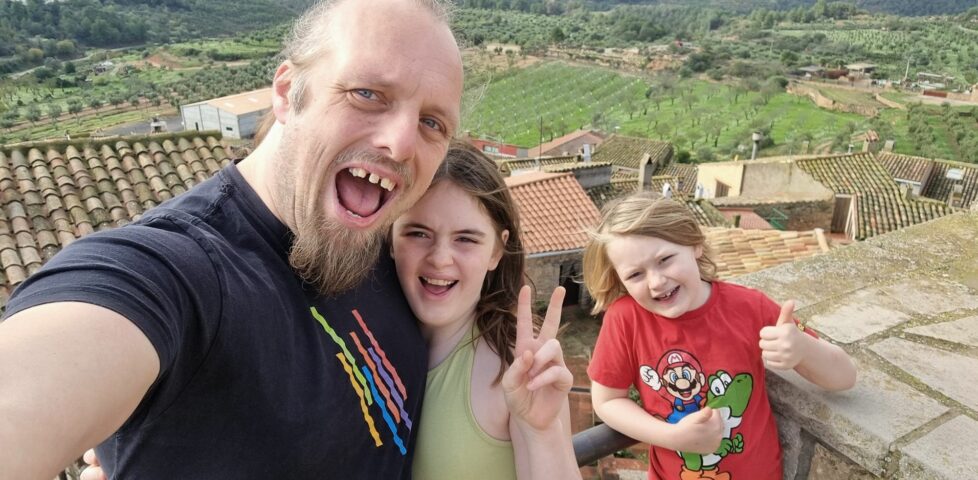
A villa in el Vilosell – a village of only 190 people – at which the kids mostly played in the outdoor pool (despite the
sometimes pouring rain) but we did get the chance to explore the local area a little. Also, of course, some geocaching: some local caches are 1-2 years old and yet had so few finds that
I was able to be only the tenth or even just the third person to sign the logbooks!
I’d known – planned – that my sabbatical would involve a little travel. But it wasn’t until we began to approach the end of this holiday that I noticed a difference that a holiday
on sabbatical introduces, compared to any other holiday I’ve taken during my adult life…
Perhaps because of the roles I’ve been appointed to – or maybe as a result of my personality – I’ve typically found that my enjoyment of the last day or two of a week-long trip are
marred somewhat by intrusive thoughts of the work week to follow.
I’m not saying that I didn’t write code while on holiday. I totally did, and I open-sourced it too.
But programming feels different when your paycheque doesn’t depend on it.
If I’m back to my normal day job on Monday, then by Saturday I’m already thinking about what I’ll need to be working on (in my case, it’s usually whatever I left unfinished right before
I left), contemplating logging-in to work to check my email or Slack, and so on5.
But this weekend, that wasn’t even an option. I’ve consciously and deliberately cut myself off from my usual channels of work communication, and I’ve been very disciplined about not
turning any of them back on. And even if I did… my team aren’t expecting me to sign into work for about another 11 weeks anyway!
🤯🤯🤯
Monday and Tuesday are going to mostly be split between looking after the children, and voluntary work for Three Rings (gotta fix that new server architecture!). Probably. Wednesday?
Who knows.
That’s my first taste of the magic of a sabbatical, I think. The observation that it’s possible to unplug from my work life and, y’know, not start thinking about it right away
again.
Maybe I can use this as a vehicle to a more healthy work/life balance next year.
Footnotes
1A sabbatical is a perk offered to
Automatticians giving them three months off (with full pay and benefits) after each five years of work. Mine coincidentally came hot on the tail of my last meetup and soon after a whole lot of drama and a major
shake-up, so it was a very welcome time to take a break… although of course it’s been impossible to completely detach from bits of the drama that have spilled out onto the open
Web!
5 I’m fully aware that this is a symptom of poor work/life balance, but I’ve got two
decades of ingrained bad habits working against me now; don’t expect me to change overnight!
My family and I are staying in El Vilosell, so this morning I borrowed a bike to take the trail over the hill from there to here. The ride was beautiful, and the easy downhill rides
between cliffs and terraces more than made up for the tiring and bumpy sections of uphill pedalling. At the highest point, I met a fox, on his way to bed I guess as the sun crested the
hilltops.
Despite the recent heavy rain the Set riverbed was almost dry: just a trickle of a stream. From the description, I was initially worried that the cache might be underneath, which looked
challenging, but a peep at the hint reassured me that there were more-likely hiding spots.
A little finger-work and the cache was in hand. Nice spot! That’s when I discovered that there was a hole in my pocket and my pen had escaped! Oh no! I hope a photolog will be
sufficient to show that I found this cache.
The geokids and I are staying nearby and came out for a walk this morning to discover this under-appreciated cache. What an amazing location and such a great view! We searched many
“obvious” locations without luck, then translated some logs to get a clue. We should have checked the attributes! A little danger later and the cache was in hand. SL, TFTC/GPC! FP awarded – thanks so much for bringing us here. Greetings from
Oxfordshire, UK!
The geokids and I had to give up after an extended search. We solved the riddle (we think) and counted steps, but, being unsure, hunted for a nearby map and attempted to un-do he
farmer’s mistake. Still no luck. 😔 Sadly it’s our last morning in the city so this one might have to remain a blue spot on our map for a while, though I’m sure I’ll think of something I
missed when I get back to my computer.
For some reason, the breakfast chef assumed that when I asked for two eggs benedict that I might want them on two separate plates. As if I WEREN’T totally planning to scoff them both
myself! 😂

An early morning walk from my hotel while I waited for the rest of my family to wake up brought me to this, another old chimney. I’ve really been enjoying discovering these relics of
the industrial history of this part of the city.
Unusual and well-disguised cache container! 😁 First name in a clean new log sheet too; thanks to the CO for maintaining their caches! ❤️ SL, TFTC/GPC. Greetings from Oxfordshire, UK!
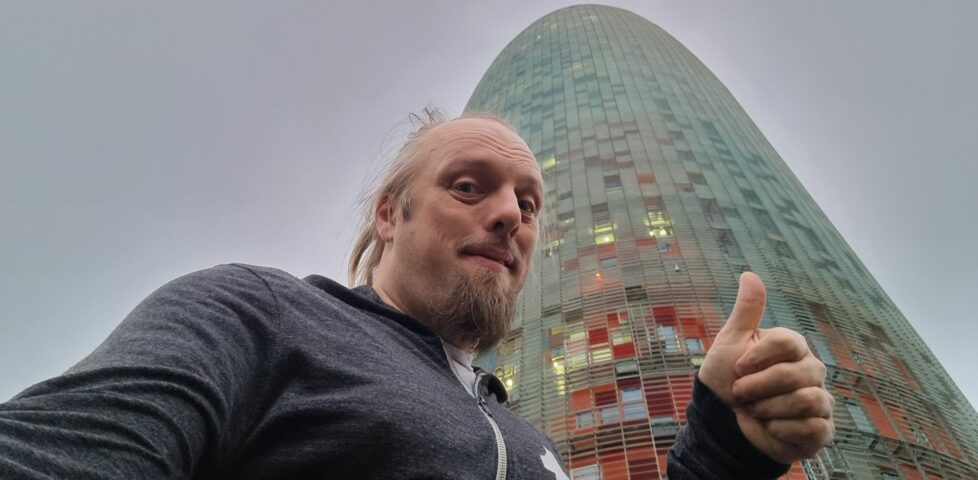
My 7-year-old, who’s really interested in skyscrapers, was excited to point this one out to me upon our arrival in Barcelona on Saturday, observing that it looks very similar to
“The Gherkin”/30 St Mary Axe, a highly-recognisable London landmark. He’s right, it does, and it’s a shame he couldn’t join me on
this geocaching expedition but he was still around asleep when I set off.
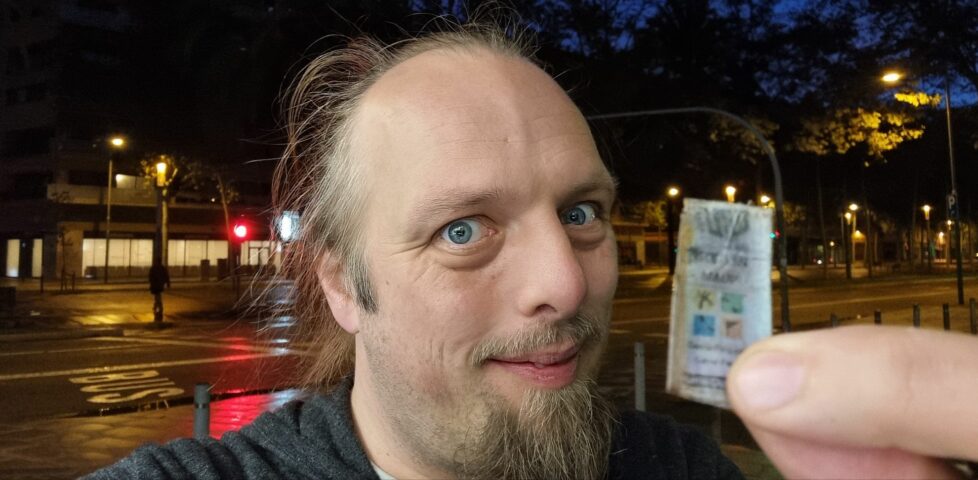
I stood pretending to wait for a bus for a little while, then quickly found, signed, and replaced the cache. TFTC/GPC!
After failing to find this yesterday, I came back earlier this morning for another
go. Thanks to the hint, I was pretty confident I’d been looking in the right place, and a message from the CO helped confirm this (gracias!).
There are, in my mind, two significant challenges to this cache:
1. It’s a challenging and unusual hiding place and you will need to use the hint. I see from previous logs that some people used the hint… and still got stuck! Got to look
around and see what it could mean. This bit… I got right. In fact, I touched the cache yesterday but just didn’t know it for sure!
2. It’s a busy area in which searching for a geocache… looks a bit suspicious! I came at almost 08:00 yesterday and, probably because it was a weekday, the area had lots of muggles. I
felt self-conscious hunting for the cache and that made it harder. Coming back today an hour earlier made all the difference.
A really sneaky cache good enough to hunt for twice. TFTC/GPC. FP awarded. Greetings from Oxfordshire, UK.
An extended search bore no fruit this morning. Worth help of the hint and an initial survey I was pretty confident in what kind of thing I was looking for, but though i inspected many
candidate hiding places I couldn’t quite find it. Perhaps I’d do better at a less-busy time.