Subverting AI Agent Logging with a Git Post-Commit Hook

Last night I was chatting to my friend (and fellow Three Rings volunteer) Ollie about our respective workplaces and their approach to AI-supported software engineering, and it echoed conversations I’ve had with other friends. Some workplaces, it seems, are leaning so-hard into AI-supported software development that they’re berating developers who seem to be using the tools less than their colleagues!

That’s a problem for a few reasons, principal among them that AI does not make you significantly faster but does make you learn less.1. I stand by the statement that AI isn’t useless, and I’ve experimented with it for years. But I certainly wouldn’t feel very comfortable working somewhere that told me I was underperforming if, say, my code contributions were less-likely than the average to be identifiably “written by an AI”.

Even if you’re one of those folks who swears by your AI assistant, you’ve got to admit that they’re not always the best choice.
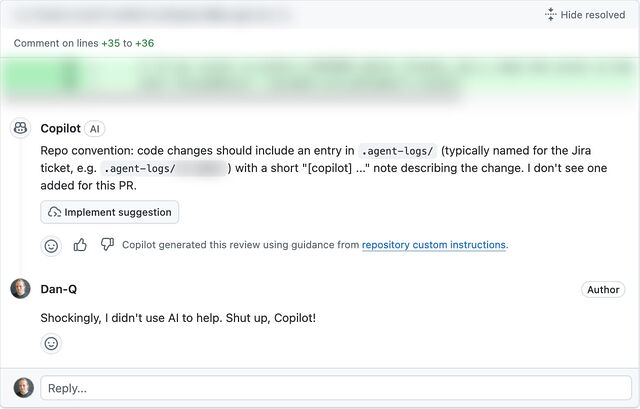
Copilot review of some code on GitHub, in which it's telling me that I should have included an .agent-logs/... file in which my AI agent describes how it helped, but I'm responding to say that 'shockingly' I wrote it without the help of AI, and telling Copilot to shut up.
I ran into something a little like what Ollie described when an AI code reviewer told me off for not describing how my AI agent assisted me with the code change… when no AI had been involved: I’d written the code myself.2

I spoke to another friend, E, whose employers are going in a similar direction. E joked that at current rates they’d have to start tagging their (human-made!) commits with fake AI agent logs in order to persuade management that their level of engagement with AI was correct and appropriate.3

Supposing somebody like Ollie or E or anybody else I spoke to did feel the need to “fake” AI agent logs in order to prove that they were using AI “the right way”… that sounds like an excuse for some automation!

I got to thinking: how hard could it be to add a git hook that added an AI agent’s “logging” to each commit, as if the work had been done by a robot?4

Turns out: pretty easy…

Animation showing a terminal. The developer switches to a branch, adds two modifications, and commits them. Afterwards, the log and filesystem show that a log file has been created crediting (fictional) AI bot 'frantic' with the change.
To try out my idea, I made two changes to a branch. When I committed, imaginary AI agent ‘frantic’ took credit, writing its own change log. Also: asciinema + svg-term remains awesome.

Here’s how it works (with source code!). After you make a commit, the post-commit hook creates a file in .agent-logs/, named for your current branch. Each commit results in a line being appended to that file to say something like [agent] first line of your commit message, where agent is  the name of the AI agent you’re pretending that you used (you can even configure it with an array of agent names and it’ll pick one at random each time: my sample code uses the names agent, stardust, and frantic).

There’s one quirk in my code. Git hooks only get the commit message (the first line of which I use as the imaginary agent’s description of what it did) after the commit has taken place. Were a robot really used to write the code, it’d have updated the file already by this point. So my hook has to do an --amend commit, to retroactively fix what was already committed. And to do that without triggering itself and getting into an infinite loop, it needs to use a temporary environment variable. Ignoring that, though, there’s nothing particularly special about this code. It’s certainly more-lightweight, faster-running, and more-accurate than a typical coding LLM.

Sure, my hook doesn’t attempt to write any of the code for you; it just makes it look like an AI did. But in this instance: that’s a feature, not a bug!

Footnotes

1 That research comes from Anthropic. Y’know, the company who makes Claude, one of the most-popular AIs used by programmers.

2 Do I write that much like an AI? Relevant XKCD.

3 Using “proportion of PRs that used AI” as a metric for success seems to me to be just slightly worse than using “number of lines of code produced”. And, as this blog post demonstrates, the former can be “gamed” just as effectively as the latter (infamously) could.

4 Obviously – and I can’t believe I have to say this – lying to your employer isn’t a sensible long-term strategy, and instead educating them on what AI is (if anything) and isn’t good for in your workflow is a better solution in the end. If you read this blog post and actually think for a moment hey, I should use this technique, then perhaps there’s a bigger problem you ought to be addressing!
× ×

git diff –name-only –diff-filter=M

Note to future self: when you want git to tell you all the files you’ve modified, but not those you’ve deleted (e.g. to pipe through xargs and feed to your linter for bulk-linting), the command you’re looking for is –

git diff –name-only –diff-filter=M

Note #25565

Last year, a colleague introduced me to lazygit, a TUI git client with a wealth of value-added features.

Somehow, though, my favourite feature is the animation you see if you nuke the working tree. 😘 Excellent.

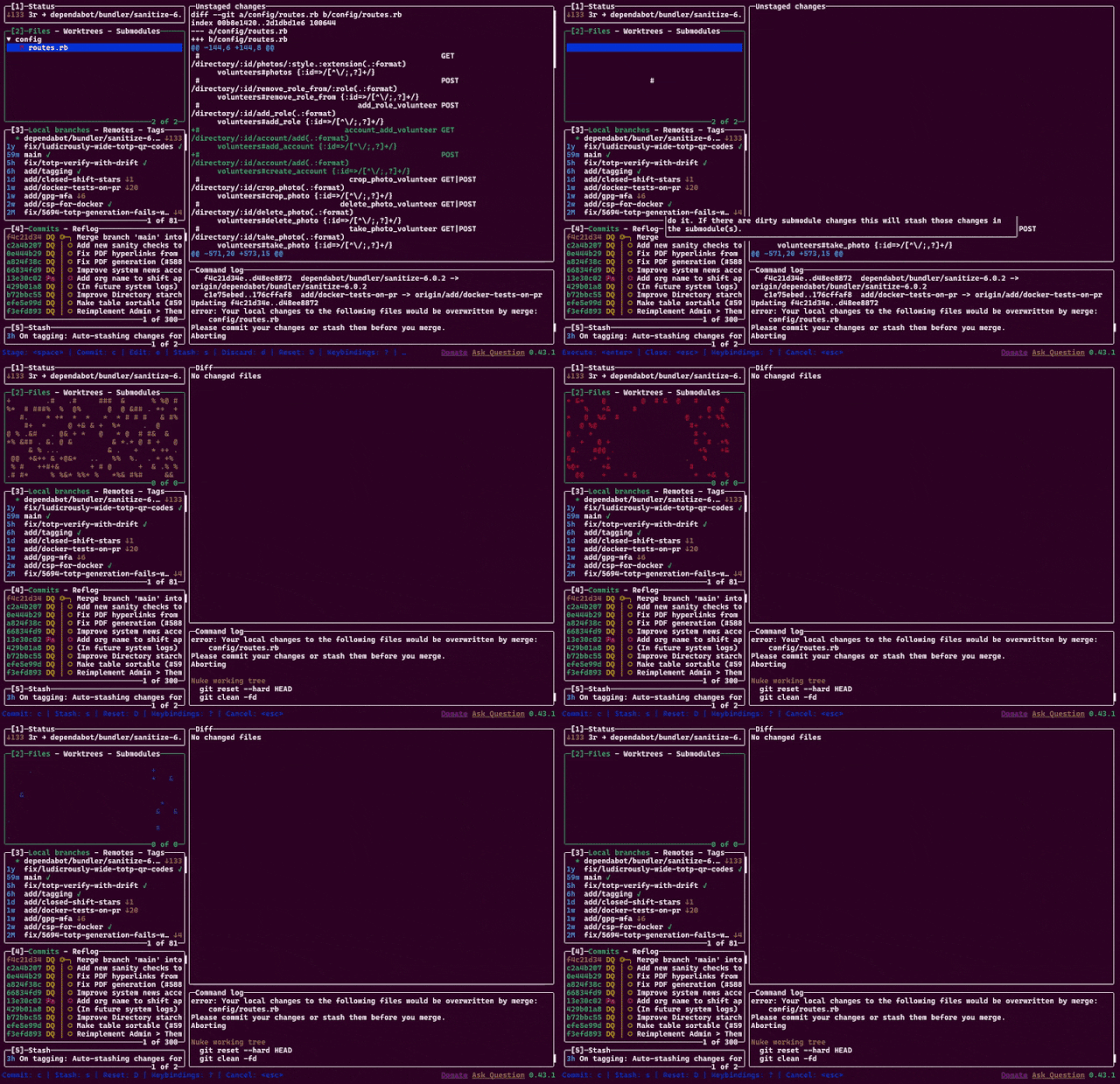
Animation showing lazygit, a command-line git client. The working tree has one changed file, config/routes.rb. With a couple of keypresses, the working tree is nuked, with a colourful ASCII-art animation illustrating the destruction of the changed file (actually, it being reset to the previous version).

Note #25337

My first task this International Volunteer Day is to test a pull request that aims to fix a bug with Three Rings’ mail merge fields functionality. As it’s planned to be a hotfix (direct into production) we require extra rigor and more reviewers than code that just goes into the main branch for later testing on our beta environment.

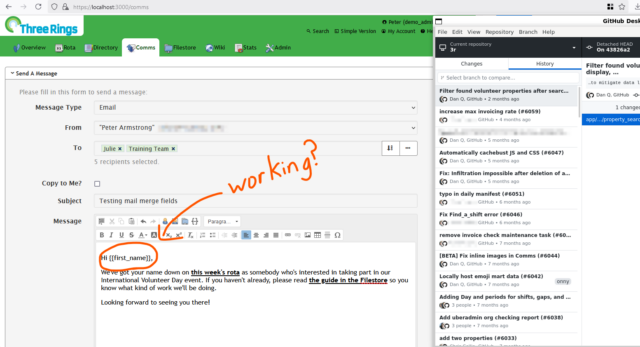
My concern is that fixing this bug might lead to a regression not described by our automated tests, so I’m rolling back to a version from a couple of months ago to compare the behaviour of the affected tool then and now. Sometimes you just need some hands-on testing!

Screenshot showing web application Three Rings viewed on a local development machine, being used to compose an email about International Volunteer Day. A merge field called 'first_name' is included in the email, and it's hand-annotated with the question 'working?'. Alongside, GitHub Desktop shows that we've rolled-back to a revision from two months ago.

×

Standing up for developers: youtube-dl is back

This is a repost promoting content originally published elsewhere. See more things Dan's reposted.

Today we reinstated youtube-dl, a popular project on GitHub, after we received additional information about the project that enabled us to reverse a Digital Millennium Copyright Act (DMCA) takedown.

This is a Big Deal. For two reasons:

Firstly, youtube-dl is a spectacularly useful project. I’ve used it for many years to help me archive my own content, to improve my access to content that’s freely available on the platform, and to help centralise (freely available) metadata to keep my subscriptions on video-sharing sites. Others have even more-important uses for the tool. I love youtube-dl, and I’d never considered the possibility that it could be used to circumvent digital restrictions (apparently it’s got some kind of geofence-evading features you can optionally enable, for people who don’t have a multi-endpoint VPN I guess?… I note that it definitely doesn’t break DRM…) until its GitHub repo got taken down the other week.

Which was a bleeding stupid thing to use a DMCA request on, because, y’know: Barbara Streisand Effect. Lampshading that a free, open-source tool could be used for people’s convenience is likely to increase awareness and adoption, not decrease it! Huge thanks to the EFF for stepping up and telling GitHub that they’d got it wrong (this letter is great reading, by the way).

But secondly, GitHub’s response is admirable and – assuming their honour their new stance – effective. They acknowledge their mistake, then go on to set out a new process by which they’ll review takedown requests. That new process includes technical and legal review, erring on the side of the developer rather than the claimant (i.e. “innocent until proven guilty”), multiparty negotiation, and limiting the scope of takedowns by allowing violators to export their non-infringing content after the fact.

I was concerned that the youtube-dl takedown might create a FOSS “chilling effect” on GitHub. It still might: in the light of it, I for one have started backing up my repositories and those of projects I care about to an different Git server! But with this response, I’d still be confident hosting the main copy of an open-source project on GitHub, even if that project was one which was at risk of being mistaken for copyright violation.

Note that the original claim came not from Google/YouTube as you might have expected (if you’ve just tuned in) but from the RIAA, based on the fact that youtube-dl could be used to download copyrighted music videos for enjoyment offline. If you’re reminded of Sony v. Universal City Studios (1984) – the case behind the “Betamax standard” – you’re not alone.

Reinventing Git interface

This is a repost promoting content originally published elsewhere. See more things Dan's reposted.

I also ask not to discard all this nonsense right away, but at least give it a fair round of thought. My recommendations, if applied in their entirety, can radically change Git experience. They can move Git from advanced, hacky league to the mainstream and enable adoption of VCS by very wide groups of people. While this is still a concept and obviosly requires a hell of a job to become reality, my hope is that somebody working on a Git interface can borrow from these ideas and we all will get better Git client someday.

I love Git. But I love it more conceptually than I do practically. Everything about its technical design is elegant and clever. But most of how you have to act when you’re using it just screams “I was developed by lots of engineers and by exactly zero UX developers.” I can’t imagine why.

Nikita proposes ways in which it can be “fixed” while retaining 100% backwards-compatibility, and that’s bloody awesome. I hope the Git core team are paying attention, because these ideas are gold.

git git git git git

This is a repost promoting content originally published elsewhere. See more things Dan's reposted.

Ever found you’ve accidentally entered too many gits in your terminal and wondered if there’s a solution to it? I quite often type git then go away and come back, then type a full git status after it. This leads to a lovely (annoying) error out the box:

$ git git status
git: 'git' is not a git command. See 'git --help'.

What a git.

My initial thought was overriding the git binary in my $PATH and having it strip any leading arguments that match git, so we end up running just the git status at the end of the arguments. An easier way is to just use git-config‘s alias.* functionality to expand the first argument being git to a shell command.

git config --global alias.git '!exec git'

Which adds the following git config to your .gitconfig file

[alias]
  git = !exec git

And then you’ll find you can git git to your heart’s content

$ git sha
cc9c642663c0b63fba3964297c13ce9b61209313

$ git git sha
cc9c642663c0b63fba3964297c13ce9b61209313

$ git git git git git git git git git git git git git git git git git git git git git git git git git git sha
cc9c642663c0b63fba3964297c13ce9b61209313

(git sha is an alias for git rev-parse HEAD.)

See what other git alias’ I have in my ~/.gitconfig, and laugh at all the typo corrections I have in there. (Yes, git provides autocorrection if you enable it, but I’m used to these typos working!)

Now git back to doing useful things!