
My TED Video on the Future of Work

This is a repost promoting content originally published elsewhere. See more things Dan's reposted.

I was thrilled to participate in TED’s new video series, The Way We Work, and not surprisingly I made the case that distributed work is where everything is headed.

Like Automattic (Matt’s company), Three Rings has also long been ahead of the curve from a “recruit talent from wherever it is, let people work from wherever they are” perspective. Until I was recently reading (more than I had previously) about the way that Automattic “works” I was uncertain about the scalability of Three Rings’ model. Does it work for a commercial company (rather than a volunteer-run non-profit like Three Rings)? Does it work when you make the jump from dozens of staff to hundreds? It’s reassuring to see that yes, this kind of approach certainly can work, and to get some context on how it does (in Automattic’s case, at least). Nice video, Matt!

Bypassing WordPress / Jetpack’s “Prove your humanity:” CAPTCHA

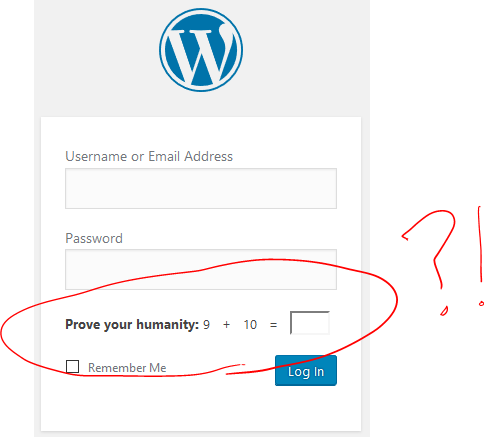
One of the most-popular WordPress plugins is Jetpack, a product of Automattic (best-known for providing the widely-used WordPress hosting service “WordPress.com“). Among Jetpack’s features (many of which are very good) is Jetpack Protect which adds – among other things – the possibility for a CAPTCHA to appear on your login pages. This feature is slightly worse than pointless as it makes it harder for humans to log in but has no significant impact upon automated robots; at best, it provides a false sense of security and merely frustrates and slows down legitimate human editors.

WordPress/Jetpack's CAPTCHA, asking for the solution to "9+10="
Thanks, WordPress, for slowing me down with a CAPTCHA that a robot can solve more-easily than a human.

“Proving your humanity”, as you’re asked to do, is a task that’s significantly easier for a robot to perform than a human. Eventually, of course, all tests of this nature seem likely to fail as robots become smarter than humans (especially as the most-popular system is specifically geared towards training robots), but that’s hardly an excuse for inventing a system that was a failure from its inception. Jetpack’s approach is fundamentally flawed because it makes absolutely no effort to disguise the challenge in a way that humans are able to read any-differently than robots. I’ll demonstrate that in a moment.

Jetpack security settings: "Protect" switch
Don’t just disable this, though! Other “Protect” features make sense. If only you could disable just the one that doesn’t…

A while back, a colleague of mine network-enabled Jetpack Protect across a handful of websites that I occasionally need to log into, and it bugged me that it ‘broke’ my password safe’s ability to automatically log me in. So to streamline my workflow – as well as to demonstrate quite how broken Jetpack Protect’s CAPTCHA is, I’ve written a userscript that you can install into your web browser that will completely circumvent it, solving the maths problems on your behalf so that you don’t have to. Here’s how to use it:

  1. Install a userscript manager into your browser if you don’t have one already: I use Tampermonkey, but it ought to work with almost any of them.
  2. Install Jetpack Maths Solver.

From now on, whenever you go to a page whose web path begins with “/wp-login.php” that contains a Jetpack Protect maths problem, the answer will be automatically calculated and filled-in on your behalf. The usual userscript rules apply: if you don’t trust me, read the source code (there are really only five lines to check) and disable automatic updates for it (especially as it operates across all domains), and feel free to adapt/improve however you see fit. Maybe if we can get enough people using it Automattic will fix this half-hearted CAPTCHA – or at least give us a switch to disable it in the first place.

Update: 15 October 2018 – the latest version of Jetpack makes an insignificant change to this CAPTCHA; version 1.2 of this script (linked above) works around the change.