
Dan Q found GCBJ704 Seven Dials Sundial

This checkin to GCBJ704 Seven Dials Sundial reflects a geocaching.com log entry. See more of Dan's cache logs.

Approaching from the West I was foiled by the glare of the rising sun in my efforts to claim this fascinating monument from afar and eventually had to walk all the way past it to line up my photo!

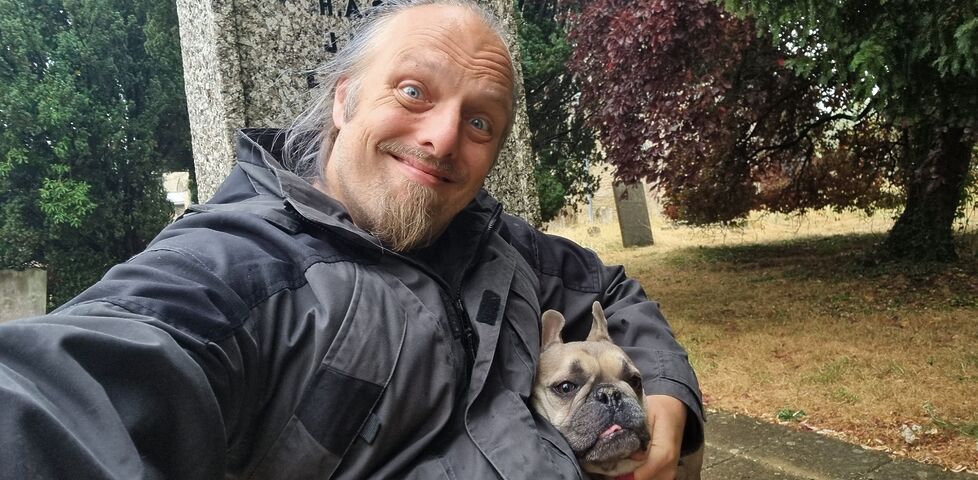
Dan in front of a tall pillar in the morning sun.

Thanks for the detailed cache page; I love a history lesson when I’m on a morning walk! TFTC.

×

Dan Q found GC38EQ3 Underground

This checkin to GC38EQ3 Underground reflects a geocaching.com log entry. See more of Dan's cache logs.

Initially thought I’d be able to find this one without the hint, but when I couldn’t get fix to closer than 8m I took a peep at it and was instantly aware of where to search. Soon the cache was in hand and I was back on my way. TFTC!

Dan Q found GC240NQ West End 1 – The Beatles

This checkin to GC240NQ West End 1 - The Beatles reflects a geocaching.com log entry. See more of Dan's cache logs.

Stood around for a bit reading about David Bowie while I waited for the waitstaff -on their pre-work fag break down the alleyway – stopped their muggling and went inside. Glad I came early while it was quiet here! TFTC.

Dan Q found GC5E4E Catastrophe, Calamity, Cataclysm Part 4

This checkin to GC5E4E Catastrophe, Calamity, Cataclysm Part 4 reflects a geocaching.com log entry. See more of Dan's cache logs.

Can’t do the physical today, but scooping a pic with the virtual during a morning walk around the neighbourhood.

Dan stands on a London street, gesturing to an old water pump (against which a man reclines).

Strictly speaking, I’ve come out to check on behalf of my family whether the queue for day two of West End Live has started gathering yet, but I couldn’t resist tagging a couple of caches on the way! TFTC (and to the adopter for keeping this one alive!).

×

Dan Q found GCAJJCJ Piccadilly Circus (Virtual Reward 4.0) ツ

This checkin to GCAJJCJ Piccadilly Circus (Virtual Reward 4.0) ツ reflects a geocaching.com log entry. See more of Dan's cache logs.

After nine hours on my feet yesterday queuing for and then attending the first day of West End Live in Trafalgar Square, I somehow decided that the best thing for my poor legs would be to get up early while everybody else slept in, to come walk around and find a virtual or two. Right around the corner from my hotel, this was the first!

Dan stands in front of a scaffolded fountain at the iconic Piccadilly Circus.

There’s scaffolding around the fountain right now but you can still see it and, crucially, the lights. Good morning, London! TFTC.

×

F-Day plus 125

125 days since our house flooded, and the damaged furniture fittings, floors, underfloors, and now inner walls have been torn out.

Over a third of a year since we had to move out, I’m optimistic that perhaps, at last, reconstruction work is almost ready to begin.

It’s a long, slow process. And there’s clearly a way to go. But it’s good to see progress happening.

A view through a pair of dilapidated residential rooms, through the gaps in a hollowed-out partition wall.

×

Note #29482

🎶 It starts with sausage,
A hot dog in a bun.
One simple sausage,
Put some mustard on one…

Is it just me, or are (sinner) Sir Pentious‘s colours reminiscent of a hot dog?

Sir Pentious, an anthropomorphic snake from Hazbin Hotel, in black and yellow longitudinal stripes with red 'eyes'.

×

The chair guardian

I guess it’s sweet that the dog has decided that I’m not to leave my home office without her noticing.

But when the naps right behind my wheelie chair I worry she’s going to get her paws run over!

A fawn-coloured French Bulldog lies on a laminate floor against the feet of an office chair.

×

Elon Musk, Human Ponzi Scheme

This is a repost promoting content originally published elsewhere. See more things Dan's reposted.

Yesterday I took a short trip. I began with a ride on the local Hyperloop, which ran through a tunnel dug by Boring Company. Then I used my neural implant to summon a fully self-driving Tesla robotaxi. While enroute I read the latest news from the Mars colony.

OK, none of that actually happened, because those products don’t exist. There are no working Hyperloops. The Boring Company has not dug any commercial tunnels. Tesla has a few self-driving — though not fully self-driving — taxis in Austin and nowhere else. (Google’s Waymo driverless taxis are operational in several major hubs.) Neuralink, which is purportedly pioneering brain implants, has tested its products in a handful of patients but done no more than that. And of course there is no Mars colony: there have been no manned flights to Mars, nor the prospect of any for the foreseeable future.

Yet at various points over the past decade Elon Musk promised that each of these services would be available by 2025 if not sooner.

With thanks to Mark Palko for sharing: yes, this seems like a spot-on observation of Musk’s career:

  • a few unqualified successes (Tesla leading the charge on the EV rollout; Starlink providing widespread Internet), and
  • a lot more unfulfilled promises and vapourware (Twitter’s post-takeover nosedive, the failure to deliver anything-of-use by Neuralink, The Boring Company/Hyperloop, the worse-than-pointless Grokipedia, all the things SpaceX hasn’t yet done…).

The vast majority of his wealth comes from investment, not from returns: people buy his stock if they buy his hype. I’m not saying he’s producing nothing of value… but yeah: the “world’s first trillionaire” is… unfortunate.

But then again, I’d be quite happy for him to be the world’s last trillionaire, too.

Ad Infinitum

This is a repost promoting content originally published elsewhere. See more things Dan's reposted.

For 25 years, Google Search was built on a contract. The web provided the content – billions of pages, freely linked, freely crawled. In return, Google sent people back. The link was the unit of exchange. It’s what made the Web thrive as an information system: you publish, Google indexes, users click through, and value flows back to the source. Win-win.

That contract is now broken. Generative UI doesn’t link to your article, necessarily. It absorbs your article, synthesizes it into a widget, and presents it as Google’s own answer. Information agents don’t send users to websites. They deliver “synthesized updates” with maybe a link or two buried at the bottom. The web was the scaffolding Google needed to build its index, to train its models, to accumulate the world’s information, and put ads next to it to get filthy rich. Now that the content is inside the system, the scaffolding is no longer needed. Google is creating its own context.

Google thinks it no longer needs the Web to deliver answers. And it no longer needs ad slots to deliver ads. What it needs is you. Your emails, your files, your calendar, your purchase history, your travel plans – all flowing into Spark, all building the richest possible picture of who you are and what you’re likely to click on. That’s exactly the kind of personal context those auction models need to work. The prediction module in the prominence allocation framework doesn’t run on keywords. It runs on knowing you.

An excellent piece by Matthias Ott, discussing revelations from this year’s Google I/O. In particular, the imminent pivot of Google Search from its lifelong “query in, list of links out” model to a wholesale “query in, LLM output out” one.

This isn’t just about putting AI output at the top of the search results, as I gather they do today, but about getting rid of search “results” entirely, and running everything through the model.

To which Matthias wisely asks: well, how will ads work then? Google’s business model is based on mining your personal data and shoving ads in your face. Where do they go in a search interface that it’s really a search but a “helpful” AI.

It turns out there’s a few approaches that Google seem to be considering, but what they’ve all got in common is the idea that marketers will be able to “influence” the LLM’s token generation, perhaps by using an LLM of their own to decide whether you (based on everything Google knows about you) are worth marketing to, and how much they’ll pay to do so, and then this input being “weighted” against competing advertisers and actual ingested data in order to feature advertiser-influenced content woven directly into the output of the LLM.

David Cross, as Arrested Development's Tobias Fünke, bites into a burger in a Burger King restaurant, with a Chicken Tendercrisp advertisement prominently displayed in the background.

Superficially, this sounds a little like product placement, like you sometimes see in American-made TV shows and movies. You know, where one character says, of “I’m going to go get a drink refill. You know you can get unlimited refills on any drink you want… and it’s free?”, and the next says “It’s a wonderful restaurant.”, while they’re sitting in Burger King.

Except this isn’t about saying “hey, people who watch this show are probably high and want a snack, let’s push our fast food their way”. It’s individualised.

It’s more like if the characters, knowing that your GMail account had a recent email about some test results, and your Google Calendar had an appointment tomorrow at the doctor, started talking about a particular brand of medication to, y’know, put the idea into your head.

Scene from Futurama, showing a display of Lightspeed Briefs with the slogan 'as seen in your dreams'.
The future presented in Futurama was supposed to be a joke, right?

We’re not at the point of completely-customised TV shows – nor the injection of commercials into dreams – yet. But Google’s plans, which blur the already-grey boundaries between organic and advertising content, are pretty insidious.

Assuming you’re in their ecosystem already, and possibly even if you’re not… Google may already be looking at your search terms, your calendar, your emails, your location and schedule, who you communicate with and how often, which web pages you visit, which apps you use, where you spend money, etc. (Seriously: if you somehow haven’t begun de-googling already, what are you waiting for?)… there’s a huge potential for misuse there.

But the arms race between people blocking or learning-to-ignore ads and advertisers trying to foist them upon us continues, and Google thinks this is an acceptable next step in escalating that. Using an insane amount of energy to recycle other people’s work without crediting them, in order to mash up the result with information they know about you in order to deliver you an unverifiable soup of words which might answer your question but with no clue how much or little commercial interest went into producing it, or by whom.

That’s some proper Darkest Timeline shit, right there.

You don’t need to take my nor Matthias’s word on it (although you should read his full post because it’s excellent): just look at the concept videos in Google’s blog post on the subject. You’ll also notice that almost-nowhere in their demos do Google even hint at the possibility of linking-out to anybody else’s website: there’s like one “visit site” button that appears at the very end of one of the flows, after the agent has done its things. Google is building a walled garden where they hope you’ll live, served by their AI butler on behalf of the companies who pay Google to tell you about their products.

Ugh.

× ×