
Automattic Minus Matt

This is a repost promoting content originally published elsewhere. See more things Dan's reposted.

Matt Mullenweg takes an involuntary leave of absence from Automattic, the company behind WordPress. Let’s hope he uses his time away thoughtfully.

Matt Mullenweg is out

This morning’s been full of the media coverage that Matt Mullenweg, co-creator of WordPress and founder of (my former employer) Automattic, has been ousted from his CEO position at Automattic by his board. The article linked above is my favourite so far; there are plenty more (or, if you prefer drama, go look on Twitter or Reddit 🤮).

I think this is probably for the best. I’ve previously observed that Automattic has been a ship on fire for a while, and – both for the last few years that I was employed by him, and even more since then – Matt has seemed… distracted and unfocussed. There’ve been huge challenges (some of his own making, admittedly) in both his professional and personal life, and I’d like to imagine that it’s these that led to him making the many… questionable… decisions he’s made over the last few years. I’ve been concerned that he’s leaned-away from open source commitments, over-focussed on lawsuits and AI, and opened his mouth without turning on his brain (something we’ve all done from time to time, but it’s a problem when doing so lands you – or your company – in hot water with the community, the media, the law, or – heaven help you – Tumblrites).

This is good for Automattic

So yeah: I think this can only be good for Automattic, in the long term. I hope that my friends who still work there don’t find the inevitable upcoming shake-up too painful and dramatic. And I hope that this whole thing does not lead to any… further weaponisation of the WordPress project (which remains closely under Matt’s control, even as Automattic does not).

But mostly… I hope that Matt gets the help and support that I think he needs. His sabbatical the other year included “a lot of solo time and introspection”, but perhaps that’s not the right answer this time.

This is good for Matt

I’ve corresponded with Matt on a few occasions (occasionally even publicly e.g. here’s him reblogging me; here’s him graffifi’ing on this blog). As a very early WordPress adopter, back in the day I exchanged emails with him and talked to him on IRC (I remember one time we argued about HTML vs XHTML; in hindsight, he was right on that one). It’s funny: I used a different name back then and so I don’t imagine he ever made the connection that it was the same “me” on the rare opportunities that we connected on Slack when – many years later on – I was his employee!

But my point there is that: for a while, at least, it felt like once upon a time, his heart was in the right place. Which makes me feel like all of his problematic behaviour and questionable choices and acting-out is a result of his environment. A lot of big-tech CEOs seem to get kinda… weird and paranoid and right-wing (if they weren’t already: some of them, of course, were!): maybe the toxicity of the environment erodes at a person who was once well-meaning-but-flawed and turns them into something else.

This should be seen as an intervention

To that end, I optimistically see his removal as CEO as… perhaps a kind of intervention? I think it’s good that he’s been ousted (although I wish he could have done it himself). I think it’ll benefit Automattic in the long run. And I hope that it’ll be good for Matt, too. I hope that he’ll take six… twelve… twenty-four months – whatever it takes – and work out what went wrong. Get some therapy. Write some code (really write it; not get an AI to do it). Play some music. Get some more therapy.

Until he can unpick where his life diverged from that of the WordPress community, the feeling in Automattic, and his younger-self’s idealism… I don’t think he should be in charge of Automattic.

Automattic has a “take what you need” leave policy, and Matt needs to use it. I’m sorry that he couldn’t see that for himself and that he had to be forced to… but in my opinion: it’s the right thing.


Incidentally, this blog post… was proudly written on ClassicPress.

Pixel Area

Pixel Area (@pxlarea@mastodon.social) launched a couple of weeks ago, and DanQ.me was selected to be one of the initial “seed” blogs that were there at the outset (I’m at https://pxlarea.com/x38y34).

I’m… honestly not sure what to make of it. Organising personal websites spatially seems like a strange idea (although there’s a list view available too). And ‘pixel’ seems to be a strange name (at my desktop resolution, my ‘pixel’ comprises… 169 pixels). It’s got a little bit of a “million dollar homepage” (remember that) feel to it… though at least it’s not operating commercially. In fact, the best thing about it seems to be that it’s home-grown indie/smolweb content.

I guess it’s a bit like a webring? (Maybe it needs an embeddable component that lets a site show it’s “space” and hop to neighbours?)

So… yeah; I’m undecided on this one. But, as always, I love when people do cool, random and experimental stuff with the Web!
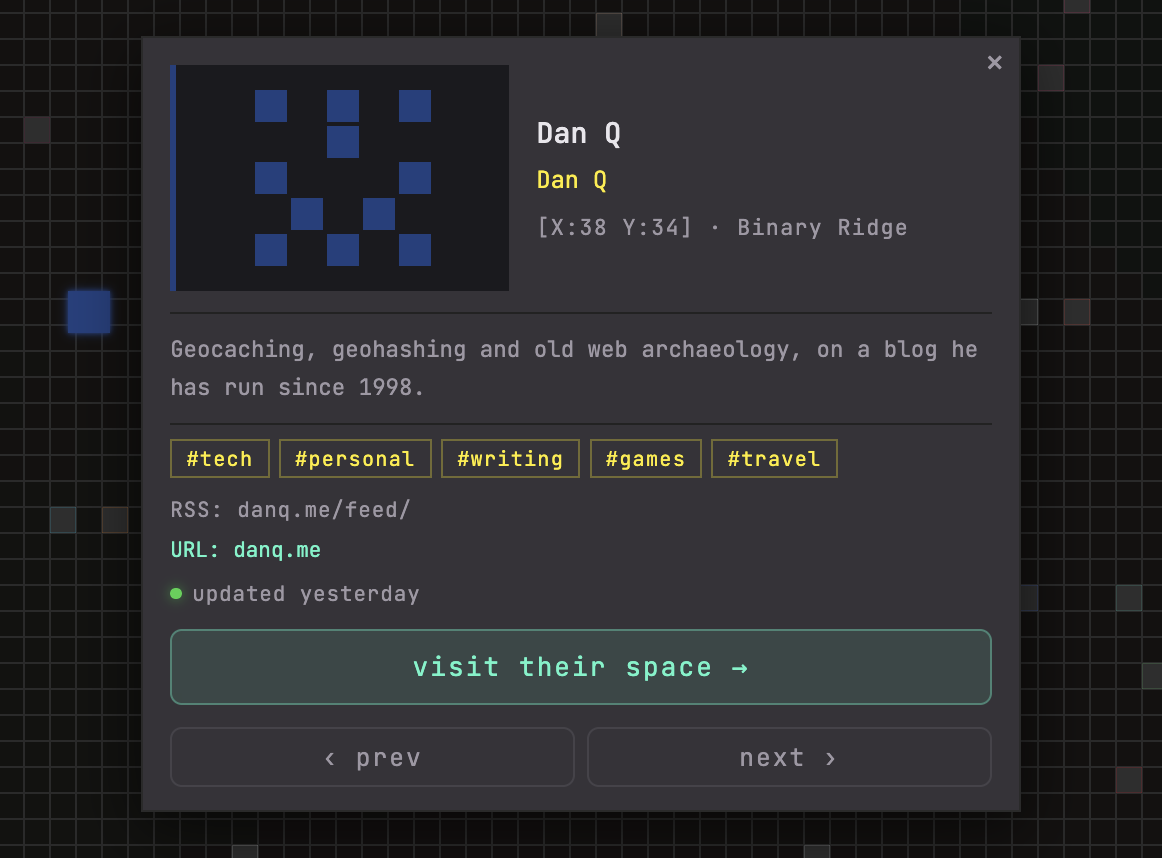
Screenshot from Pixel Area, showing a blue 'pixel' representing Dan Q.

×

Sundog

That moment when you realise that you forgot your sunglasses but figure you’ll just squint.

A fawn-coloured French Bulldog sits on the wooden decking outside a back door, squinting as she looks towards the sun (evident from the direction of the shadows).

×

Use Firefox

This is a repost promoting content originally published elsewhere. See more things Dan's reposted.

People complain about Firefox. The most recent grievance is the addition of AI features in the browser, and they will tell you they’re switching to another browser as a result.

I’m here to tell you not to do it.

At best, that person switched to a fork of Firefox, which still depends on the same browser engine. But the worst case scenario is a browser based on Blink and Chromium.

Firefox is the last major independent browser engine1. The web is a vibrant commons because of browser engine diversity. Multiple engines serve as a check on power and support the wide review process that underpins standards work on the web.

Ramkumar is right. This is a drum I’ve been beating ever since EdgeHTML got pulled out of Edge, which effectively represented a one-third reduction in real-world browser diversity. It’s more-important than ever that Firefox continues to be used, continues to exist, continues to thrive.

I mean: it’s a perfectly good browser too! I use it as my daily driver on all of my devices and I love it. But even if it weren’t for that, I’d still be pushing people towards Firefox because the Internet needs it to exist. If it stops existing, or even reaches a level of technical irrelevance, then Google gains an unprecedented level of control over the direction of the Web… which – even despite their monopoly abuses via Google Search and other integrations – they’ve shown they can’t be trusted with: consider how they (yet again) exempted themselves from their own privacy controls this week, or else look back over technologies they’ve strongarmed onto the Web, benefitting themselves at the expense of the Web, like FLoC and AMP, or else look at the gradual enshittification of their browser – which no longer supports deep integration by adblockers – or of the Android operating system – which you’re getting locked-out of this year.

So yeah. Use Firefox. You can keep a Blink/WebKit-based browser for secondary purposes, like for when you’re saving battery on a MacBook (I’d use Safari) or for when you want to use a badly-implemented application that thinks it requires Chrome (I’d use Edge). But making Firefox – or failing that, a fork of it that meets your needs, maybe Waterfox or LibreWolf – your daily driver is one of the single easiest things you can do to help keep the Web free and open.

And you get some cool perks on the side, like mobile plugins (uBlock on mobile… yes please!), better tab management (and adding Multi-Account Containers is life-changing!), stronger privacy protection, lower RAM usage, etc. So yeah: use Firefox.