How do people blog for thirty years without running out of things to say?

This is a repost promoting content originally published elsewhere. See more things Dan's reposted.

I have such an admiration for those who post so much without fear of reprisal; posting purely for the sake of loving writing and sharing their opinions and thoughts with the world, not because they’re trying to manipulate search engines or grift some ad revenue from whatever happens to be popular that week. Pure and simple posting for the love of the game. Take my Three Rings colleague Dan Q, whose blog spans multiple decades across countless topics. I’m sure he would shy away from such an accolade, but I think it’s truly a fantastic example of using the Internet as it was intended: having your own little corner of it and filling it with the things that interest you, regardless of whether anybody else particularly cares.

Aww.

I first met Oli shortly before a nonprofit I founded – Three Rings – took the necessary technical steps to formally adopt/rescued a piece of software he’d been working on – Portal – in order to continue to make it available to the voluntary organisations that depended upon it (and perhaps, hopefully, along the way make it suitable for use by a wider range of charitable enterprises to boot).

I’ve long known that Oli blogs well and his writings are worth seeing… but he does so at what one might call a “normal person” cadance. This is perhaps unlike my pace, which might be generously described as somewhere between “breakneck” and “obsessive”.

Anyway: Oli’s latest blog post, How do people blog for thirty years without running out of things to say?, touches on another difference between our respective blogs: mine is old. Not quite 30 years, as he hints, but next month it will be 28 days since my first blog post, and in January it’ll be 28 years since my oldest surviving contemporaneous blog post.

How do people blog for this long without running out of things to say, asks Oli. And then, over the course of his post and via a glimpse at a post-ideas spreadsheet (as well as a conversation with an LLM), he comes to a conclusion:

As for the question I started with – how do people blog for thirty years without running out of things to say? I think I was approaching it from the wrong direction. Nobody sits down with thirty years’ worth of material ready to go. They just keep finding things interesting for thirty years.

And that’s it: that’s it exactly. You don’t start a blog with three decades’ worth of ideas. Hell, if I could only write about things that I’ve got notes or drafts about, and at my current cadence, I’d be dry before the end of the year (and I have a lot of half-written ideas just waiting for polishing!).

If there is a secret to blogging for thirty straight years, I think it’s this. Stay curious. Never stop asking questions. Never stop learning. Try to look at your world as if you’re seeing it for the first time, and remember that what’s mundane to you could be fascinating to somebody else, or in the right light. And, crucially, the single-most important thing of all: find a motivation to keep writing for yourself. When you’re writing for yourself, first and foremost, you’ve always got a reason to keep going.

That’s what I think, anyway. You don’t have to blog like me, of course, but if you want to… the paragraph above represents all I know about how to do so!

The modern app

This is a repost promoting content originally published elsewhere. See more things Dan's reposted.

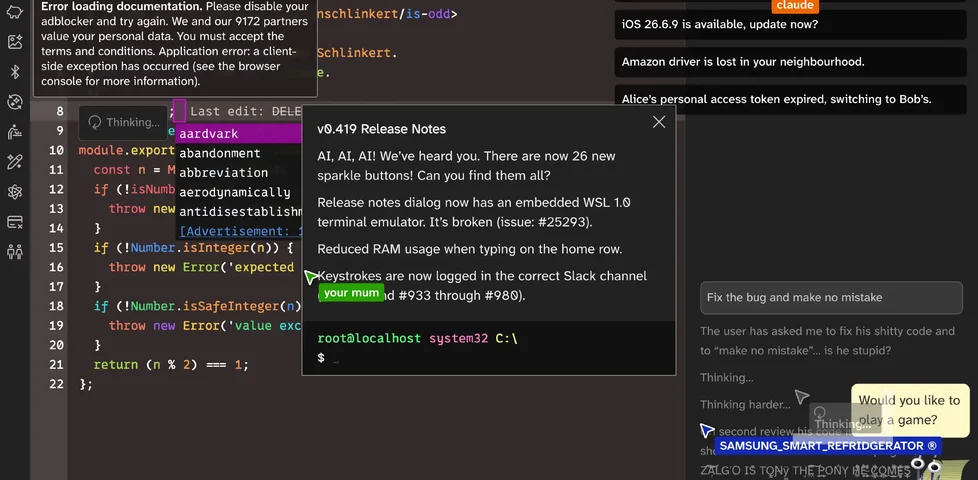
Today I’m introducing the next generation of code editor. A modern app to satiate the needs of the discerning coder. We’re talkin’ blazing fast collaboration between man and machine.

Static screenshot of David Bushell's (interactive) 'modern editor'

Yeah so um… have you noticed that all modern software is teetering on the enshitty cliff? Everything in my dock is an Electron-ified enshittybomb one update from disaster. There used to be alternatives. Now those suck too.

You probably saw this one already; I forgot to share it in July, but it’s done the rounds a-plenty. It’s worth experiencing on David’s website where the “Modern Editor” is interactive (kinda: it’s still about as much use as it looks like it’s gonna be… and that’s kind-of the point).

The enshittification of modern apps is very real. Simple tools that ought to work offline don’t start without an Internet connection (or, worse yet, a slow Internet connection means that they stall during their self-update check or phone-home analytics). AI “features” get stitched in to everything, whether you want them or not. Desktop applications are constructed using the same super-heavyweight React + Tailwind + whatever else stacks under which the Web creaks, but because they’re now long-running system tray/notification area processes their gradual memory leaks make them painfully slow. Updates change the UI without warning and you need to work to find where your favourite features have gone, if they even still exist. You’re nagged to “create an account” and “log in” even if you have no use for the connectivity “features”. Kebab menus everywhere make for a whole new level of mystery meat navigation, once you eventually find the right to click out of  the three that are typically visible at any given time. And every application acts like it’s the single-most important thing on your screen, competing for real estate and attention.

So yeah, I feel David’s pain.

Anyway: go play with his interactive modern editor.